
This news article is a continuation of previous news articles on the same event. If you want to know the event in its entirety, please save the related news sections. For part 1 news articles, click the following link https://international.stekom.ac.id/en-news-and-event/.the-first-day-of-the-cultural-exchange-of-stekom-university -Part 1. For part 2 which contains presentations from Kazakhstan, you can visit the following link: https://international.stekom.ac.id/en-news-and-event/the-first-day-of-the-stekom -university-cultural -change-part-2-culinary-and-traditions-kazakhstan. Part 3 of Uganda, can be seen via the following link: https://international.stekom.ac.id/en-news-and-event/.the-first-day-of-the-stekom-university-cultural-exchange -part-3-uganda-culinary-and-traditions. For part 4.1 of the first part of Ukraine, it can be seen via the following link: https://international.stekom.ac.id/en-news-and-event/.the-first-day-of-the-cultural-exchange-of -stekom-university-section-41-culinary-and-ukrainian-tradition. News article part 4.2 of the second part of Ukraine, can be viewed via the following link: https://international.stekom.ac.id/en-news-and-event/.the-first-day-of-the-cultural-exchange- from-stekom-university-section-42-culinary-and-ukrainian-tradition. News article part 5 can be visited via the following link: https://international.stekom.ac.id/en-news-and-event/.the-first-day-of-the-stekom-university-cultural-exchange-part -5-culinary-and-malaysian-traditions. News article part 6 which discusses Uzbekistan culinary and traditions can be visited via the following link: https://international.stekom.ac.id/en-news-and-event/.first-day-of-stekom-university-cultural- exchange-section-61-uzbekistan-cuisine-and-traditions.
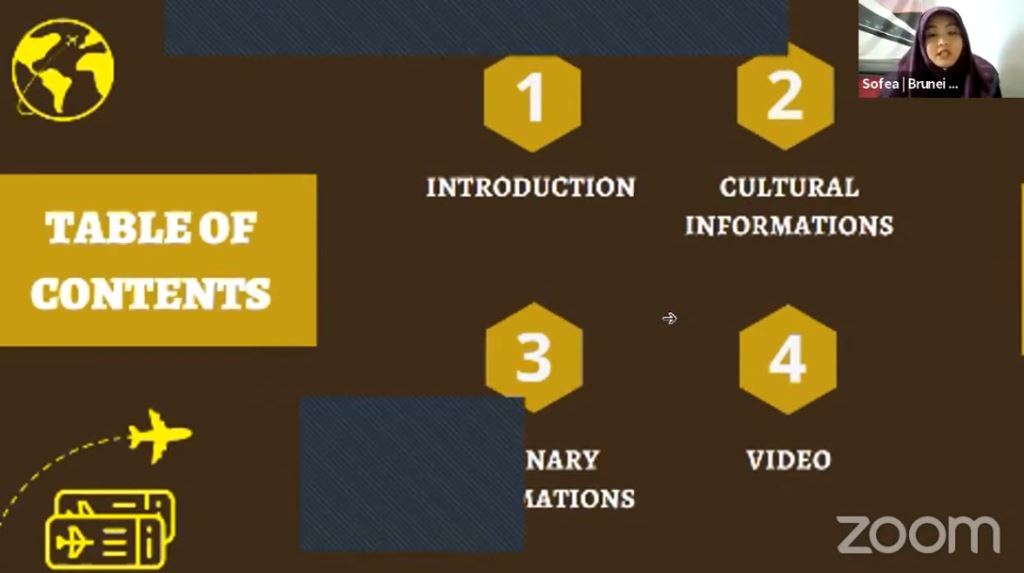
This cultural and culinary presentation is from Indonesia's neighboring country, Brunei Darussalam. The presentation from Brunei Darussalam conveyed two people, namely Sofea and Zikry. At the beginning of the presentation, the presenter introduced the country of Brunei Darussalam.
Brunei Darussalam or Brunei is a sovereign country in Southeast Asia located on the northern coast of the island of Borneo. This country has an area of 5,765 km² which occupies the island of Borneo with the entire coastline touching the South Sea. Its territory is separated into states in Sarawak, Malaysia.
Currently, Brunei Darussalam has the second highest Human Development Index in Southeast Asia after Singapore, so it is classified as a developed country. According to the International Monetary Fund, Brunei has the fifth largest per capita gross domestic product in the world in terms of spending power. Meanwhile, Forbes ranked the Kingdom of Brunei as the fifth richest country out of 182 countries due to its vast oil and natural gas fields. In addition, Brunei is also famous for its prosperity and firmness in carrying out Islam, both in the field of government and public life. In 2020 it was recorded that Brunei had a population of 460,345 people.
The national flag of Brunei Darussalam was introduced on 29 September 1959 when Brunei was a protectorate of the Kingdom and was established when Brunei attained independence on 1 January 1984. The flag consists of the coat of arms of the state in the center on a yellow background and black and white stripes on the flag plane.
The coat of arms of the state consists of a crescent (symbol of Islam), imprinted with an umbrella of torches (a symbol of government under a sultan). Under the umbrella are wings that fight for justice, prosperity, prosperity and security. On the left and right there are a pair of hands holding up. On the crescent moon there is a motto in Jawi script, "Always be solemn with God's guidance" and under the crescent, it is written "Negara Brunei Darussalam" also in Jawi writing. In the archipelago, yellow is the traditional color for kings. This can be seen on the royal ensigns of Vietnam and Thailand as well as the Indonesian flag.
The next presentation is about language. Where the people of the country mostly use standard Malay and some use English. Malay is an Austronesian language spoken by approximately more than 41 million people (13.5 million people in Malaysia, 5 million people in Indonesia, without a total number of Indonesian speakers) or more than 290 million people (with a total number of Indonesian speakers). about 260 million) worldwide. The origin of the growth of the Malay language comes from South Sumatra, Indonesia. The earliest record of the Old Malay language is an inscription dated 682 AD found in South Sumatra.
Next Sofa explained about the longest bridge in Southeast Asia. The name of the bridge is Sultan Haji Omar Alifuddien Sai Bridge. The bridge is a double track bridge in Brunei. This bridge is the longest bridge in Southeast Asia, with a length of 30 kilometers. Construction of the bridge began in 2014 and was expected to be completed and opened by the end of 2019, but finally opened in March 2020. Due to the COVID-19 pandemic, the bridge opened ahead of schedule on 17 March 2020, a day after Brunei banned most non-resident foreigners. entered the country, and most of its citizens and residents left, which would otherwise cut Temburong off from the rest of the country.
The next presentation about Brunei Darussalam was delivered by Zikri, namely presentations on Religion, ethnic groups, cultural practices, and pictures. Currently the religion in Brunei Darussalam, Sunni Islam is the most widely practiced religion. As many as 78% of the total population is Muslim. However, other religions are also present in the country of Brunei. 7.8% of the total population is Buddhist and another 8.7% adheres to the Christian faith. There is also another 6.5% fused into various religions, including local indigenous beliefs.
Islam is the national religion of the state of Brunei Darussalam, but freedom of religion is guaranteed. Those of other faiths are also allowed to worship in Brunei. In addition, holidays other than Islamic holidays, such as Christian holidays, are also announced. Even though freedom is maintained, this freedom does not apply in the strict education system, especially for private schools, and any objects or materials for worshiping other religions are not permitted. circulated and subject to confiscation.
The Islamic school used in Brunei is the Shafi'i School of Sunni Islam. Most of Brunei's Muslims adhere to the Shafi'i teachings in their daily worship and the Shafi'i teachings are also a source of law for the country.
According to Zikri, there are 7 main ethnic groups in Brunei. The ethnic groups are Brunei Malay, Kadayan, Tutong, Malaut, Bisaya, Belait, and Desun. Several other foreign ethnic groups also exist in the country of Brunei Darussalam. Inter-tribal harmony in Brunei is going well and is guaranteed by the kingdom.
The next presentation is about the culture that runs in Brunei Darussalam. The culture presented from Brunei is about wedding ceremonies. There are 10 ceremonies in marriage that are usually carried out in Brunei Darussalam, namely:
1. Needle assembly
2. The Assembly Sends Signs of Engagement
3. The Ceremony of Delivering Gifts
4. Afternoon Powder Ceremony
5. Marriage Contract Assembly
6. Powder Night Party
7. Bernai Assembly
8. Side by Side Assembly
9. Take-away
10. Majlis Mulih 3 or 7 days 4
Other cultures that run in Brunei Darussalam according to the zikry presentation are:
1. Weaving
2. Circumcision / Circumcission
3. Egg flower
4. Hari Raya Practices
5. Gasing / Spinning Top
6. Ramadan Practices
7. Bermukun
Other cultures the reader may already understand. But the culture of bermukun may require special explanation. “Bermukun” is a speech art tradition in the form of reciprocated rhymes accompanied by music, such as Flying, Violin, Accordion, and stringed instruments such as Sitar.
The next presentation is about culinary. The first culinary described is abuyat. This Bruneian specialty is eaten by using thick wooden chopsticks to scoop out the porridge which is then put into the fish soup. This dish can be eaten using a bamboo fork (chandas) by rolling the starch all over the branches and dipping in the sauce, which has many variations. The special ambuyat sauce is made from salted durian (tempovak), lemon juice, belacan (shrimp paste) and binjai, a mango-like fruit.
The next presentation about food is about pinyaram. This dish is made by deep-fried rainbow-shaped with crisp edges and a chewy texture towards the center. Pinvaram is made from palm sugar (anau sugar) and white sugar (white sugar). This food is sold mostly by traders in the open market in Brunei Darussalam.
The next food presentation is the palurut. This food is also called clorot, celorot, cerorot or jelurut which is a traditional sweet taste snack or sweet and soft rice flour cake with coconut. This food is wrapped in coconut leaves or young coconut leaves in the shape of a cone. This food is a popular traditional sweet snack commonly found in Indonesia, Malaysia and Brunei.
The presentation about traditional food continued about kelupis. This food is in the form of rice rolls filled with traditional cakes for local, such as Sabah and Sarawak, Malaysia. This traditional snack for ordinary people is found in fellow Malays.
There were other interesting foods that were presented at the presentation of Sofea and Zikry. After that they showed a video showing various activities of the people of Brunei. Then the presentation ends.
The first day of the Cultural Exchange of STEKOM University part 7 (Culinary and traditions of Brunei Darussalam)
International Webinar
Kembali ke Berita
International Webinar
Selasa, 18 Oktober 2022
Priyadi, S.Kom, M.Kom
0 Dilihat