
This paper is a continuation of the previous articles entitled “The
first day of the Cultural Exchange of STEKOM University part 1” and
“The first day of the STEKOM University Cultural Exchange Part 2
(Culinary and traditions of Kazakhstan)”. If you first read part 1
of the same webinar, please click on the following link
https://international.stekom.ac.id/en-news-and-event/.the-first-day-of-the-cultural-
exchange-of-stekom-university-part-1. For part 2 which contains
presentations from Kazakhstan, you can visit the following link:
https://international.stekom.ac.id/en-news-and-event/the-first-day-of-the-stekom-university-cultural
-exchange-part-2-culinary-and-traditions-of-kazakhstan.
Before discussing the material presented by the presenter from
Uganda, it helps us to briefly discuss about the country of Uganda in
general. The Republic of Uganda is a country in East Africa.
Nicknamed the "Pearl of Africa" by Winston Churchill,
the country is bordered by Kenya to the east, Sudan to the north, the
Democratic Republic of the Congo to the west, Rwanda to the
southwest, and Tanzania and Lake Victoria to the south. The name of
this country comes from the kingdom of Buganda whose territory
formerly covered the southern part of Uganda. Uganda is divided into
70 districts.
At first Uganda was ruled by several large
tribes who worked as hunters. The largest tribe is the Baganda or
Buganda tribes. This tribe succeeded in establishing an empire led by
Kimera. Giovani Miani (an explorer from Italy) was the first European
to discover Uganda in 1860.
Then, the missionaries
arrived. In 1862, the site of the 30th King of the Buganda Kingdom
was discovered, which is believed to have reigned in the 16th
century. In the 19th century, Uganda was ruled by the British and
Egyptians. At that time Uganda became one of the provinces of Egypt
called Equatoria. Egyptian control of Equatoria ended in the reign of
Emin Pasha in 1889 and passed to the British in 1890.
The
struggle for independence from Britain began in 1945-1949, when there
was a proletarian riot in Buganda. In 1953, King Mutesa II (Kabaka)
was exiled to England and returned to Uganda in 1955. Finally on
October 9, 1962, Uganda gained independence from Britain.
Although
it has no beaches, Uganda has several large lakes, such as Lake
Victoria, Lake Albert, Lake Kyoga, and Lake Edward. This country is
located on the plateau of East Africa, about 900 m above sea level.
Uganda generally has a tropical climate, but there are variations.
Uganda has several islands in Lake Victoria. The most important towns
located in the south near Lake Victoria include the capital Kampala
and the nearby town of Entebe.
Although it has no beaches,
Uganda has several large lakes, such as Lake Victoria, Lake Albert,
Lake Kyoga, and Lake Edward. This country is located on the plateau
of East Africa, about 900 m above sea level. Uganda generally has a
tropical climate, but there are variations. Uganda has several
islands in Lake Victoria. The most important towns located in the
south near Lake Victoria include the capital Kampala and the nearby
town of Entebe.
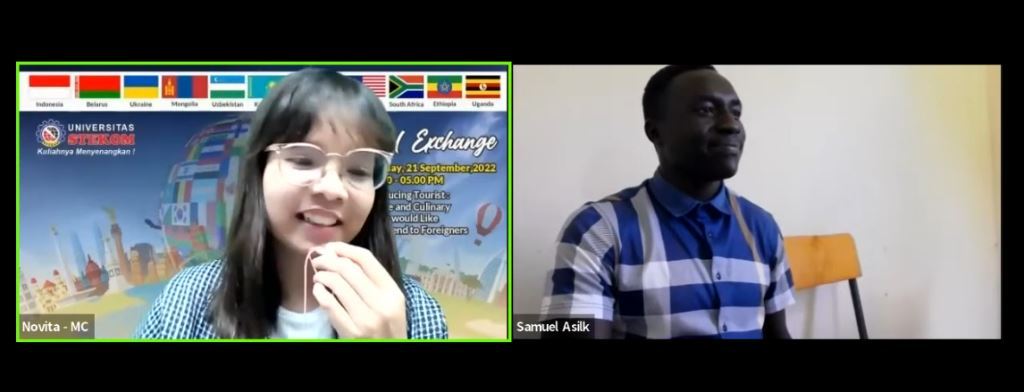
The presenter from Uganda in this event
was Samuel D. Asilk. Samuel comes from the school of business
accounting and business at BUGEMA University, Uganda. At the
beginning of the presentation, Samuel explained that Uganda is one of
the best countries in Africa and in the world with a variety of foods
for each tribe. Uganda is one of the best gifted countries in Africa
and the rest of the world with a diversity of foods embedded in the
excavation of ethnic tribes, each with a staple diet and the best way
to experience the culture is through food. Uganda is a small
landlocked country but huge in terms of culture with 50 tribes. Most
of these tribes have special and unique foods.
Food in
Uganda is served to connect people with land, and heritage. It is a
diverse and dynamic channel for sharing stories, forming
relationships, and building community.
Cultural Tours in
Uganda are not as popular as visiting gorillas, mountains and game
drives. We have to look further. Uganda has so much to offer beyond
wildlife. Ugandans are one of the friendliest people in carth. They
are receptive and easy to get along with strangers. One reason is
that the country's ethnic groups have learned to live in harmony with
one another. This makes it easier for Ugandans to welcome foreigners
without suspicion. Uganda is also a country with a strong cultural
heritage. This is evidenced by the many cultural and tribal sites in
the country.
To be specific,
there are 65 tribes in Uganda to mention but a few; Acholi, Baganda,
Bagishu, Bakiga, Banyoro, Banyuli, Bateso, Batooro, Batwa, Jonam,
Karamajong, Kumam, Langi gbra, Madi, Jopadhola and Tepeth. Each group
has its own unique language, cultural practices and norms. Most have
a king or adat chief as head.
Next, samuel showed pictures
of the kamojong people. How the customs and habits are explained very
interestingly. A photo of the kamojong people's house was also
featured in the presentation. The traditional houses of the Kamojong
people displayed look simple but also quite functional and
artistic.
Samuel's presentation was followed by an
explanation of “The source of the Nile River” in Uganda. The
source of the Nile is a world landmark that attracts many tourists to
explore Uganda as it is from here that the longest Nile begins. The
Nile is famous as the Longest River in the world because of the Greek
meaning valley and was considered the source of the Nile by the
ancient Nile and has played a big role in the history of African
countries. This is just a natural wonder on the African continent
which starts right in the city of Jinja one of the developed cities
in Uganda and the Northeast region of Africa. The city happens to be
one of the biggest tourist destinations in Uganda.
The
Nile drains its waters from the surrounding area near the equator and
rises to the northeastern mouth of the Mediterranean. This river is
the longest river in the world with a length of 6,696 kilometers and
has become an international river that flows its basin to more than
11 countries although most of its water is centered in Uganda and
Egypt. There are other countries including Ethiopia, South Sudan,
Kenya, Eritrea, Tanzania, Rwanda, Burundi, Democratic Republic of
Congo and Republic of Sudan. The Nile Basin covers 3.4 million square
kilometers and consists of 2 major branches, namely the white Nile
which is shallower than the Arab Bahr-el fissure which rises to a
depth of 9 kilometers and is divided into three regions, namely the
highlands, the sudd, and the upper. . Central Sudan region. The Blue
Nile is estimated to be about 5-9 kilometers deep. Both the White
Nile and the Blue Nile are natural bodies of water that flow from
Lake Victoria and Lake Albert from Uganda and also connect at
Khartoum to form the base of the Nile River which comprises the Nile
along the Egyptian Nile.
Regarding food, samuel explained
about luombo. This Ugandan dish combines meat, usually beef, chicken,
or mutton, with a rich, bean-based sauce that is sometimes enriched
with mushrooms, dried fish or smoked meats. The ingredients are
wrapped in banana leaves, and the packets are then steamed for hours.
Luwomobo is a Ugandan classic traditionally served with stir-fried
vegetables or steamed plantains (matooke). In addition, Semuel also
explained that the coffee industry in his country developed quite
significantly. The country's coffee industry is growing from upstream
to downstream.
At the end of his presentation Samuel
explained about grasshoppers / nsenene. Nsenene - Grasshoppers are a
delicacy in Uganda. The Ugandan grasshopper is closely related to the
bush cricket and the grasshopper or bush cricket in Uganda. No matter
what you call it, grasshoppers or bush crickets here in Uganda are
called Nsenene.