
This news article is a continuation of previous news articles on the same event. If you want to know the event in its entirety, please save the related news sections. For part 1 news articles, click the following link https://international.stekom.ac.id/en-news-and-event/.the-first-day-of-the-cultural-exchange-of-stekom-university -Part 1. For part 2 which contains presentations from Kazakhstan, you can visit the following link: https://international.stekom.ac.id/en-news-and-event/the-first-day-of-the-stekom -university-cultural -change-part-2-culinary-and-traditions-kazakhstan. Part 3 of Uganda, can be seen via the following link: https://international.stekom.ac.id/en-news-and-event/.the-first-day-of-the-stekom-university-cultural-exchange -part-3-uganda-culinary-and-traditions. For part 4.1 of the first part of Ukraine, it can be seen via the following link: https://international.stekom.ac.id/en-news-and-event/.the-first-day-of-the-cultural-exchange-of -stekom-university-section-41-culinary-and-ukrainian-tradition. For part 4.2 of the second part of Ukraine, it can be seen via the following link:
Culinary and cultural presentations from Malaysia were delivered by: Rais Hassan Bin Helmy who has a Facebook account: Rais Hassan and an Instagram account: rhhelmyabdrashid. In his explanation, Malaysia is a multi-cultural society. There are Malay, Chinese, Indian and Bumiputra (Sabah & Sarawak) tribes.
Malay society is one component of the Malaysian nation. Most are local residents who have inhabited the Malay Peninsula and the northwestern part of the island of Borneo. The Malay community in Malaysia is most often the same as the Malay community living in several parts of Indonesia, although in some areas it is a separate group (eg in Sarawak, Sabah, Kedah, Terengganu or Kelantan). However, the Malaysian Constitution has its own limitations regarding Malayness in the country.
The definition of Malay is as an indigenous population who speaks the Malay language, is Muslim, and who follows Malay traditions and customs. In Malaysia, the indigenous population of ethnic descent in Indonesia, such as the Minangkabau, Acehnese, Bugis, Mandailing, Banjar, or Javanese who speak Malay, are Muslim and follow Malay customs, are considered as Malays (Children of Trade) other than from Malay Anak Jati who came from the Malay land itself. Even non-natives who marry Malays and embrace Islam are also accepted as Malays.
According to the 1997 Vital Statistics Malaysia Report, the total operating population of Malaysia is nearly 21 million (true number 20,997,220), and of this, the Malay population is 10.2 million (48.5%). Other indigenous peoples (including Iban, Kadazan, Melanau, Bidayuh, Murut, etc.) found 2.2 million (10.5%). consists of non-indigenous people, namely Chinese people (5.4 million – 25.7%), and Indians, Seranis etc. (3.1 million – 14.7%).
most of the Malay population (approximately 65%) live in rural areas, in villages. In the past, a Malay village was a political unit, an economic unit, a genealogical unit, and a religious unit. Now, the existence of the Malay village does not fully fulfill the four four characteristics above.
Next, Rais explained about the typical Malaysian food. The first food described is nasi lemak. Nasi lemak is the national dish of Malaysia. The seasoning for Nasi Lemak is chili, shrimp, garlic, ginger, shallots, scallions, palm and sugar. This food is usually served for breakfast.
The next food dish described is Chicken Percik. This dish originates from the state of Kelantan. This dish is in the form of grilled chicken with sauce. The ingredients include coconut milk, lemon grass, ginger, chili, red onion, salt, sugar. Another dish that hails from the same state is Kuih Abuk-abuk. Usually the abuk-abuk quiz is served together at tea/coffee time. This dish is cooked by steaming. The ingredients for this dish are sago, grated coconut, sugar, salt, and palm sugar.
Hassan's definite explanation of traditional Malaysian food is Nasi Trade and Nasi Kerabu. Rice is a traditional food originating from the Terengganu trade. This rice is cooked with steamed glutinous rice with coconut milk. The serving of Nasi Dagan is usually accompanied by cod curry and pickles. While nasi kerabu is a traditional food originating from the state of Kelantan. This rice uses Natural Food coloring (Butterfly-pea). This dish is usually a combination of rice, shrimp paste, chili paste, and coconut.
Hasan's explanation continued with nasi kandar and keropok lekor. Nasi kandar is usually served in an Indian-style mamak restaurant. This rice is cooked by steaming and served with curry, chicken, and side dishes. While keropok lekor which is a traditional food originating from the state of Terengganu is a traditional food cooked by boiling. This food is made from sea fish, sago / starch, salt. This meal includes snacks served with chili sauce.
Furthermore, Hasan conveyed traditional food botok and spicy sour. Botok traditional food is a traditional food originating from the state of Johor. The food comes from steamed mackerel / puffer fish / tuna, fish / stingray, tamarind (Javanese acid), coconut milk, coconut. As for the spicy acid, it is actually somewhat similar to botok, except that the raw ingredients consist of mackerel, spicy acid, long bean okra, tomato, chili, onion, garlic, ginger, lemongrass, shrimp paste, black paper.
Hasan's next presentation of dishes from the state of Sabah. The first is aloe vera cake. This food is a sugar-coated snack. The raw materials for this food consist of wheat flour, tapioca flour (cassava), sugar. The way to cook these foods is to fry them in cooking oil. Next is the ring cake. The food is made from apong sugar / Melaka sugar (palm sugar), rice flour.
The way to cook this food is to fry it in cooking oil. Usually this food is served at tea/coffee time.
Hassan's next presentation is still related to the food from the state of Sabah. This time it's about baro food. Barobo is corn rice porridge with sticky corn (sweet corn) combined with chicken, shrimp, carrots, radishes, shallots, garlic, salt, MSG, chicken seasoning cubes, and white pepper. After barobo then pinasakan on the same presentation slide. Pinasakan is usually served with linut/ambuyat. The ingredients for this dish are sardines, turmeric, ginger, shallots, lemongrass, pepper, tamarind, salt, and MSG.
After that, Hassan ended his presentation and returned control of the event to the moderators. The presentation of Hassan is quite simple but there are many things that make us interested in Malaysian culture and traditional food.
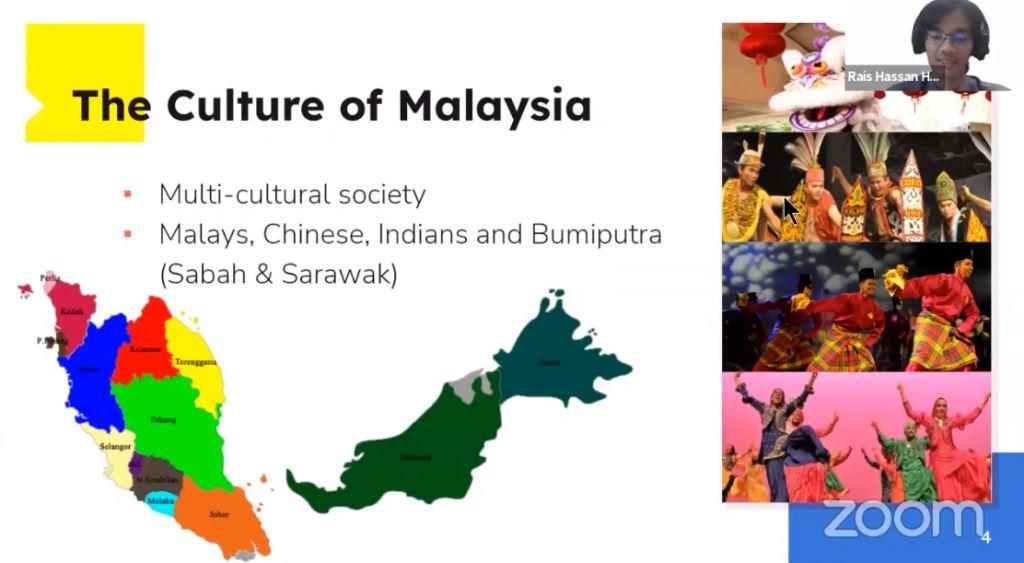
The first day of the STEKOM University Cultural Exchange Part 5 (Culinary and Malaysian traditions)
International Webinar
Kembali ke Berita
International Webinar
Senin, 17 Oktober 2022
Priyadi, S.Kom, M.Kom
0 Dilihat