
System analyst and design are processes used in the development of information systems. In this process there are activities that include identifying problems in the business and solutions proposed in an information system format for one or more identified problems and designs. In addition, the solutions proposed are also implemented to achieve organizational goals.
Usually, people think of systems analysis and design as writing computer programs. Activities like this would actually be encountered in the world of systems analysts, however, the actual domain is much more varied. The most important thing in the real world is that the big solutions proposed are computer-based solutions. System Analyst and Design (SAD) exists as a tool for designing information systems intended to solve identified organizational problems.
Examples of several kinds of problems faced by a systems analyst in the real world are:
1. A company wants to provide an opportunity for customers to place an order for a product at any time, day or night and from any place.
How can this objective be achieved without incurring additional selling costs?
2. A company wants to need information to know the exact location of each of its transportation assets, whether moving or not.
How can this goal be achieved? Not only determine the location of the asset but also want to be able to instruct the operator to move to a new location.
3. What happens if a production department of a factory has limited space on its shop floor? It is necessary to carefully and accurately combine it with the production plan.
The three points above are examples of the various types of problems a systems analyst will encounter that require a formal approach from SAD. Note that some problems will require multiple computer program formats. But none of these can be classified as programming problems.
In addition, there are many complex business issues that require broader and more varied processes, tight controls, in order to achieve their business objectives. Information systems are designed and implemented to solve business problems, and an analyst uses SAD methods and tools to define and operate these solutions. SAD isn't just about computers, it's about problems and their solutions, and a modern systems analyst isn't just a computer professional.
System analysis and design implies at least two different activities. First, the analysis activity mainly focuses on determining the origin and domain of the business problem and the characteristics of an appropriate solution.
Many things influence the process of developing an information system that will be used to solve business problems that occur within a company. Time is a crucial factor. Though often the process results in more time than the original plan.
Factors causing this delay is a very interesting thing to study. By shortening the software development time, it means that the time-to-market will be faster and the effect is that the company's financial condition is better. Now the question is how to design and make software on time.
For this reason, it is necessary to question the determination of the estimated software development time. Have you used the correct time? If not, it means that the estimate is not correct, so that timely software development will be difficult to achieve.
Another factor is the collection of user requirements (user requirements). Not infrequently it happens, that when the software is handed over to the user, many changes still need to be made. As a result, software developers often rework.
It is often found that software developers do not follow the system development life cycle (SDLC) in accordance with the projects they are working on. Choosing the right SDLC is one way for projects to be completed on time. The following are the results of a survey presented by Steve McConnel in his book Code Complete. From table 1 it is clear that in small-scale software development projects, the most time is spent on coding activities. Whereas in large-scale projects, design activities take the most time.
The above material was delivered by a presenter from Indonesia in an international visiting lecturer held by STEKOM University in collaboration with Universities from Ukraine. The title of the presentation is "Engineering in the Software Development Model". The name of the presenter is Migunani Hudayatullah, S.Kom., M.Kom. Mr. Migunanani is an active lecturer and head of the Information Systems study program at STEKOM University.
This international webinar activity is part of the implementation of STEKOM University's commitment to increase various international activities. This was done in order to realize the vision to become an international-class university. Various international activities carried out by STEKOM University continue from year to year. There are international activities that are sustainable and there are also some international activities that are not sustainable. All types of international activities are accommodated and regulated by the International department of STEKOM University.
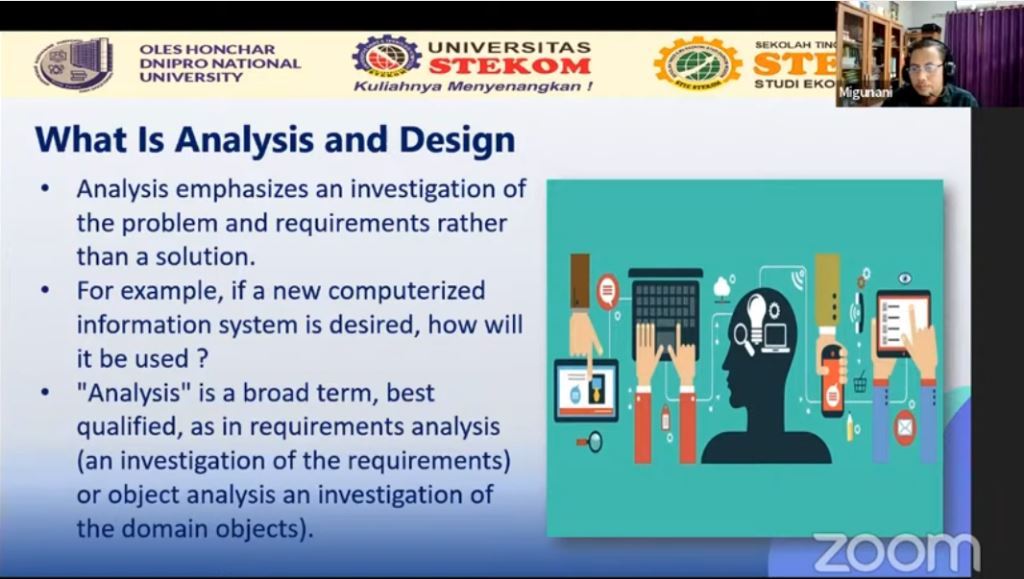
Visiting Lecturer from STEKOM University with Oles Honchar Dnipro National University (Ukraine) part 1
International Webinar
Kembali ke Berita
International Webinar
Selasa, 28 Maret 2023
Priyadi, S.Kom, M.Kom
0 Dilihat