
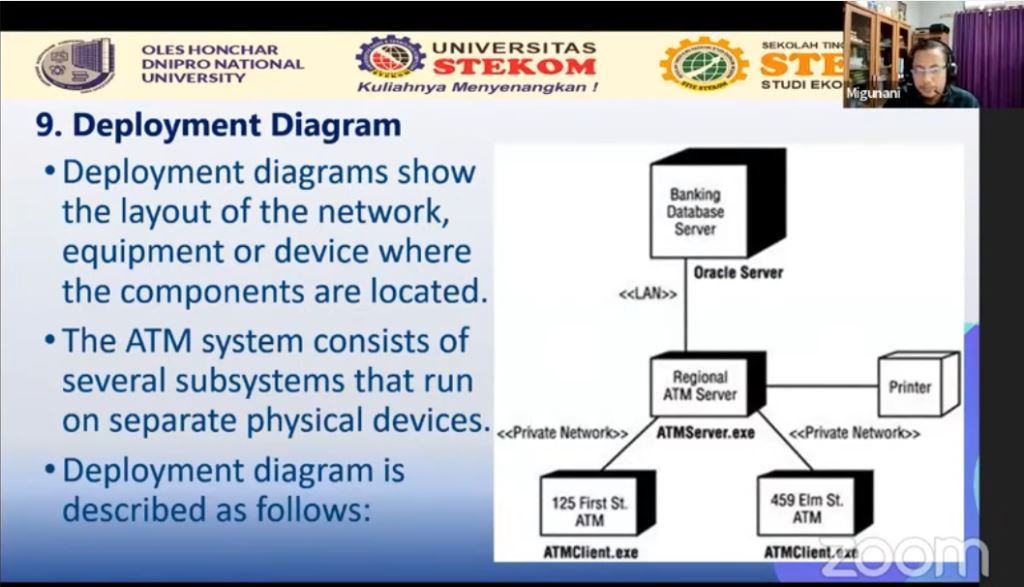
If we interpret deployment diagrams in general, deployment diagrams are a type of UML (unified modeling language) diagram. Its function is to describe, visualize, specify and document a process that occurs in an OOP (Object Oriented Programming) based system that will be built.
Another opinion also interprets the deployment diagram as a description of the processes in a running system and explains how the relationships are in the system. The Deployment diagram itself is a static type of diagram, meaning that it will not change, when we design the diagram like A, it will last forever.
In addition, the deployment diagram also makes it easier for users to use the system that has been built. As mentioned above, one of the functions of the deployment diagram is to describe and visualize and specify the process.
An example is when specifying a website, the deployment diagram will show the hardware used or in this case called nodes, for example:
- Application servers
- Web servers
- Database servers
While the deployment diagram according to Winbrello is as follows. Deployment diagrams are diagrams that explain in detail how components are deployed or deployed into the infrastructure of a system.
The Deployment diagram has 4 symbols including;
- Packages
- nodes
- dependency
- links
Deployment diagrams have the following benefits;
- Provide convenience in explaining or explaining a system compared to just words.
- Makes it easier to remember quantitative data.
- More effective and proactive as an explanation compared to using sentences.
The uses or functions of the deployment diagram are;
- Specifies the structure of the run-time system.
- Provides an overview of how hardware is related to one another.
- Shows hardware and software installed.
There are 10 components that must be understood so that you can make a deployment diagram properly and be understood by users. So for that 10 components will be presented in the following section.
1. Manifestations
Manifestation or in Indonesian is part of the deployment diagram, which is an abstraction relationship that describes the physical rendering. In addition, this manifestation represents the result of one or more implementations of the model element of the artifact. Artifact itself in the deployment diagram can have more than one manifestation, each manifestation shows the package table element.
2. Deployment Targets
Each artifact in the deployment diagram is routed to the target deployment. Deployment target itself is the location for the artifact that has been directed. Don't think that the deployment target has its own notation, because this deployment diagram uses the notation of the subclass.
3. Nodes
Usually these nodes are depicted in the form of a three-dimensional cube. But on several occasions we will see that it is depicted in a visual form or even a combination of visuals and nodes.
The node itself is a deployment target that shows the computing resources that artifacts can use to execute.
This component is always associated with deployment artifacts, indirectly also nodes can be associated with package table elements. One node with other nodes can be connected with a path node.
Well, the node is divided into 2 parts.
Devices that represent hardware such as PCs, laptops, printers, mobile phones etc.
Execution environment represents software containers such as software, server applications, JVM etc.
4. Communication Path
This is a connection or association that connects two target deployments, it is done by exchanging signals, one sends the other one receives it.
The communication path is represented by the full line symbol and connects the two nodes. Any type of communication can be modeled using appropriate stereotypes.
5. Deployments
This is a dependency relationship that defines the allocation of artifacts to the target deployment. Deployment is often interpreted as a level instance that is allocated specific artifact instances to the target deployment instance.
We can show target deployment in following 3 ways;
- Described in a rectangular shape, which is then given a name in the upper corner.
- By being given a post listing deployment artifacts in a deployment target.
- Can be described with a deployment target contained in an artifact.
6. Dependencies
This is a relationship indicating one or a set of model elements used for specification or implementation.
Dependency can also be interpreted as a supplier who provides something for the client.
7. Deployment Specifications
The deployment specification is a general mechanism for specifying deployment relationships. Where this deployment specification is rendered as a classifier in a box with the deployment properties options in the compartment.
8. Deployment Specification Dependencies
Usually shown in the form of a classifier box that includes artifact components using dependency arrows.
9. Deployment Specification Association
Deployment specifications can be associated with the deployment of an artifact component in a node.
10. Components
Components represent modularity in a system, which can encapsulate content and whose manifests can change their environment. This component defines and describes behavior in terms of interfaces.
The above material was delivered by a presenter from Indonesia in an international visiting lecturer held by STEKOM University in collaboration with Universities from Ukraine. The title of the presentation is "Engineering in the Software Development Model". The name of the presenter is Migunani Hudayatullah, S.Kom., M.Kom. Mr. Migunanani is an active lecturer and head of the Information Systems study program at STEKOM University.
This international webinar activity is part of the implementation of STEKOM University's commitment to increase various international activities. This was done in order to realize the vision to become an international-class university. Various international activities carried out by STEKOM University continue from year to year. There are international activities that are sustainable and there are also some international activities that are not sustainable. All types of international activities are accommodated and regulated by the International department of STEKOM University.
Visiting Lecturer from STEKOM University with Oles Honchar Dnipro National University (Ukraine) part 12
Visiting Lecturer
Kembali ke Berita
Visiting Lecturer
Rabu, 3 Mei 2023
Priyadi, S.Kom, M.Kom
0 Dilihat