
Object-oriented analysis and design (OOAD) is a technical approach to analyzing and designing applications, systems or businesses by applying object-oriented programming and using visual modeling throughout the software development process to guide stakeholder communications and product quality.
OOAD in modern software engineering is usually done iteratively and incrementally. The output of OOAD activities is an analysis model (for OOA) and a design model (for OOD). The aim is for it to be continuously refined and developed, driven by key factors such as risk and business value.
The software life cycle is usually divided into stages from an abstract description of the problem to design, then code and testing, and finally deployment. The earliest stages of this process are analysis and design. The analysis phase is also often called "requirements acquisition".
The OOAD waterfall model is carried out iteratively and incrementally, as formulated by the Unified Process. In several approaches to software development—known collectively as the waterfall model—the boundaries between each stage are meant to be fairly rigid and sequential. The term "waterfall" was coined for such a methodology to signify that progress proceeds sequentially in one direction only, i.e., after analysis is complete, design begins and it is rare (and considered a source of error) when a design problem requires a change in the analytical model or when coding issues require a change in design.
An alternative to the waterfall model is the iterative model. This distinction was popularized by Barry Boehm in his highly influential paper on the Spiral Model for iterative software development. With an iterative model it is possible to perform work in the various stages of the model in parallel. So for example it is possible—and not seen as a source of error—to do analysis, design, and even code on the same day and have problems from one stage impact problems from another. The emphasis on the iterative model is that software development is a knowledge-intensive process and that things like analysis cannot really be understood without understanding the design problem, that coding problems can affect the design, that testing can yield information about how the code or even the design should be. modified, etc.
While it is possible to do object-oriented development using the waterfall model, in practice most object-oriented systems are developed with an iterative approach. As a result, in object-oriented processes "analysis and design" are often considered at the same time.
The object-oriented paradigm emphasizes modularity and reuse. The goal of the object-oriented approach is to fulfill the "open-closed principle". A module is open if it supports extensions, or if it provides a standard way to add new behavior or describe new state. In the object-oriented paradigm, this is often done by creating a new subclass of an existing class. A module is closed if it has a well-defined stable interface that all other modules must use and that limits the interactions and potential errors that can be introduced into one module with changes in other modules. In the object-oriented paradigm, this is done by defining methods that invoke services on objects. Methods can be public or private, that is, certain behaviors that are unique to an object are not exposed to other objects. This reduces many common errors in computer programming.
The software life cycle is usually divided into stages from an abstract description of the problem to design, then code and testing, and finally deployment. The earliest stages of this process are analysis and design. The difference between analysis and design is often described as "what vs. how". In analysis, developers work with users and domain experts to determine what the system should do. Implementation details should be mostly or completely (depending on the particular method) ignored in this phase. The aim of the analysis phase is to create a functional model of the system regardless of constraints such as the appropriate technology. In object-oriented analysis, this is usually done through use cases and abstract definitions of the most important objects. The design phase then refines the analytical model and establishes the required technology and other implementation options. In object-oriented design, the emphasis is on the description of various objects, their data, behavior and interactions. The design model should have all the necessary details so that programmers can implement the design in code.
The above material was delivered by a presenter from Indonesia in an international visiting lecturer held by STEKOM University in collaboration with Universities from Ukraine. The title of the presentation is "Engineering in the Software Development Model". The name of the presenter is Migunani Hudayatullah, S.Kom., M.Kom. Mr. Migunanani is an active lecturer and head of the Information Systems study program at STEKOM University.
This international webinar activity is part of the implementation of STEKOM University's commitment to increase various international activities. This was done in order to realize the vision to become an international-class university. Various international activities carried out by STEKOM University continue from year to year. There are international activities that are sustainable and there are also some international activities that are not sustainable. All types of international activities are accommodated and regulated by the International department of STEKOM University.
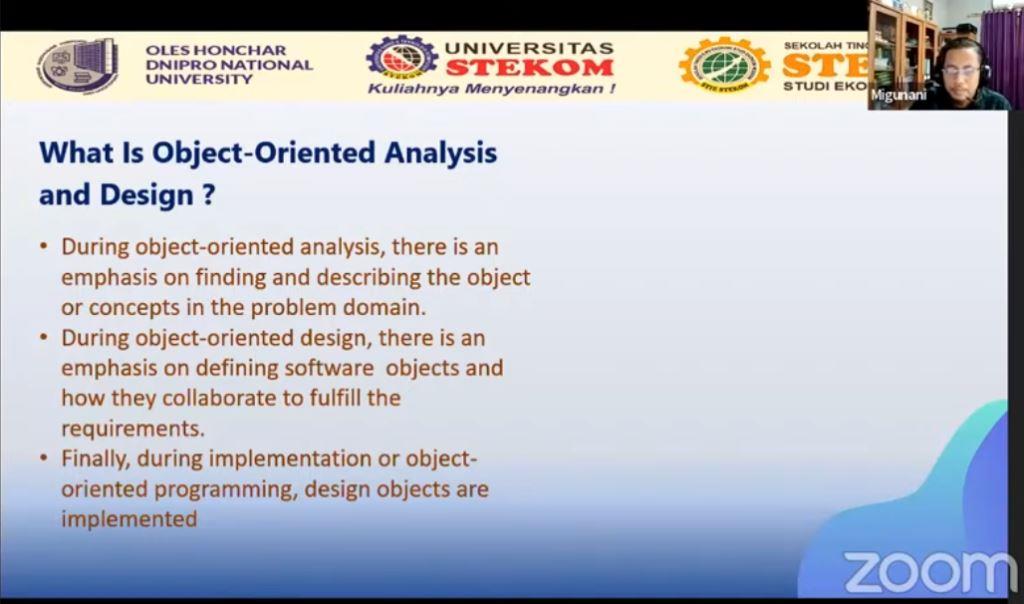
Visiting Lecturer from STEKOM University with Oles Honchar Dnipro National University (Ukraine) part 2
Visiting Lecturer
Kembali ke Berita
Visiting Lecturer
Selasa, 28 Maret 2023
Priyadi, S.Kom, M.Kom
0 Dilihat