
The international webinar "culture exchange" held by STEKOM University on the second day continues. Speakers from various universities around the world take turns giving interesting explanations about the popuper traditions of their respective countries. Various interesting things continue to be presented from various speakers who get the opportunity. The next interesting speaker was a beautiful woman named Dilshoda from Uzbekistan.
Dilshoda's first presentation was about music. Music connects world cultures and is a window into the ethos of any country. Likewise, Uzbek music is one of the keys to understanding Uzbek culture.
The traditional music of Uzbekistan has ancient origins; during archaeological deposits in Samarkand and Termez, frescoes depicting musical instruments similar to modern Uzbek string and wind instruments were discovered. Traditional musical works are centered on folklore or built around poetry by famous Uzbek poets such as Alisher Navoi, Jam, Mukimi, and others—a truly deep connection of culture and tradition.
UNESCO has included Shashmaqam, a unique musical genre from Uzbekistan and Tajikistan, in its list of Masterpieces of the Oral and Intangible Cultural Heritage of Man. Shashmagam translates as six maqom or "modes". Each of the six modes has its own sequence, rhythm and value, and the result is a uniquely Uzbek sound. This style of music is performed by a group of singers and musicians and uses dutar, gijak, and tanbur as well as doira (drums) as instruments. Shashmagam schools can be found all around Uzbekistan and Tajikistan.
Uzbekistan folk music is more often engrossed in the dutar and bakhshi. The duar is a simple musical instrument with two silk strings and the bakhshi is a musician who plays a musical instrument while singing folk songs. Uzbekistan's festive music is performed on the karnay (wind instrument), surnay (flute) and doira, whose voices can be heard hundreds of meters away, inviting locals and tourists alike to join in on the event.
In the 19-20 centuries, after Uzbekistan became part of Russia and the Soviet Union, a school for classical music was opened in Uzbekistan. Uzbek folk motifs permeate classical music creating a uniquely Eastern flavour. After independence, Uzbekistan pop music emerged in the same way, and the original genre revival.
In Uzbekistan today, guests can hear modern Uzbek pop music, folk music, Uzbek neoclassicism, as well as shashmaqam and lazgi. Live music is heard during holiday holidays, weddings, at the Tashkent Conservatory, and in Snows folklore such as that at the Nadir Divan-Begi Madrasa. In addition, there is a biennial music festival in Samarkand called shard Taronalari”. Here, national music from countries around the world is displayed.
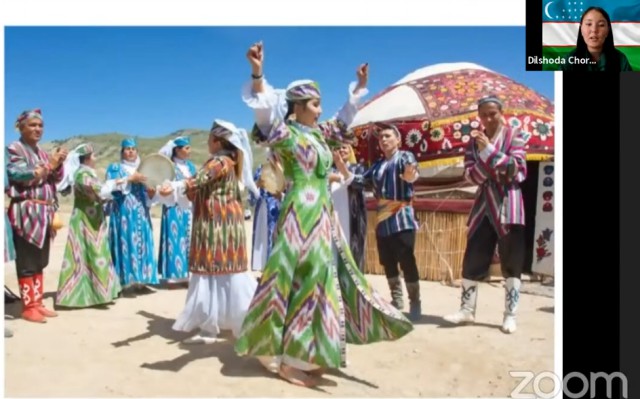
Dilshoda's presentation continued on dance in Uzbekistan. The dance art of contemporary Uzbek people has been developed since ancient times. In rock paintings and archaeological finds images of dancing figures are preserved. In the IV - VIII centuries the art of Uzbek dancers from Samarkand, Bukhara and Khorezm was known in many countries of the East.
The national dance of Uzbekistan is very expressive. It embodies all the beauty of the Uzbek nation. The main differences of Uzbek dance from other Eastern dances are, first, the emphasis on complex and expressive hand movements; and second is diverse facial expressions.
Dilshoda's presentation on dance continued on the types of national dances in Uzbekistan. The national dance of Uzbekistan has come down to our time in two forms, namely traditional classical dance and folk dance. Uzbekistan folk dances are very diverse. These are funny, lyrical, dramatic dances with their regional differences.
Uzbek classical dance is an art developed in special dance schools, and then performed on a large stage. It should also be noted that Uzbek dancers must be agile and very precise in their movements, because every movement of every part of the body, down to the fingers and eyebrows, contributes to the accuracy of the narrative. In Uzbek dance, expression is as important as the technical execution of the steps.
In Uzbek folk dances there are unusual variations. This dance comes alive on all family, country and city holidays. These dances are passed down from generation to generation, they maintain the ancient dance traditions, as well as the reasons for life out. In Uzbekistan folk dances, almost all 12 regions are represented by Uzbekistan.
Like other folk dances, Uzbek dance is a dance of individuality, the soul and body in it are united in one whole. Performers sometimes have no special training, trained equipment, but their movements are always accurate and emotionally expressive.
Every Uzbek folk dance is a mini-drama: embroidering gold, working in the cotton fields, picking fruits, oriental bazaars or baking cakes in a tandyr. Traditional Uzbek dances, as a rule, tell about any history or events, and do not serve the dancer's self-expression. Their extensive repertoire demonstrates the importance of dance to the country's culture.
The presentation then continued about traditional popular games in Uzbekistan. According to him, for a long time, during the main holidays, weddings, celebrations, the Uzbeks enjoy themselves, have fun, organize games, compete in strength, dexterity, speed, sharpness.
And today, the national match in Uzbekistan was not forgotten, but even experienced a revival. Some games even rise to the world level, as a separate sport. There is a lot of humor, jokes and competitive enthusiasm in the Uzbek folk game. They retain their artistic charm, aesthetic value and are the most valuable and unique folklore.
Ulak-kupkari is one of the most ancient equestrian games of the Uzbeks and the peoples of Central Asia. This very exciting spectacle can be combined with the intensity of passion except with the Spanish corrida. Traditionally, ulak-kupkari is held on national holidays, weddings, in the spring before starting agricultural work and in the fall after harvest.
Uzbekistan's national wrestling or game of kurash is one of the oldest arts of war in the world and perhaps the most popular form of entertainment in Uzbekistan. No holiday or celebration can do without it. Kurash does not require an athletic field or a dedicated gym. Previously, men fought only on the ground, sometimes carpets were laid. The rules of the fight are simple and democratic. Kurash is available for both young and old men. Often on holidays you can see gray-bearded elders fighting.
In addition to the above games, in Uzbekistan there are a number of other national matches: chavgon — equestrian field hockey; kyz-kuvdi - chasing the girl; teng keluv - take a scarf from the ground; olomon-poyga - jumps at various distances; ogdarysh - horseman battle; isindi - rider fighting with arrows; sultonlar jangi - sword duel; kabakhi - defeat the purpose of jumping arrows from the bow; nizaki-netum - defeat the target with a spear; syur papakh - equestrian basketball; ukhin-burti - ball game with rackets. And all these games were held with the participation of noble horses.
If you go to Uzbekistan, you can take part in most of Uzbekistan's games and entertainment during the national customs and traditions of the Uzbek people. This was conveyed by Dilshoda at the end of his presentation.
The presentation news article from Dilshoda that explained about popular traditions in Uzbekistan as well as closed the series of articles that reported on the international activity “Culture Exchage” which was pioneered by STEKOM University.
Day Two of STEKOM University Cultural Exchange Part 10 (Uzbekistan Popular Traditions)
International Webinar
Back to News
International Webinar
Tuesday, October 25, 2022
Priyadi, S.Kom, M.Kom
0 Views