
This news article is a continuation of previous news articles on the same event. If you want to know the event in its entirety, please save the related news sections. For part 1 news articles, click the following link https://international.stekom.ac.id/en-news-and-event/.the-first-day-of-the-cultural-exchange-of-stekom-university -Part 1. For part 2 which contains presentations from Kazakhstan, you can visit the following link: https://international.stekom.ac.id/en-news-and-event/the-first-day-of-the-stekom -university-cultural -change-part-2-culinary-and-traditions-kazakhstan. Part 3 of Uganda, can be seen via the following link: https://international.stekom.ac.id/en-news-and-event/.the-first-day-of-the-stekom-university-cultural-exchange -part-3-uganda-culinary-and-traditions. For part 4.1 of the first part of Ukraine, it can be seen via the following link: https://international.stekom.ac.id/en-news-and-event/.the-first-day-of-the-cultural-exchange-of -stekom-university-section-41-culinary-and-ukrainian-tradition. News article part 4.2 of the second part of Ukraine, can be viewed via the following link: https://international.stekom.ac.id/en-news-and-event/.the-first-day-of-the-cultural-exchange- from-stekom-university-section-42-culinary-and-ukrainian-tradition. News article part 5 can be visited via the following link: https://international.stekom.ac.id/en-news-and-event/.the-first-day-of-the-stekom-university-cultural-exchange-part -5-culinary-and-malaysian-traditions. News article part 6 which discusses Uzbekistan culinary and traditions can be visited via the following link: https://international.stekom.ac.id/en-news-and-event/.first-day-of-stekom-university-cultural- exchange-section-61-uzbekistan-cuisine-and-traditions. The news article part 7 which discusses the culinary and traditions of Brunei Darussalam can be visited via the following link: https://international.stekom.ac.id/en-news-and-event/.the-first-day-of-the-cultural -exchange-stekom-university-section-7-culinary-and-tradition-brunei-darussalam. News article part 8 that discusses Vietnamese cuisine and traditions can be visited via the following link: https://international.stekom.ac.id/en-news-and-event/.the-first-day-of-the-cultural- exchange-of-stekom-university-part-8-food-and-traditions Vietnam. News article part 9 which discusses Ethiopian cuisine and traditions can be visited via the following link: https://international.stekom.ac.id/en-news-and-event/the-first-day-of-stekom-university-cultural -change-section-9-ethiopia-culinary-and-tradition.
This cultural and culinary presentation is from a country located in South Africa, namely a country called South Africa. The presentation from South Africa was delivered by Vusani Mavhungu from Venda University. Before discussing further about Vusani's presentation, it helps us to know about the country of South Africa. The Republic of South Africa or commonly abbreviated as South Africa, is a country located in the southernmost region of Africa. South Africa is bounded by a 2,798 km long coastline that stretches along the Atlantic and Indian Oceans to the south; to the north with Namibia, Botswana and Zimbabwe; to the east and northeast with Mozambique and Eswatini; and the country surrounding the Lesotho enclave. South Africa is the southernmost country on the mainland of the Old World and the most populous country by area located south of the equator. South Africa is a biodiversity hotspot with unique biodiversity and plant and animal life. With a population of over 60 million people, South Africa is the 23rd most populous country in the world covering an area of 1,221,037 km2. South Africa has three capital cities, with the executive branch in Pretoria, the judiciary in Bloemfontein, and the legislature in Cape Town. The largest city is Johannesburg.
81% of the population Around South Africa are Black South Africans. The remainder consists of the largest community of European descent in Africa (White South Africans), Asian (Indian-South African and Chinese-South African), and multiracial (Colored South Africans). South Africa is a multiethnic society spanning a wide variety of cultures, languages and religions. Its pluralistic composition is the highest in the recognition of 11 official languages, as the fourth most official country in the world. According to the 2011 census, the first two most widely spoken languages are Zulu (22.7%) and Xhosa (16.0%). The next two languages came from Europe: Afrikaans (13.5%) which developed from Dutch and served as a language the mother's hope of most Colored and White South Africans; and English (9.6%) which reflects the legacy of British colonialism which is generally used in public and commercial life as a bassist.
South Africa is often dubbed the "Land of the Rainbow" because of the country's multicultural diversity, especially after the apartheid era. The country is also known as a major producer of diamonds, gold and platinum in the world.
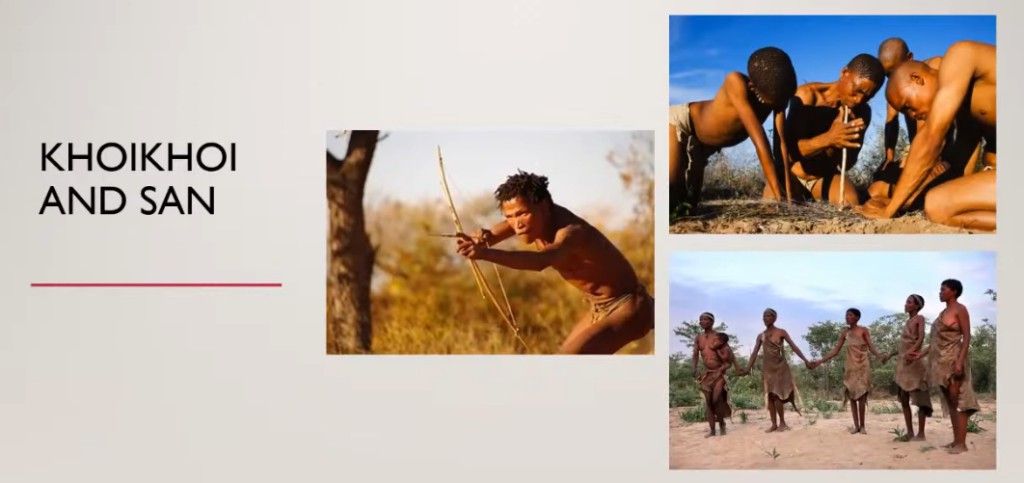
At the beginning of the presentation, Vusani conveyed the concept of culture. In his explanation, Vusani refers to Steinmetz, (2018) who mentions culture as art, costumes, lifestyles, backgrounds, and habits that characterize human beings, or a particular society or nation. Culture influences the behavior and ideology of a community. Culture, among others, affects the acceptance of society's values and norms. South African culture is a blend of African and European elements, and the UK reflects the diversity of the nation's population. Traditionally, people's behavior and views are influenced by culture, but contemporaryly through globalization it has changed, e.g. Fashion, Feminism and Patriarchy. After the explanation, Vusani explained the various languages and cultures found in the tribes in southern Africa with the media of photographs of each tribe.
Furthermore, Vusani explained the food culture in South Africa. Vusani refers to Enriquez, (2022) who says that South Africa is generally known for its ethnic diversity and traditions. Food in diverse populations is obtained through agriculture, hunting and individual occupations. Among the traditional South African cuisine is Venda Porridge. Venda porridge is grits that are common in Venda's menu. The porridge can be eaten plain, prepared like pancakes, or eaten with spinach and meat as a type of stew. Then there are Vowa, phuri, nngu and delele. Vowa, phuri, nngu and delele are very good venda food. They are commonly found during the summer. Viwa, phuri and nngu are also rich sources of vitamin C. Mandande delle is the only low source of vitamin C, with beta-carotene and iron. Health educators should promote the nutritional benefits of wild vegetables in rural communities to increase intake of micronutrients.
The next traditional food described by Vusani is a type of termite called madzhulu, dry worms called mashonzha, insects called thongolifha and nemeneme.
1. 'Madzhulu' are small insects that can bite when you catch them. They are one of the best authentic foods the Venda people eat. They have their own unique taste which you can't compare with other food.
2. Their 'Thongolifha' is not common in other cultures although some do eat them. Venda has a variety of natural foods that you can eat with your stomach.
3. Their 'mashonzha' is found in trees. They are usually cooked using a natural ingredient, tomatoes. Too many ingredients take away the original flavor, which is why they cook it with tomatoes just for the natural taste.
First Day of STEKOM University Cultural Exchange Part 10 (South African Culinary and Traditions)
International Webinar
Back to News
International Webinar
Tuesday, October 18, 2022
Priyadi, S.Kom, M.Kom
0 Views