
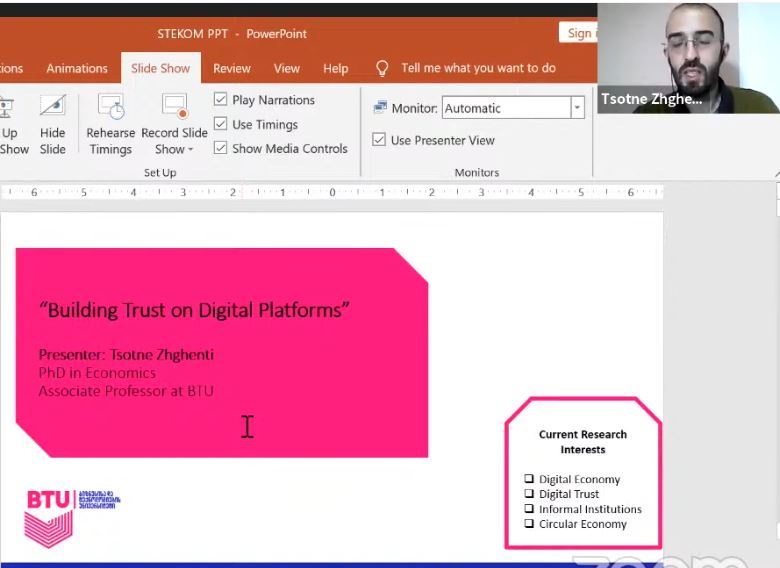
On June 7 2022 a lecturer with the position of associate professor from Geordia gave a guest lecture at STEKOM University. The lecturer's name is Tsotne Zhghenti. Tsotne Zhghenti is an academic with a PhD academic degree in Economics from Georgia. Mr. Tsotne is an Associate Professor at the Business and Technology University (BTU) in Georgia. For Mr. Tsotne, this guest lecture was the first lecture whose participants were students from Indonesia. This is a great opportunity for Indonesian students.
This activity is part of the implementation of STEKOM University's commitment to increase various international activities in order to realize the vision to become an international-class university. Various international activities carried out by STEKOM University continue from year to year. There are international activities that are sustainable and there are also some international activities that are not sustainable. All types of international activities are accommodated and regulated by the International Department of STEKOM University.
In the guest lecture, Mr. Tsotne delivered lecture material on how to build trust in digital platforms. At the beginning of his introduction, Mr. Tsotne said that his name was quite strange for people outside of Georgia, because the spelling was quite difficult to pronounce. He also displayed a visual estimate of the distance between Semarang and Georgia, which is around 8,500 kilometers. As a courtesy, Mr. Tsotne also gave light questions to the participants. Does Georgia belong to Europe or not? asked Tsutne. In his explanation, Georgia is sometimes mentioned as being in the European region, sometimes mentioned as being in the Asian region, or sometimes mentioned as being in the Caucasus region.
Next, Mr. Tsotne gave a brief introduction about the country of Georgia. In general, Georgia is known as a country in West Asia. The former republic of the Soviet Union is bordered by Russia to the north, Turkey and Armenia to the south, and Azerbaijan to the southeast. The Black Sea is located in the west of this country. The area of Georgia is 69,700 square kilometers, with a population of 3.75 million (excluding Abkhazia and South Ossetia, the territories occupied by Russia).
In classical times, several independent kingdoms were established in what is today Georgia. The kingdoms of Colchis and Iberia adopted Christianity in the early fourth century. The kingdom of Georgia reached its political and economic peak under King David IV and Queen Tamar in the 11th and 12th centuries. It was later invaded by larger kingdoms such as the Mongolian Empire, the Ottoman Empire, and Iranian dynasties. In the late 18th century, the Kingdom of Kartli-Kakheti formed an alliance with the Russian Empire, resulting in the area being annexed by Russia in 1801, confirmed by the Treaty of Gulistan with the Qajar dynasty. When the Russian Revolution took place in 1917, Georgia gained independence and became the first republic to be formed under German and British protection, before being invaded again in 1921 and merging into the Soviet Union as the Georgian Soviet Socialist Republic.
Since the creation of the modern Republic of Georgia in April 1991, Georgia has suffered from civil and economic crises during the 1990s. This lasted until the Rose Revolution in 2003, when Georgia decided to follow a pro-Western foreign policy and declared European and Euro-Atlantic integration its top priority. This would lead to a deteriorating relationship between Russia and Georgia, and trigger the Russo-Georgian War in 2008.
Georgia is a member of the European Assembly and the Organization for Democracy and Economic Development GUAM. There are two de-facto independent territories in Georgia, namely Abkhazia and South Ossetia, which received limited international recognition after the Russo-Georgian War.
Geographically Georgia is located in the South Caucasus with an area of 67,900 km2 (26,911 sq mi) with mountainous contours. The Likhi Mountains divide the country into western and eastern parts. Historically, the western part of Georgia is known as Colchis, while the eastern part is known as Iberia. Due to its complex topography, the northern regions of Georgia (such as Svaneti) are isolated from the rest of the country.