
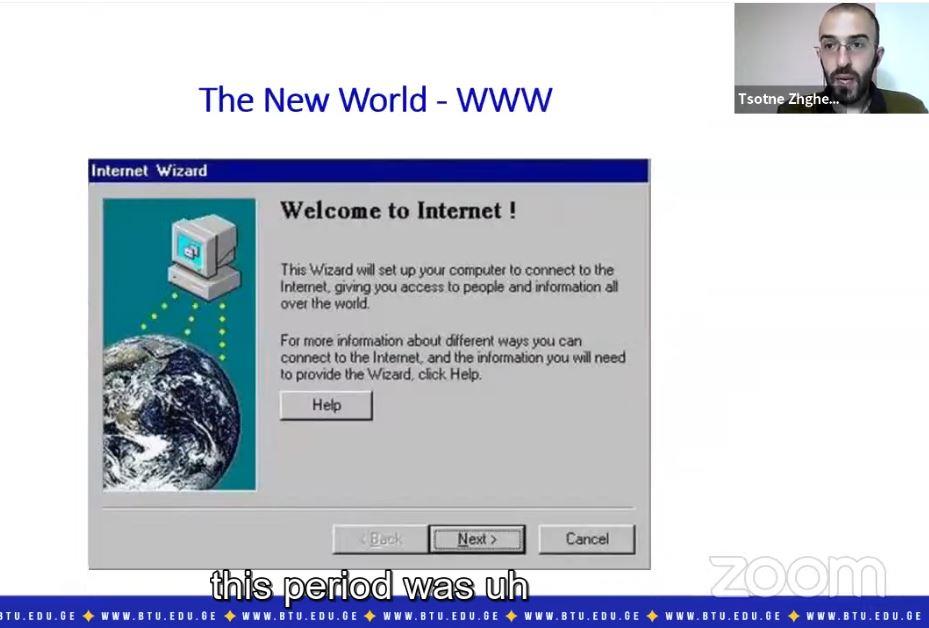
Mr. Tsotne from Georgia University of Business and Technology in a guest lecture 07 June 2022 at STEKOM University further explained about the new world www. The World Wide Web (WWW), commonly known as the Web, is an information system that supports documents and other web resources to be accessed over the Internet. Documents and media that can be downloaded for the network via a web server and can be accessed by programs such as web browsers. Servers and resources on the World Wide Web are identified and located through character sets called Uniform Resource Locators (URLs). The original and still very common type of document is a web page formatted in Hypertext Markup Language (HTML). This markup language supports plain text, images, embedded video and audio content, and scripts that implement complex user interactions. The HTML language also supports hyperlinks (embedded URLs) that provide direct access to other web resources. Navigating the web, or browsing the web, is a common practice following such hyperlinks on some websites. A web application is a web page that functions as application software. Information on the Web is transferred over the Internet using the Hypertext Transfer Protocol (HTTP).
This activity is part of the implementation of STEKOM University's commitment to increase various international activities in order to realize the vision to become an international class university. Various international activities carried out by STEKOM University continue from year to year. There are sustainable international activities and there are also some unsustainable international activities. All kinds of international activities are accommodated and regulated by the International department of STEKOM University.
Several web resources with the same theme and usually the same domain name make up a website. A single web server can provide multiple websites, while multiple websites, especially the most popular ones, can be provided by multiple servers. Website content is provided by various companies, organizations, government agencies, and individual users; and contains a large amount of educational, entertainment, commercial, and government information.
The World Wide Web has become the dominant software platform in the world. It is the primary tool that billions of people around the world use to interact with the Internet. The web was originally known as a document management system. It was by Tim Berners-Lee at CERN in 1989 and opened to the public in 1991.
In order to anticipate crime, For criminals, the Web has become a place to spread malware and engage in various cyber crimes, including identity theft, fraud, espionage and intelligence gathering. Web-based vulnerabilities now outweigh traditional computer security concerns, and as measured by Google, about one in ten web pages may contain malicious code. most web-based attacks occur on legitimate websites, and most, as measured by Sophos, are hosted in the United States, China, and Russia. The most common of all malware threats are SQL injected attacks against websites. Through HTML and URIs, the Web is vulnerable to attacks such as cross-site scripting (XSS) which came with the introduction of JavaScript and was exacerbated by Web 2.0 and Ajax web designs that supported the use of scripts. Today by one estimate, 70% of all websites are open to XSS attacks on their users. Phishing is another common threat to the Web. In February 2013, RSA (EMC's security division) estimated global losses from phishing at $1.5 billion in 2012. Two well-known phishing methods are Covert Redirects and Open Redirects.
The proposed solutions vary. Major security companies like McAfee have designed governance and compliance suites to meet post-9/11 regulations, and some, like Finjan have recommended active real-time checks of programming and all content regardless of source. Some argue that it is for companies to see Web security as a business opportunity rather than centrally, while others are "always-on digital rights management" implemented in the infrastructure to train companies that run data and networks. Jonathan Zittrain said that users who share responsibility for computing security are much better than the Internet.
Privacy guarantees on www are constantly improving. Whenever a client requests a web page, the server can identify the IP address of the request. Web servers usually log IP addresses in log files. Also, unless set not to do so, most web browsers record the requested web page in a viewable history feature, and usually store most of the content locally. Unless server-browser communication uses HTTPS encryption, web requests and responses travel in plain text across the Internet and can be viewed, recorded, and cached by intermediary systems. Another way to hide personally identifiable information is to use a virtual private network. VPN encrypts online traffic and masks the real IP address which lowers the possibility of user identification.
When a web page requests, and a user provides, personally identifiable information—such as real name, address, email address, etc. web based entities can associate current web traffic with that individual. If a website uses HTTP cookies, username and password authentication, or other tracking techniques, it may link other web visits, before and after, with the identifiable information provided. In this way, web-based organizations can develop and build profiles of the individual people who use their site or sites. May be able to build records for individuals that include information about their recreational activities, their shopping interests, their profession, and other aspects of their demographic profile. These profiles are potentially attractive to marketers, advertisers and others. Subject to website terms and conditions and local laws that apply information from this profile, it may be sold, shared, or passed on to other organizations without notifying the user. For many ordinary people, this means nothing more than a few unexpected emails in their inbox or some highly relevant advert on a future web page. For others, this could mean that time spent indulging in an unusual interest could result in a flood of further potentially unwanted targeted marketing. Law enforcement, counter-terrorism, and espionage agencies may also identify, target and track individuals based on their interests or tendencies on the Web.
Social networking sites usually try to get users to use their real names, interests, and locations, rather than pseudonyms, because their executives believe that this makes the social networking experience more engaging for users. On the other hand, an uploaded photo or an unattended statement can be identified to a person, who may regret this exposure. Employers, schools, parents, and other relatives may be affected by aspects of social networking profiles, such as posting of text or digital photos, that were not intended by the individual posting for this audience. Online bullies may use personal information to harass or stalk users. Modern social networking websites allow fine control of privacy settings for each post, but these can be complex and not easy to find or use, especially for beginners. Photos and videos posted to websites have caused certain problems, as they can add a person's face to online profiles. With modern and potential facial recognition technology, it is possible to associate that face with previously anonymous images, events and other scenarios that have been imaged elsewhere. Due to image storage, mirroring, and copying, it is difficult to remove images from the World Wide Web.
Guest lecture 2022 Georgia University of Business and Technology lecturer ferry, how to build trust in digital platforms part 8
International Webinar
Back to News
International Webinar
Wednesday, November 16, 2022
Priyadi, S.Kom, M.Kom
0 Views