
Negro is a term that has historically referred to people characterized as being of black African descent. The word negro in Spanish and Portuguese means black, which was later adopted into English. The term may be construed as offensive, non-offensive, or completely neutral, which also depends on the region or country in which the term is spoken. This word has various equivalents in other European languages.
It is very interesting if we learn about the history and civilization of the Negro. Especially if we learn from the African people directly. Where we will learn about Negro civilization and history from direct Negroes who live and work there every day.
STEKOM University on July 18, 2022 has held guest lecturer lectures from Ethiopia directly. The guest lecture is carried out through zoom media which can interactively communicate in two directions. The guest lecturer is Abraham Melkie, Phd from Debre Tabor University in Ethiopia. STEKOM University has several times conducted academic cooperation with the university.
At the beginning of his presentation, Mr. Abraham said that the Negroid was the last advanced human being and the founder of all civilizations (review of the achievements of the black race from pre-history to the 21st century) the founder of all civilizations (review of the achievements of the black race from pre-history to the 21st century). Mr. Abraham was quite sure of his statement which was then explained in the next presentation slide.
Furthermore, Mr. Abraham explained the evidence that the Africans were the last developed people. According to the Omo Valley people, Kenya has existed since 100,000-200,000 years ago. He said that Tanzanians were the ancestors of Europeans about 50,000 years ago. They underwent a change in pigmentation about 40,000 years ago (Source: Indus Khamit Kush, 1999 Noval Harr 2011, Cheikh Anata Diop, 1981, Charles Finch, 2019).
Furthermore, Mr. Abraham explained about the spiritual civilization of the Negro. One of the stories told by the father of Abraham is about the famous god Zeus. Father Abraham quotes a statement "make this little shift, the ships that sail in the sea, and continue thy wrath against the Achaeans, and keep thee out completely from battle; for Zeus yesterday went to Oceanus, to the Ethiopians who innocent for a feast, and all the gods follow him (Illiad as translated by A.T. Murry, 1925: 35)".
Zous is a famous god in Greek civilization. Zeus or Dias is the king of the gods in Greek mythology. In Hesiod's Theogonia, Zeus is referred to as "Father of Gods and Men". Zeus lived on Mount Olympus. Zeus is the god of the sky and thunder. Its symbols are lightning, eagle, bull and oak tree. Zeus was often depicted by Greek artists in a standing position with a thunderbolt in his hand or sitting on his throne. Zeus was also known in Ancient Rome and ancient India. In Latin it is called Iopiter while in Sanskrit it is called Dyaus-pita.
Zeus was the son of Kronos and Rea, also known as Kronide, and was the youngest of his siblings. Zeus married his older sister Hera who became the goddess of marriage. Zeus is famous for his relationships with many women and having many children. His children included Athena, Apollo and Artemis, Hermes, Ares, Hebe, Hephaistos, Persephone, Dionysus, Perseus, Heracles, Helene, Minos, and Mousai.
Zeus divided the world into three and shared these worlds with his two brothers, Poseidon who became the god of the seas, and Hades who became the god of the underworld (the realm of the dead). Another opinion says that the distribution is based on the lottery made by the three gods.
Zeus is associated with the god Jupiter from Roman mythology, the god Amun from Egyptian mythology, the god Tinia from Etruscan mythology, and the god Indra from Hindu mythology. Zeus, along with Dionysus, was associated with the Phrygian god Sabazius, known as Sabazius in Rome.
Zeus, often referred to as Zeus pater, is an extension of Di̯ēus, the god of the day sky in Proto-Indo-European mythology, also called Dyeus ph2tēr ("Father of Heaven"). Thus, Zeus is a Greek god whose name comes from Indo-European culture. Zeus was adapted into Roman mythology as Jupiter. In Norse mythology, Zeus/Jupiter is known as Thor (god of thunder). Unlike Zeus and Jupiter who are the rulers of the heavens, Thor is not the leader of the gods but Odin.
Another spirituality that is still related to the Negro civilization, especially in Africa, according to Abraham's father is Krishna. Krishna is the main god in Hinduism. He is revered as the eighth avatar of Vishnu and also as the supreme god in himself. He is the god of protection, compassion, tenderness, and love; and is one of the most popular and widely revered among the Indian gods. Krishna's birthday is celebrated annually by Hindus at Krishna Janmashtami according to the lunisolar Hindu calendar, which falls in late August or early September in the Gregorian calendar.
Anecdotes and narratives of Krishna's life are generally titled Krishna Leela. He is a central figure in the Mahabharata, Bhagavata Purana, Brahma Vaivarta Purana, and Bhagavad Gita, and is mentioned in many Hindu philosophical, theological, and mythological texts. They depicted him in various perspectives: as a child of a god, a prankster, a model lover, a divine hero, and a universal supreme being. His iconography reflects these legends, and shows him in different stages of his life, such as a baby eating butter, a boy playing the flute, a boy with Radha or surrounded by female devotees; or a friendly charioteer giving advice to Arjuna.
Krishna's name and synonyms have been traced to literature and cults of the first millennium BC. In some sub-traditions, Krishna is worshiped as Svayam Bhagawan (Supreme God), and is sometimes known as Krishnaism. This sub-tradition emerged in the context of the medieval Bhakti movement. Literature related to Krishna has inspired many performing arts such as Bharatanatyam, Kathakali, Kuchipudi, Odissi and Manipuri dance. He is a pan-Hindu deity, but is highly revered in several locations, such as Vrindavan in Uttar Pradesh, Dwarka and Junagadh in Gujarat; the Jagannatha aspect in Odisha, Mayapur in West Bengal; in the form of Vithoba in Pandharpur, Maharashtra, Shrinathji in Nathdwara in Rajasthan, Udupi Krishna in Karnataka, Parthasarathy in Tamil Nadu, Parthasarathy in Aranmula, Kerala and Guruvayoorappan in Guruvayoor in Kerala. Since the 1960s, worship of Krishna has also spread to the West and Africa, largely because of the work of the International Society for Krishna Consciousness (ISKCON).
Buddhism in Thailand, according to Abraham's explanation, is also related to the Ethiopian Negro civilization. Buddhism in Thailand is largely Theravada. Nearly 95% of Thailand's population are Theravada Buddhists, although Buddhism in the country has become integrated with folk beliefs. The main characteristics of Buddhism in Thailand are the tradition of the temporary ordination of every Thai man to become a monk and the close connection of Buddhism with Thai culture and nation.
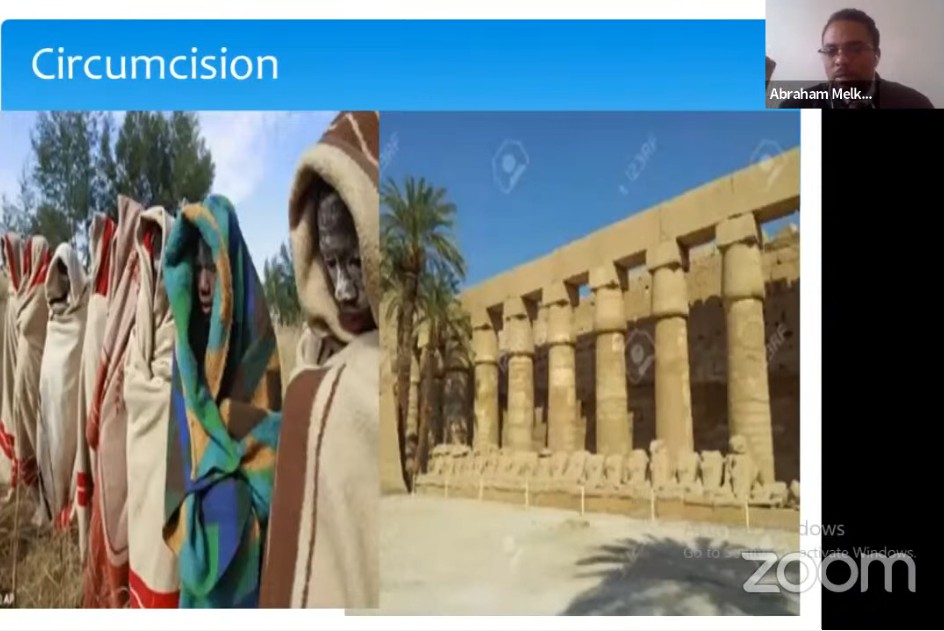
Guest lecturer - Learn Negroid Civilization from Ethiopian lecturer 2022 part 1
International Webinar
Back to News
International Webinar
Wednesday, November 9, 2022
Priyadi, S.Kom, M.Kom
0 Views