
Architecture and infrastructure is one indication of the progress of society which includes science and art. Many examples of buildings, megaliths and monoliths were built throughout the African continent. It is a testament to their technological achievements. From ancient Egypt to Europe, archaeological research has exposed the ancient and diverse traditions of architectural and infrastructural heritage in Africa. North Africa has perhaps the most luxurious and magnificent examples of architecture and infrastructure. African Negroes have played a significant role in various advanced architectural civilizations in ancient Africa.
Negro is a term that has historically referred to people characterized as being of black African descent. The word negro in Spanish and Portuguese means black, which was later adopted into English. The term can be interpreted as offensive, offensive, or completely neutral, which also depends on the region or place where the term is spoken. This word has various equivalents in other European languages.
Interesting if we learn about the history and civilization of the Negro. Especially if we learn from the African people directly. Where we will learn about the civilization and history of the Negro from the Negro people live and live there every day.
STEKOM University on July 18, 2022 has held guest lecturers who come from Ethiopia directly. The lecture is carried out through interactive zoom media that can carry out two-way communication. The guest dose was Abraham Melkie, Phd from Debre Tabor University in Ethiopia. STEKOM University has several times conducted academic cooperation with the university.
Continuing the previous article that discussed the presentation of Mr. Abraham, this article is a continuation of the discussion of the next father of Abraham which discusses the ancient civilization of the African Negro on architecture. The statue of Ramsus II is one of the most widely recognized ancient architectural civilizations of Africa. The statue in the presentation of Mr. Abraham is juxtaposed with the modern architecture of the statue of Abraham lincoln who is the President of the United States.
Ramses II or Ramses II was the third Pharaoh of the 19th Dynasty of Egypt. He is often regarded as the greatest, strongest and most famous Pharaoh of the New Kingdom period, which itself was Egypt's strongest period in Ancient Egypt.
Ramsus II is known as Ozymandias which comes from the first part of Ramses' throne name, Usermaatre Setepenre, "The Maat of (God) Ra is mighty, Chosen by (God) Ra". He is also called Ramses the Great. His successors and the Egyptians were later referred to as the "Great Ancestors".
At the age of 14, he was made princely prince by his father, Seti I. Most Egyptologists today believe that he ascended the throne on May 31, 1279 BC, based on the known date of accession from Harvest Season III, the 27th day.
Early in his reign, he focused on building cities, temples, and monuments. He founded the city of Pi-Ramesses in the Nile Delta as his new capital and used it as the main base for his campaign in Syria. He led several military expeditions to the Levant, reaffirming Egyptian control of Canaan. He also led expeditions to the south, to Nubia, which are commemorated in inscriptions at Beit el-Wali and Gerf Hussein. He celebrated 13 or 14 Sed festivals, which is more than any other pharaoh.
At the time of his death, at the age of about 90 years, Ramses II was suffering from severe dental problems as well as appreciating joint and hardening of the arteries. He was buried in a tomb in the Valley of the Kings; it was later moved to a royal hideout where it was discovered in 1881, and is now on display in the Egyptian Museum.
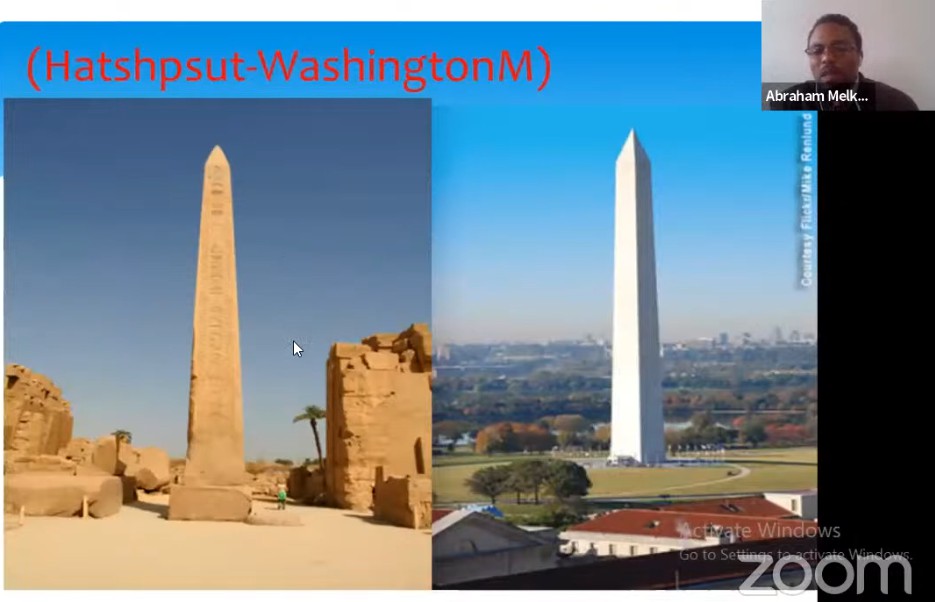
The next ancient architecture presented by Mr. Abraham is the Temple of Hatshepsut's mortuary which is juxtaposed with the modern architecture of the Washington Monument. The architecture of the two is very similar in visual appearance to the presentation of Mr. Abraham.
Hatshepsut's mortuary temple is a mortuary temple built during the reign of Pharaoh Hatshepsut of the Eighteenth Dynasty of Egypt. Located opposite the city of Luxor, this temple is considered to be a masterpiece of ancient architecture. Three large terraces rise above the desert floor and into the cliffs of Deir el-Bahari. His tomb, KV20, lies within the same massif enclosed by El Qurn, a pyramid for his mortuary complex. On the edge of the desert, 1 km (0.62 mi) east, connected to the complex by a causeway lies the accompanying valley temple. Across the Nile, the entire structure leads to the monumental Eighth Column, Hatshepsut's best known addition to the Temple of Karnak and the place from which the procession of the Beautiful Festival of the Valley departs. The temple's twin functions are identified by its axes: the east-west axis serves primarily to receive the Amun-Re barque at the climax of the festival, while the north-south axis represents the life cycle of the pharaoh from coronation to rebirth.
Construction of the terraced temple took place between the seventh and twentieth years of Hatshepsut's reign, during which the building plans were repeatedly modified. In its design, the temple is heavily influenced by the Temple of Mentuhotep II of the Eleventh Dynasty which was built six centuries earlier. However, in the arrangement of its chambers and shrines, this temple is entirely unique. The main axis, usually reserved for morgue complexes, is occupied instead by the barque sanctuary of Amun-Re, with the morgue cult being moved to the south to form an additional axis with the solar cult complex to the north. Apart from the main shrine is the shrine to Hathor and Anubis located on the central terrace. The front porch of the terrace here houses the most prominent temple reliefs. The people of the expedition to the Land of Punt and the divine birth of Hatshepsut, the backbone of her case for rightfully occupying the throne as members of the royal family and as pious descendants. Below, the lowest terrace leads to the causeway and out to the valley temple.
The state of the temple has suffered over time. Two decades after Hatshepsut's death, under the direction of Thutmose III, references to her reign were removed, captured or obliterated. The campaign was intense but brief, quelled after two years when Amenhotep II ascended the throne. The reason behind the ban remains a mystery. Personal revenge seems unlikely as Thutmose III has waited twenty years to act. Perhaps the concept of a female monarch was anathema to ancient Egyptian society or the dynastic dispute between the Ahmosid and Thutmosid lineages needed to be resolved. In the Amarna Period the temple was rebuilt when Akhenaten ordered images of the Egyptian gods, particularly Amun, to be removed. This damage was later repaired under Tutankhamun, Horemheb and Ramses II. An earthquake in the Third Intermediate Period caused further damage. During the Ptolemaic period, the sanctuary of Amun was restructured and a new portico was built at its entrance. A Coptic monastery of Saint Phoibammon was built between the 6th and 8th centuries AD and the image of Christ is painted over the original reliefs. The last remaining graffiti is dated c. 1223.
The temple reappeared in modern-era records in 1737 with Richard Pococke, an English traveler, who visited the site. Several visits followed, although serious excavations were not carried out until the 1850s and 60s under Auguste Mariette. The temple was completely excavated between 1893 and 1906 during the Egypt Exploration Fund (EEF) expedition directed by douard Naville. Further efforts were made by Herbert E. Winlock and the Metropolitan Museum of Art (MMA) from 1911 to 1936, and by Mile Baraize and the Egyptian Antiquities Service (now Supreme Council of Antiquities (SCA)) from 1925 to 1952. Since 1961, The Polish Center for Mediterranean Archeology (PCMA) has carried out extensive consolidation and restoration work throughout the temple.
Guest lecturer - Learn Negroid Civilization from Ethiopian lecturer 2022 part 4
International Webinar
Back to News
International Webinar
Wednesday, November 9, 2022
Priyadi, S.Kom, M.Kom
0 Views