
Gross Domestic Product (GDP) also known as Gross Domestic Product (GDP) is an important indicator to measure the economic condition of a country. Taken from the official website of the Central Bureau of Statistics, GDP is one of the important indicators to determine the economic conditions in a country in a certain period. GDP is basically the amount of added value generated by all business units in a country. Or is the total value of final goods and services produced by all economic units. In short, GDP is one method for calculating national income.
There are three approaches that can be used to calculate GDP figures, namely:
- Production approach
GDP is the sum of the added value of goods and services produced by various production units in the territory of a country in a certain period of time (usually in one year).
The production units in this presentation are grouped into 9 sectors, namely:
-- Agriculture, animal husbandry, forestry, and fisheries. Mining and excavation.
-- Processing industry.
-- Electricity, gas and clean water.
-- Construction.
-- Trade, hotels and restaurants.
-- Transport and communication.
-- Finance, real estate, and corporate services.
-- Government services.
- Revenue approach
GDP is the amount of remuneration received by the factors of production that participate in the production process in a country within a certain period of time. Remuneration for factors of production in question are wages and salaries, land rent, interest on capital and profits. All before deducting income tax and direct taxes. Here, GDP includes depreciation and net indirect taxes.
- Expenditure approach
GDP is all components of final demand consisting of:
-- Household consumption expenditure
Household consumption expenditure is spending on goods and services by households for consumption purposes. Households are the end users of various types of goods and services provided in a country's economy. Households are defined as individuals or groups of individuals who live together in a residential building. They collect income, have assets and obligations, and consume goods and services together, especially the food and housing groups.
-- Government consumption expenditure
It is the value of all types of government output minus the output value for self-capital formation minus the sales value of goods or services plus the value of goods or services purchased from market producers to be given to households free of charge or at prices that are not economically significant.
- Gross fixed capital formation
Defined as spending units of production to increase fixed assets minus the reduction of used fixed assets. It is referred to as the formation of gross fixed capital because it describes the addition and reduction of capital goods in a certain period.
Capital goods have a useful life of more than one year and will experience depreciation or the term "gross". Depreciation or consumption of capital goods illustrates the decrease in the value of capital goods used in the normal production process during one period.
- Inventory
Inventories held by producing units for use in further processing, for sale, or for giving to other parties. It can also be interpreted as inventory originating from other parties, which will be used as input or resold without undergoing further processing.
- Export Import
In general, the concept of export-import abroad refers to the 1933 System of National Accounts (SNA). Goods export transactions are defined as transactions in the transfer of economic ownership of goods from residents of a province to foreign economic actors.
This material was delivered by a presenter from Malaysia in an international webinar entitled "Business culture: how to step forward" which was held by STEKOM University in collaboration with Universiti Perlis Malaysia, Singapore University of social science, PTIC and various other parties. The name of the presenter from Malaysia is DR MOSD SHAHIDAN SHAARI who is a lecturer at the Faculty of Applied and Human Science Universiti Malaysia Perlis.
This international webinar activity is part of the implementation of STEKOM University's commitment to increase various international activities. This was done in order to realize the vision to become an international-class university. Various international activities carried out by STEKOM University continue from year to year. There are international activities that are sustainable and there are also some international activities that are not sustainable. All types of international activities are accommodated and regulated by the International department of STEKOM University.
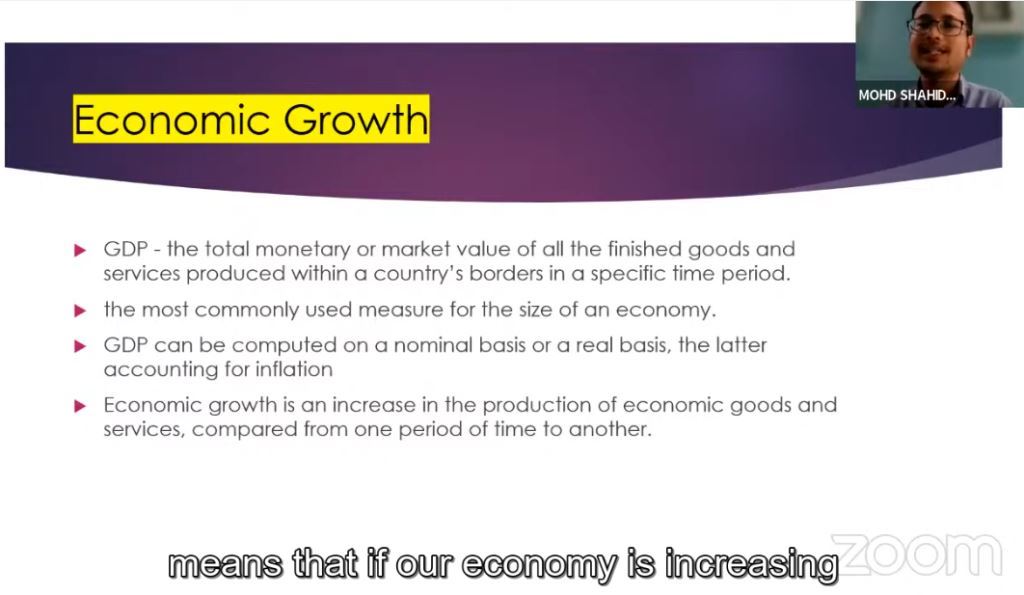
International Webinar 2022 - Business culture, how to step forward - part 1
International Webinar
Back to News
International Webinar
Tuesday, January 3, 2023
Priyadi, S.Kom, M.Kom
0 Views