
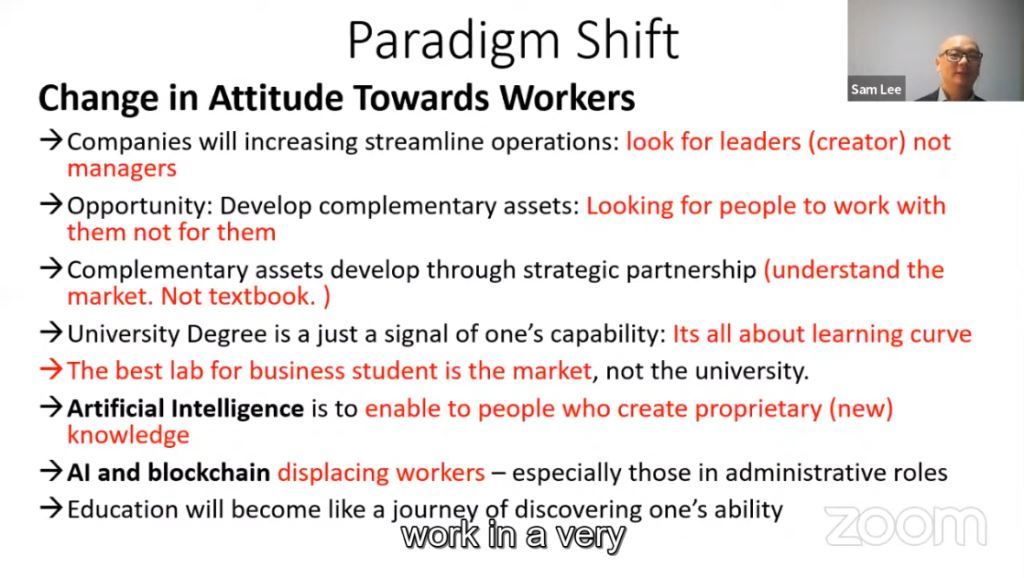
Slowing global economic growth not only brings challenges but also changes in attitudes towards workers, according to a presenter from Singapore. Changes in attitude towards workers are:
> Companies will increase streamlining operations: looking for leaders (creators) not managers.
> Opportunity: Develop complementary assets: Find people to work with them, not for them.
> Complementary assets develop through strategic partnerships (understand the market. Not textbooks. ).
> A University degree is simply a signal of one's abilities: It's all about the learning curve.
> The best lab for business students is the marketplace, not the university.
> Artificial Intelligence is to enable people to create exclusive (new) knowledge.
> Al and blockchain replacement workers — especially those in administrative roles.
> Education will be like a journey of discovering one's abilities.
Artificial intelligence is intelligence that is added to a system that can be regulated in a scientific context or can also be called artificial intelligence or simply AI for short, defined as the intelligence of a scientific entity. Andreas Kaplan and Michael Haenlein define artificial intelligence as "the ability of a system to correctly interpret external data, to learn from that data, and to use that learning to achieve specific goals and tasks through flexible adaptations". Such systems are generally considered computers. Intelligence is created and put into a computer so that it can do work like humans can do. Several types of fields that use artificial intelligence include expert systems, computer games, fuzzy logic, artificial neural networks and robotics. Technically, artificial intelligence is a statistical model that is used to make decisions by generalizing the characteristics of an object based on data which is then installed in various electronic devices.
Many things seem difficult for human intelligence, but for informatics it is relatively easy. For example: transforming equations, solving integral equations, or making chess games. On the other hand, things that seem to humans to require a little intelligence, are still difficult to realize in Informatics. For example: Object/Face Recognition, playing soccer.
Although AI has strong science fiction connotations, it forms a very important branch of computer science, dealing with intelligent behavior, learning and adaptation in machines. Research in AI concerns building machines and computer programs to automate tasks that require intelligent behavior. Examples include control, planning and scheduling, the ability to answer diagnostics and customer inquiries, and handwriting, voice and facial recognition. These have become separate disciplines, focused on providing solutions to real-life problems. AI systems are now frequently used in economics, science, medicine, engineering and the military, as they have been built into several software applications for home computers and video games.
This material was presented by a presenter from Singapore in an international webinar entitled "Paradigm Shift - The World is Changing - Opportunity and Challenges - Challenges: Slow Global Growth - Opportunity: Greater Regional Cooperation" held by STEKOM University in collaboration with Universiti Perlis Malaysia, Singapore University of social science, PTIC and various other parties. The presenter's name from Singapore is Lee Khuay Khiang who is a lecturer at STEKOM University.
This international webinar activity is part of the implementation of STEKOM University's commitment to increase various international activities. This was done in order to realize the vision to become an international-class university. Various international activities carried out by STEKOM University continue from year to year. There are international activities that are sustainable and there are also some international activities that are not sustainable. All types of international activities are accommodated and regulated by the International department of STEKOM University.
International Webinar 2022 - Business culture, how to step forward - part 15
International Webinar
Back to News
International Webinar
Monday, January 9, 2023
Priyadi, S.Kom, M.Kom
0 Views