
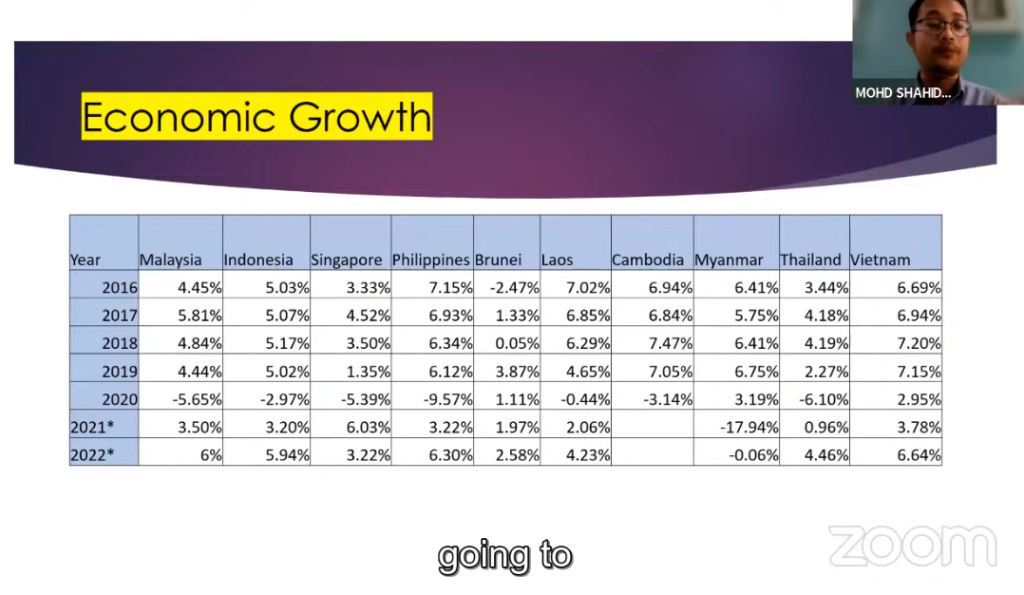
The ASEAN region will remain one of the fastest growing regions in the world in 2023, but economic growth is likely to drop slightly from 2022. This is largely due to deteriorating global economic conditions and tightening monetary policies.
The second half of the year is likely to see conditions more conducive to organic growth as reduced inflation gives the central bank greater interest rate flexibility. This should complement the increase in economic activity in China.
The ASEAN region will remain attractive to foreign direct investment, with commercial and sovereign investment trends likely to remain consistent throughout the year, despite a more challenging macroeconomic environment.
The ASEAN (Association of Southeast Asian Nations) region is one of the fastest growing regions in the world in 2022 – the Asian Development Bank (ADB) predicts that economic growth in Southeast Asia will equal 5.5 percent for 2022.
However, we enter 2023 with a growing number of economic pressures. Some of these are bound to act as a drag on growth globally. As such, ADB recently revised its 2023 forecast to 4.7 percent for ASEAN as global demand weakens.
It should be noted that forecasts do vary, and this can depend in part on how the organization categorizes the region. Credit Suisse analysts predict growth for the six ASEAN economies – Indonesia, Malaysia, the Philippines, Singapore, Thailand and Vietnam – will moderate to 4.4 percent in 2023 from a projected 5.6 percent in 2022.
These figures put regional economic growth far above the global average. The IMF predicts global growth of 3.2 percent in 2022 and 2.7 percent in 2023. As such, ASEAN remains an attractive destination for international investment, providing investors with exposure to one of the fastest growing regions globally.
ASEAN nations could benefit from a privileged geopolitical position in the coming years as US-China competition intensifies and the two superpowers seek to deepen ties in the region. The two countries have highlighted their commitment to trade with the ASEAN-China economy in particular through access to the Regional Comprehensive Economic Partnership (RCEP) agreement and the Comprehensive and Progressive Agreement for Trans-Pacific Partnership (CPTPP). The US only has free trade agreements with certain ASEAN countries.
The competition of these superpowers is not the only factor that can positively contribute to ASEAN's growth in 2023. Several countries in the region have large international tourism sectors, and a better epidemiological environment will contribute to the recovery of the industry in 2023.
This material was delivered by a presenter from Malaysia in an international webinar entitled "Business culture: how to step forward" which was held by STEKOM University in collaboration with Universiti Perlis Malaysia, Singapore University of social science, PTIC and various other parties. The name of the presenter from Malaysia is DR MOSD SHAHIDAN SHAARI who is a lecturer at the Faculty of Applied and Human Science Universiti Malaysia Perlis.
This international webinar activity is part of the implementation of STEKOM University's commitment to increase various international activities. This was done in order to realize the vision to become an international-class university. Various international activities carried out by STEKOM University continue from year to year. There are international activities that are sustainable and there are also some international activities that are not sustainable. All types of international activities are accommodated and regulated by the International department of STEKOM University.
International Webinar 2022 - Business culture, how to step forward - part 2
International Webinar
Back to News
International Webinar
Tuesday, January 3, 2023
Priyadi, S.Kom, M.Kom
0 Views