
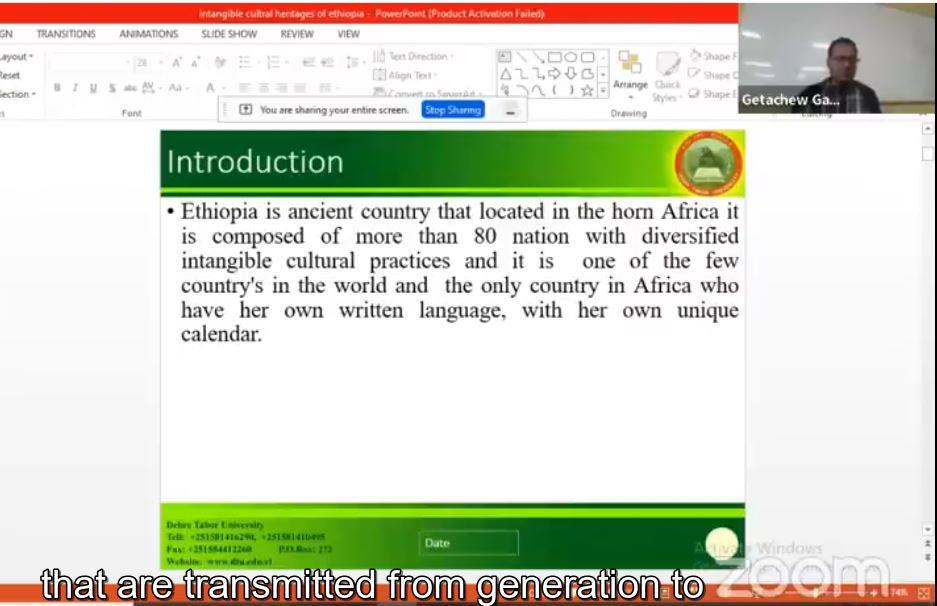
Academics from Ethiopia explain about Ethiopia as an ancient country. In his explanation, Ethiopia is an ancient country located on the horn of Africa, consisting of more than 80 countries with diverse intangible cultural practices and is one of the few countries in the world and the only country in Africa that has its own written language, with its itself, as well as its own unique calendar.
Ethiopia is a country in the Horn of Africa. The country lies entirely on tropical latitudes and is relatively dense, with similar north-south and east-west dimensions. The capital is Addis Ababa (“New Flower”), which is located almost in the center of the country. Ethiopia is the largest and most populous country in the Horn of Africa. With the partition of Eritrea in 1993, its former province along the Red Sea, Ethiopia became landlocked.
Ethiopia is one of the oldest countries in the world, its area has varied over the thousands of years of its existence. In ancient times it remained centered at Aksum, the imperial capital located in the northern part of the modern country, about 100 miles (160 km) from the Red Sea coast. The current territory was consolidated during the 19th and 20th centuries when European powers encroached on the historical domain of Ethiopia. Ethiopia came to prominence in modern world affairs first in 1896, when it defeated colonial Italy in the Battle of Adwa, and again in 1935–36, when it was invaded and occupied by Italian fascists. Liberation during World War II by the Allied powers set the stage for Ethiopia to play a more prominent role in world affairs. Ethiopia was one of the first independent states to sign the Charter of the United Nations, and provided moral and material support for the decolonization of Africa and the growth of Pan-African cooperation. These efforts culminated in the creation of the Organization of African Unity (since 2002, the African Union) and the United Nations Economic Commission for Africa, both headquartered in Addis Ababa.
There are many other important fossil finds in this country. Stone tools at Gona were discovered in 1992 which are 2.52 million years old, the oldest tools found in the world. In 2010 fossilized animal bones, dating back 3.4 million years, were found with stone tool marks in the Lower Awash Valley by an international team, led by Shannon McPherron, in what is the oldest evidence of stone tool use ever found. anywhere in the world. In 2004 fossils discovered near the Omo river in Kibbish by Richard Leakey in 1967 were 195,000 years old, East Africa's oldest date for modern Homo sapiens. Homo sapiens idaltu, discovered in the Middle Awash in Ethiopia in 1997, lived about 160,000 years ago.
Some of the earliest known evidence of an early stone-tipped projectile weapon (a signature tool of Homo sapiens), the point of a stone javelin or throwing spear, was found in 2013 at the Gademotta site, and dates to around 279,000 years ago. In 2019, further evidence of Middle Stone Age complex projectile weapons was found in Aduma, also in Ethiopia, dated 100,000-80,000 years ago, in the form of points thought to possibly belong to arrows sent by spear throwers.
The material above was delivered by a presenter from Ethiopia in an international webinar held by STEKOM University in collaboration with Universities from Mexico, Ukraine, Ethiopia and various other parties. The presenter's name is Getachew Gashaw who is an academic in the country.
This international webinar activity is part of the implementation of STEKOM University's commitment to increase various international activities. This was done in order to realize the vision to become an international-class university. Various international activities carried out by STEKOM University continue from year to year. There are international activities that are sustainable and there are also some international activities that are not sustainable. All types of international activities are accommodated and regulated by the International department of STEKOM University.
International Webinar 2022 - Get to know the beauty of diverse cultures between countries – Part 12
International Webinar
Back to News
International Webinar
Thursday, January 26, 2023
Priyadi, S.Kom, M.Kom
0 Views