
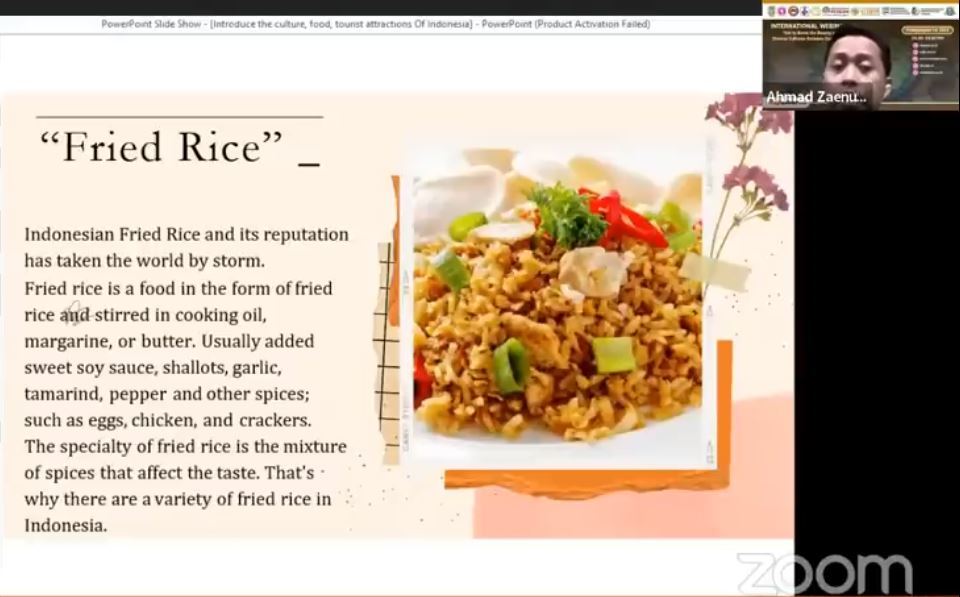
Indonesian academics explain about the traditional food fried rice which is said to have taken the world by storm in an international webinar. Fried rice is food in the form of rice that is fried and mixed in cooking oil, margarine or butter. Usually added with sweet soy sauce, shallots, garlic, tamarind, pepper and other ingredients; such as eggs, chicken meat, and crackers. There is also another type of fried rice made with salted fish which is also popular throughout Indonesia.
Fried rice is also known as the national dish of Indonesia. Fried rice can be found in roadside stalls, mobile vendor carts, to restaurants and buffet tables at weddings in Indonesia. In 2011, an Internet poll conducted by CNN International and attended by 35,000 people placed fried rice at number two on their '50 Most Delicious Foods in the World' list after rendang.
Fried rice has the same start as other versions of fried rice; as a way to avoid wasting rice. Frying rice can prevent the spread of harmful germs, bacteria, microbes, especially in pre-freezing technology in Indonesia and also avoid the need to waste valuable food. Fried rice is traditionally served at home for breakfast and is traditionally made from leftover rice from the night before. In addition to ingredients such as shallots, tomatoes, peppers and chilies, fried rice with chunks of chicken or beef; usually leftovers from cooking chicken or beef.
Nasi goreng is often described as a modification of Indonesian fried rice and with other fried rice recipes in Asia, it has been suggested to trace its origins to South Chinese fried rice. However, it is unclear when Indonesia started accepting Chinese fried rice and making their own version. Trade between China and the Indonesian Archipelago developed since the time of the Srivijaya Kingdom around the 10th century and intensified during the time of the Majapahit Kingdom around the 15th century. At that time Chinese immigrants began to settle in the Archipelago, bringing their culture and cuisine with them. The Chinese usually favor freshly cooked hot food, and in their culture it is taboo to throw away uneaten food. As a result, the previous day's leftover rice is often re-cooked in the morning. In the past, Indonesia was probably just leftover rice that was dried in the sun to make intip or rengginang (rice crackers), dry rice could also be ground to make rice flour.
Fried rice was considered a part of Indian culture during the colonial era. Mentions of fried rice appear in Dutch East Indies colonial literature, such as in the student story Hidjo by Marco Kartodikoromo, which was published in the Sinar India newspaper in 1918. It is mentioned in the 1925 Dutch cookbook Groot Nieuw Vollemenggali Oost Indisch Kookbook. Trade between the Netherlands and the Dutch East Indies at that time has increased the popularity of fried rice to the world.
After Indonesia's independence, fried rice was considered a national dish, although unofficially. It was on the menu that was introduced, offered and served at the Indonesian Theater Restaurant 1964 inside the Indonesian pavilion at the New York world's fair. Howard Palfrey Jones, US Ambassador to Indonesia in the last year of Ir. Soekarno in the mid-1960s, in his memoir "Indonesia: a dream possible", said that he was like fried rice. She described her bravery for fried rice cooked by Hartini, one of Sukarno's wives, and praised it as the most delicious fried rice she had ever tasted.
The above material was presented by presenters from Indonesia in an international webinar held by STEKOM University in collaboration with Universities from Mexico, Ukraine, Ethiopia and various other parties. The presenter's name is Ahmad Zaenuri, M.Si who is a lecturer and head of the entrepreneurship study program at STEKOM University. The title of the presentation he delivered was "Introduce the culture, culinary, tourist attractions of Indonesia as a nation's economic asset".
This international webinar activity is part of the implementation of STEKOM University's commitment to increase various international activities. This was done in order to realize the vision to become an international-class university. Various international activities carried out by STEKOM University continue from year to year. There are international activities that are sustainable and there are also some international activities that are not sustainable. All types of international activities are accommodated and regulated by the International department of STEKOM University.
International Webinar 2022 - Get to know the beauty of diverse cultures between countries – Part 17
International Webinar
Back to News
International Webinar
Sunday, January 29, 2023
Priyadi, S.Kom, M.Kom
0 Views