
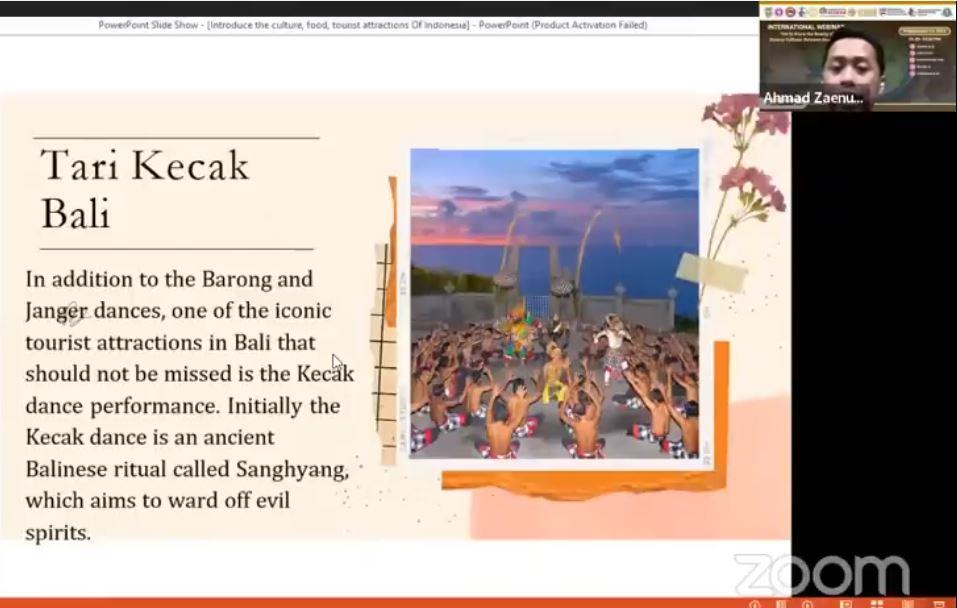
Indonesian academics explain about the traditional food of the Kecak dance in Bali in an international webinar. Apart from the Barong and Janger dances, one of the icons of tourist attractions in Bali that should not be missed is the Kecak dance performance. Initially the Kecak dance was an ancient Balinese ritual called Sanghyang, which aims to drive away evil spirits.
Kecak is a typical Balinese art drama that mainly tells about the Ramayana and is played mainly by men. This dance is performed by many (tens or more) male dancers who sit in a circle and with a certain rhythm shout "cak" and raise both arms, depicting the story of Ramayana when a line of monkeys helped Rama fight Ravana. However, Kecak originates from the sanghyang ritual, which is a dance tradition in which the dancer will be in an unconscious state, communicating with God or the spirits of the ancestors and then conveying their hopes to the community.
The dancers who sit in a circle wear checkered cloth like a chessboard around their waists. Apart from these dancers, there are also other dancers who play Ramayana characters such as Rama, Shinta, Ravana, Hanuman, and Sugriwa. The Kecak dance song is taken from the sanghyang dance ritual. Additionaly, do not use musical instruments. Only use kincringan worn on the feet of dancers who play the characters of the Ramayana.
This dance is a sacred dance. It can be seen from the dancers who are burned by fire, but they do not experience pain and are not burned, instead they become immune to fire. Apart from the Fire Dance or Cak Dance, the Kecak Dance is also known as the Sanghyang Dance which is performed during religious ceremonies.
At that time, these dancers were generally possessed by spirits, and could interact with the ancestors or gods who had been purified by them. He used this dancer as a medium to convey His word. When possessed, they also perform actions beyond expectations. For example, doing some quite dangerous moves or making sounds that they rarely make.
Wayan Limbak is a creator figure of the Kecak Dance. In 1930, he introduced this dance to various countries, assisted by a painter from Germany named Walter Spies. The male dancers who dance this, will shout the word "cak, cak, cak". It was from this call that the name Kecak was created.
Around the 1930s, Wayan Limbak worked with German painter Walter Spies to create the Kecak dance based on the Sanghyang tradition and parts of the Ramayana story. Wayan Limbak popularized this dance while traveling the world with his troupe of Balinese dancers.
The above material was presented by presenters from Indonesia in an international webinar held by STEKOM University in collaboration with Universities from Mexico, Ukraine, Ethiopia and various other parties. The presenter's name is Ahmad Zaenuri, M.Si who is a lecturer and head of the entrepreneurship study program at STEKOM University. The title of the presentation he delivered was "Introduce the culture, culinary, tourist attractions of Indonesia as a nation's economic asset".
This international webinar activity is part of the implementation of STEKOM University's commitment to increase various international activities. This was done in order to realize the vision to become an international-class university. Various international activities carried out by STEKOM University continue from year to year. There are international activities that are sustainable and there are also some international activities that are not sustainable. All types of international activities are accommodated and regulated by the International department of STEKOM University.
International Webinar 2022 - Get to know the beauty of diverse cultures between countries – Part 19
International Webinar
Back to News
International Webinar
Tuesday, January 31, 2023
Priyadi, S.Kom, M.Kom
0 Views