
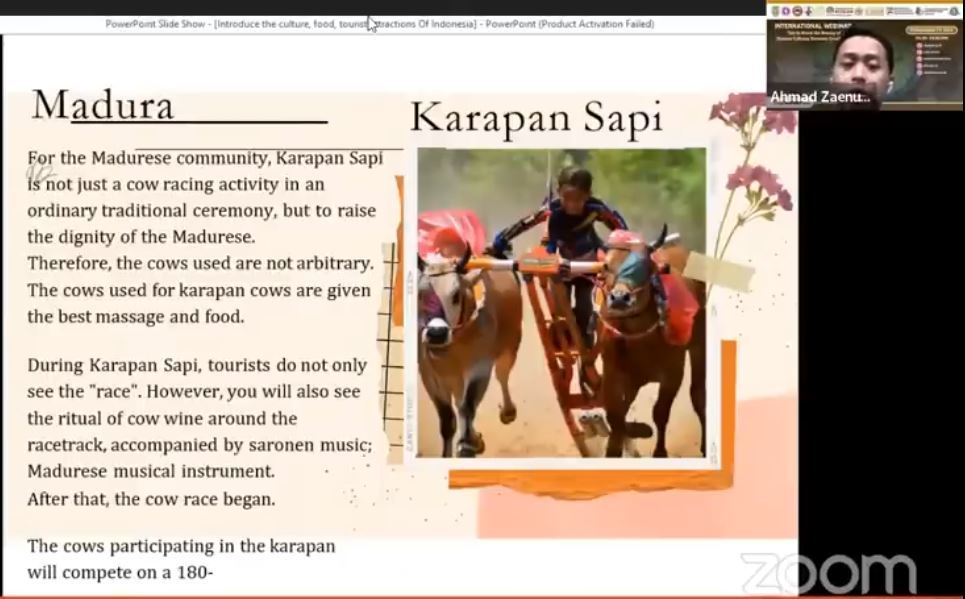
Indonesian academics explain the traditional karapan sapi food in Madura in an international webinar. For the Madurese people, Karapan Sapi is not just a cow racing activity in an ordinary traditional ceremony, but to elevate the dignity of the Madurese. Therefore, the cattle used are not arbitrary. The cows used for karapan sapi are given the best massage and food.
During the Cow Race, tourists don't only see the "race". However, you will also see the ritual of cow wine around the racetrack accompanied by saronen music; Madurese musical instruments. After that, the cow race begins. The cows participating in the karapan will compete in the 180s.
At the beginning, Karapan Sapi was motivated by the less fertile land of Madura for agricultural land. Instead, the Madurese shifted their livelihoods as fishermen to coastal areas and raising cattle which were also used for farming, especially in plowing rice fields or fields.
Once upon a time a Sumenep scholar named Syeh Ahmad Baidawi (Prince Katandur) introduced a method of farming using a pair of bamboo known by the Madurese as "nanggala" or "salaga" pulled by two cows. The initial intention of holding the Karapan Sapi was to get strong cows to plow the fields. The Madurese raise cows and work them in their fields as soon as possible. This idea then gave rise to the tradition of karapan sapi. Karapan sapi will soon become a routine activity every year, especially after the harvest season is over. Karapan Sapi is preceded by parading pairs of cows around the racetrack accompanied by saronen music.
The implementation of the Cow Race is divided into four rounds, namely: the first round, all the cows are competed for speed in two pairs to separate the winning group and the losing group. In this round all cows that win or lose can compete again according to their group.
In the second round or re-election round, the pairs of cows in the winning group will be contested again, as well as the cows in the losing group, and in this round all pairs from the winning and losing groups may not compete again except for a few pairs of cows that occupy the winning sequence. top in each group.
Third round or semifinal. In this round each cow that wins in each group is pitted again to determine three pairs of winning cows and three cows from the losing group. In the fourth round or final round, held to determine the first, second and third place winners from the losing group.
However, Karapan Sapi has been criticized by various parties, such as the Indonesian Ulama Council and the regional government in Madura because of the tradition of rengkin violence by cow owners. The Pamekasan MUI has issued a fatwa regarding the rekeng tradition because it is considered to be harmful to cows, and the Governor of East Java through a Governor's Instruction has declared a ban on the rekeng tradition. However, this tradition still continues among bull race performers.
The above material was presented by presenters from Indonesia in an international webinar held by STEKOM University in collaboration with Universities from Mexico, Ukraine, Ethiopia and various other parties. The presenter's name is Ahmad Zaenuri, M.Si who is a lecturer and head of the entrepreneurship study program at STEKOM University. The title of the presentation he delivered was "Introduce the culture, culinary, tourist attractions of Indonesia as a nation's economic asset".
This international webinar activity is part of the implementation of STEKOM University's commitment to increase various international activities. This was done in order to realize the vision to become an international-class university. Various international activities carried out by STEKOM University continue from year to year. There are international activities that are sustainable and there are also some international activities that are not sustainable. All types of international activities are accommodated and regulated by the International department of STEKOM University.
International Webinar 2022 - Get to know the beauty of diverse cultures between countries – Part 21
International Webinar
Back to News
International Webinar
Tuesday, January 31, 2023
Priyadi, S.Kom, M.Kom
0 Views