
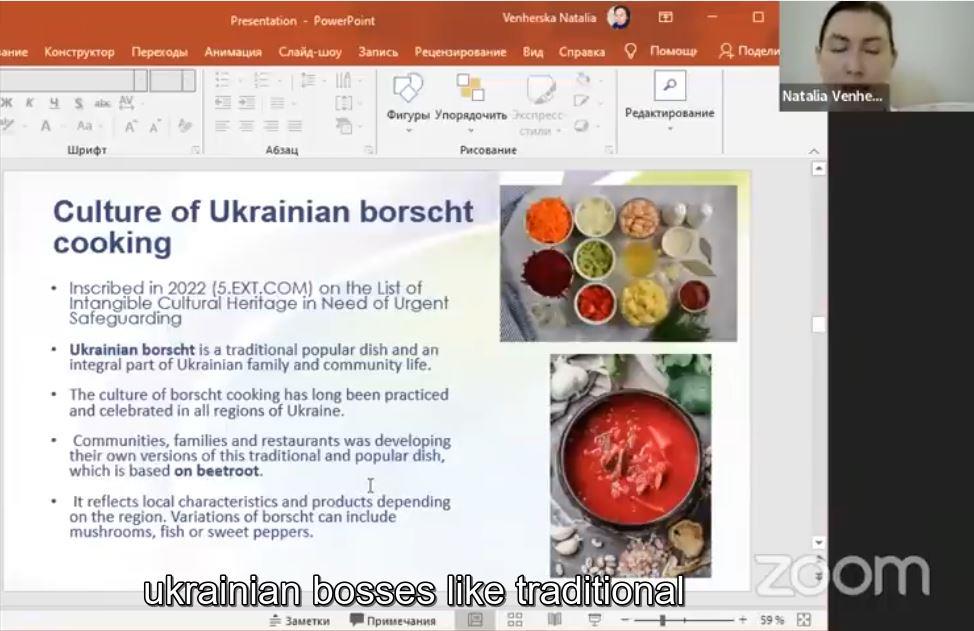
Academics from Ukraine explained Ukrainian borsch which is a very unique traditional Ukrainian dish. Ukrainian borscht is a traditional dish cooked in broth mixed with fermented beets, beet sugar or beet juice. There are many versions, and the practice requires the recipe, the cooking method, and the occasion, according to which certain varieties are prepared. Borscht is cooked in a large saucepan or pot and is usually served with bread or garlic buns. It is prepared mainly by women, although many men also prepare it as an everyday dish. This practice dates back centuries and is passed down in families, with children participating in its preparation. An expression of hospitality, Ukrainian borscht brings people of all ages, genders, and backgrounds together at the table. It is also used in ritual practices, such as in the Podillia region, where the third day of the wedding retains its ritual name do nevistky – na borshch, meaning 'to visit the daughter-in-law to eat borscht'. It is praised in fairy tales, folk songs and proverbs and is seen as a way of life and a marker of identity. The elements' survival, however, has been threatened by various factors since the start of the armed conflict in February 2022, including the displacement of carriers from their home communities and from the cultural context necessary for the cooking and consumption of borscht in Ukraine. In addition, the destruction of the surrounding environment and traditional agriculture has prevented people from accessing local produce, such as vegetables, which are needed to prepare dishes. Despite these hardships, communities across Ukraine have rallied around the elements.
Borsch is a traditional beetroot soup that was cooked in every household in the former republics of the former Soviet Union – Ukraine, Russia, Moldova, Belarus, etc. Not to mention all over Eastern Europe. There are as many variations of the traditional Ukrainian borscht recipe as there are regions and families. Everyone makes it different, even within the same household.
The traditional borscht recipe is sure to taste like beets, sweet and tangy. The earthy beetroot flavor really shines through in this dish. It is also a kind of sweet and sour soup. Sometimes also added vinegar and a little sugar to complement the natural sweet taste of tubers. And lots of fresh dill and garlic after this delicious Ukrainian beetroot soup is cooked.
The best borscht is like a good bottle of wine, it gets better with time. Therefore, I always make a very large pot and we eat it for days or frozen. Refrigerate leftovers in the large pot where you cooked the soup for up to 5 days. Reheat by boiling in a small saucepan only the amount you plan to consume. Freeze in an airtight glass container for up to 3 months. Then thaw on the counter overnight and reheat.
The above material was presented by a presenter from Ukraine in an international webinar held by STEKOM University in collaboration with Universities from Mexico, Ukraine, Ethiopia and various other parties. The title of the presentation brought by the presenter from Mexico was "Get to know the beauty of diverse cultures between countries". The presenter's name is Natalia Venherska who is an academic with the academic position of associate professor and PhD academic degree in the field of economics at the Zaporizhzhia National University's national economics department.
This international webinar activity is part of the implementation of STEKOM University's commitment to increase various international activities. This was done in order to realize the vision to become an international-class university. Various international activities carried out by STEKOM University continue from year to year. There are international activities that are sustainable and there are also some international activities that are not sustainable. All types of international activities are accommodated and regulated by the International department of STEKOM University.
International Webinar 2022 - Get to know the beauty of diverse cultures between countries – Part 8
International Webinar
Back to News
International Webinar
Wednesday, January 25, 2023
Priyadi, S.Kom, M.Kom
0 Views