
Academics from Ukraine explained about the history museum of Transcarpathia which displays Ukraine. Currently historical museums that reveal the genocide of Roma during World War II are working in the Czech Republic (Brno), Poland (Tarnovo), the United States, Ukraine (Dnipro) and other countries. Their exposition highlights the fact of killing innocent people who did not have weapons in their hands and were unable to defend themselves, they were killed simply for being a Roman minority.
The creation of our virtual museum is determined by several factors. The most important thing is to understand one of humanity's most tragic experiences in the 20th century – the Roman genocide. In addition, it is important for future generations to remember this tragic page of history so that such inhumane treatment never happens again.
In the virtual museum, Visitors can find four thematic video exhibitions:
1. Situation of Rome in the Transcarpathian region between the two World Wars.
2. The life of the Roman community before the tragedy – Porajmos.
3. Porajmos in Transcarpathia during the Second World War.
4. Memory and recognition of Porajmos in Transcarpathia.
Eyewitness interviews of Porajmos and their descendants in Transcarpathia ("Reflections of the Past").
Audio guide on the life of Roma and the tragedy of Porajmos in the cities of Transcarpathia.
Documents from the Transcarpathian Regional Archives fund, photographs and historical works about Porajmos.
Video exposition reviews, video interviews of eyewitnesses and their descendants, documents and listening to audio guides will allow you to learn about the history, culture and situation of Rome before World War II, the suppression and restrictions on the rights of Rome which had all the hallmarks of genocide, also about the recognition of Porajmos as a tragedy not only for Rome, but for all of humanity.
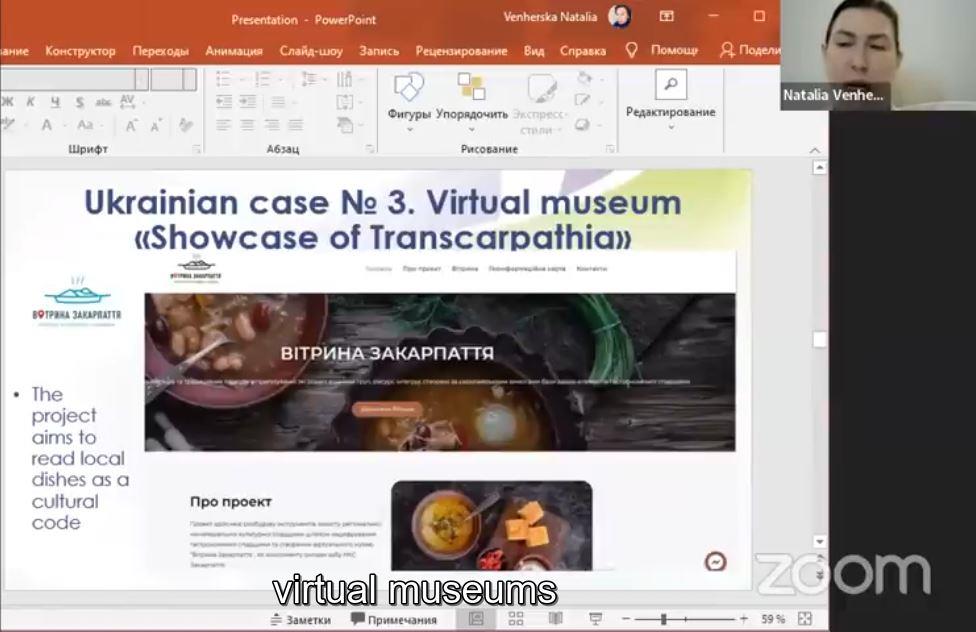
In order to preserve the ritual cooking traditions of different ethnic groups, the resource integrates a database of elements of the gastronomic heritage created according to European requirements, and on their basis, three records on elements of the intangible cultural heritage of the Zakarpattia and Odessa regions have been developed.
Multicultural Zakarpattia has its own culinary symbols and broadcasting the rich palette of gastronomic heritage should not be limited to well-known foods, but some "pop" foods. In the modern study of gastronomic heritage, our project, supported by the Cultural Foundation of Ukraine, aims to read local dishes as cultural codes belonging to certain places and ethnic groups, and to present them to the general public.
The above material was presented by a presenter from Ukraine in an international webinar held by STEKOM University in collaboration with Universities from Mexico, Ukraine, Ethiopia and various other parties. The title of the presentation brought by the presenter from Mexico was "Get to know the beauty of diverse cultures between countries". The presenter's name is Natalia Venherska who is an academic with the academic position of associate professor and PhD academic degree in the field of economics at the Zaporizhzhia National University's national economics department.
This international webinar activity is part of the implementation of STEKOM University's commitment to increase various international activities. This was done in order to realize the vision to become an international-class university. Various international activities carried out by STEKOM University continue from year to year. There are international activities that are sustainable and there are also some international activities that are not sustainable. All types of international activities are accommodated and regulated by the International department of STEKOM University.
International Webinar 2022 - Get to know the beauty of diverse cultures between countries – Part 9
International Webinar
Back to News
International Webinar
Wednesday, January 25, 2023
Priyadi, S.Kom, M.Kom
0 Views