
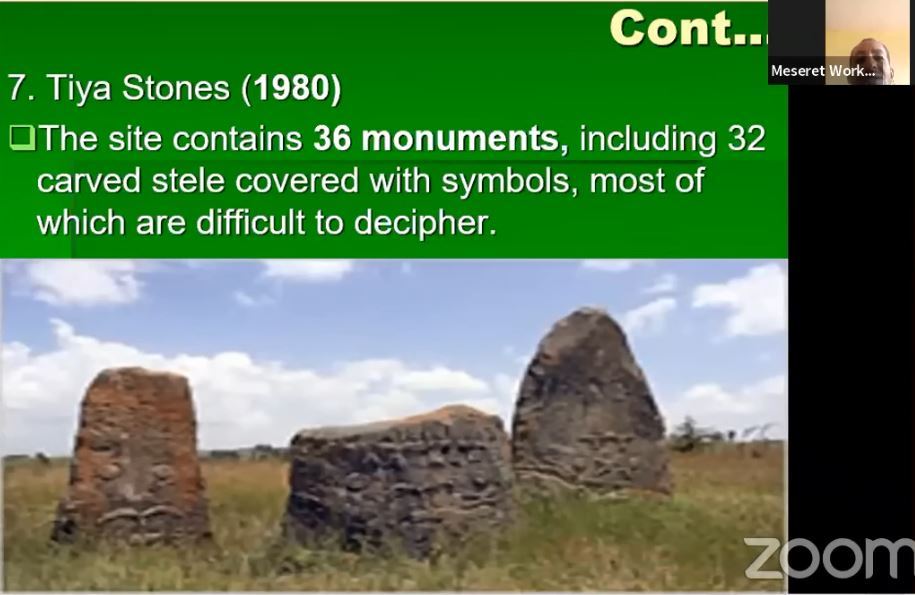
Next, Mr. Meseret explained about the tiya stone. Tiya is an archaeological site in central Ethiopia. It is located in Soddo Wearda, in the South Gurage Zone of the Nation, Nationality, and People's Territory south of Addis Ababa. This place is notable for its archaeological site, its massive stone pillars, many of which have some form of decoration. This archaeological site was designated as a World Heritage Site in 1980, due to the uniqueness of this monolithic monument.
The above material was presented at an international webinar held by STEKOM UNIVERSITAS on August 18 2022 by an academic from Debre Tabor University, Ethiopia. The academic's name is Meseret Worku who is a lecturer in the department of history and cultural heritage management. The title of the presentation delivered by Mr. Meseret was "Survey of tangible cultural of Ethiopia". The explanation starts with a fight, then continues with an explanation of the definition of inheritance, and so on.
This activity is part of the implementation of STEKOM University's commitment to increase various international activities in order to realize the vision to become an international-class university. Various international activities carried out by STEKOM University continue from year to year. There are international activities that are sustainable and there are also some international activities that are not sustainable. All types of activities are accommodated internationally and regulated by the International department of STEKOM University.
According to Joussaume (1995), who led the archaeological work at Tiya, this site is relatively new. It dates from the time period between the 11th and 13th centuries AD. Later dating places the stela's construction between the 10th and 15th centuries AD. However, megalith construction in Ethiopia is a very ancient tradition, with many such monuments dating back to BC.
The menhirs or inscriptions at the site, "32 of which are engraved with mysterious symbols, especially swords", most likely mark a large prehistoric burial complex. A German ethnographic expedition had visited the site in April 1935, and within an hour's drive south of the caravan camp, a stone monolith with the symbol of a sword was discovered, which had been seen previously by Neuville and Pere Azais.
Surface finds at Tiya contain a selection of Middle Stone Age (MSA) tools that are technologically similar to tools found at Gademotta and Kulkuletti. Due to a unique production process that uses what is called a "tranchet punch", Tiya's tools may also have the same lifespan as the other two locations. In addition, the archaeological ruins at Tiya have yielded tombs.
Tiya is one of nine megalithic pillar sites in the Gurage Zone. In 1997, 118 inscriptions were reported in the area. Along with inscriptions in the Hadiya Zone, the building is identified by locals as Yegragn Dingay or "Stone of the Gran", referring to Imam Ahmad ibn Ibrahim al-Ghazi (Ahmad "Gurey" or "Gran"), the ruler of the Adal Sultanate.
The Gurage stela is of three types: anthropomorphic stela with human figures, phallic stela and stela of neither anthropomorphic nor phallic type. The anthropomorphic and non-anthropomorphic/non-phallic stela types are flat, being the only stela with this shape in the southern region. Most of these steles, including the 46 at Tiya, which is the largest, also have a distinctive and elaborate decoration. Among the designs are a sword, a plant symbol, and a human figure standing with akimbo arms. Herb and sword emblems can be found on the same inscription. The sword design is reportedly of the local "Galla" type, as made by the Oromo. In addition, the Tiya stone slabs also often display a T-shaped symbol.
The inscriptions at Tiya and other areas of central Ethiopia are similar to those on the route between the Djibouti cities of Djibouti and Loyada. In the latter area there are a number of anthropomorphic and phallic inscriptions, which are associated with rectangular graves flanked by vertical slabs. The Djibouti-Loyada inscriptions are of uncertain age, and some of them are decorated with a similar T-shaped coat of arms.
International webinar 2022 – Implementation of local culture in modern technology part 10.
International Webinar
Back to News
International Webinar
Wednesday, November 23, 2022
Priyadi, S.Kom, M.Kom
0 Views