
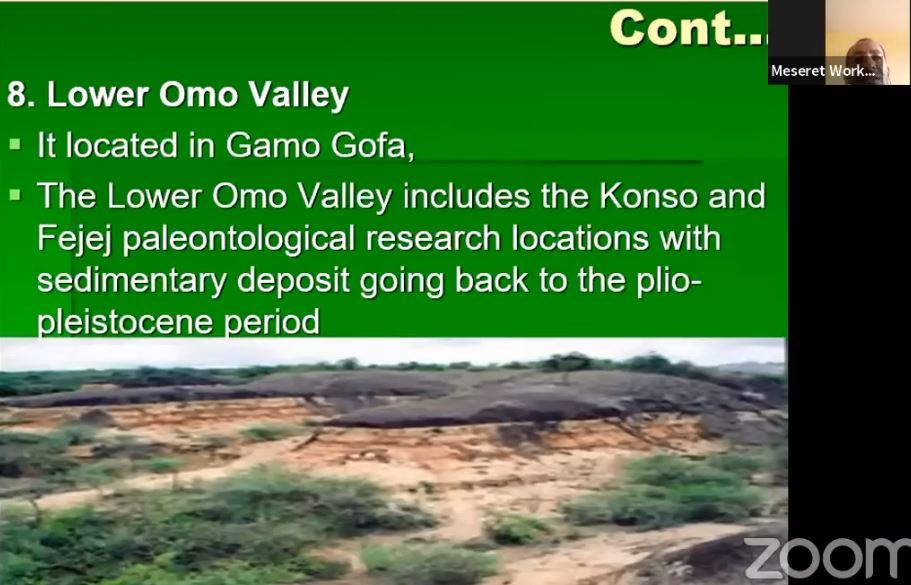
Next, Mr. Meseret explained about the Lower Omo Valley. The Lower Omo Valley is a prehistoric site near Lake Turkana, the lower Omo valley is famous worldwide. The discovery of many fossils there, especially Homo gracilis, is of great importance in studying human evolution.
The above material was presented at an international webinar held by STEKOM UNIVERSITAS on August 18 2022 by an academic from Debre Tabor University, Ethiopia. The academic's name is Meseret Worku who is a lecturer in the department of history and cultural heritage management. The title of the presentation delivered by Mr. Meseret was "Survey of tangible cultural of Ethiopia". The explanation starts with a fight, then continues with an explanation of the definition of inheritance, and so on.
This activity is part of the implementation of STEKOM University's commitment to increase various international activities in order to realize the vision to become an international-class university. Various international activities carried out by STEKOM University continue from year to year. There are international activities that are sustainable and there are also some international activities that are not sustainable. All types of activities are accommodated internationally and regulated by the International department of STEKOM University.
The Lower Omo Valley is located in southwest Ethiopia. The area reaches 165 km2. The old sedimentary deposits in the Lower Omo Valley are now world famous for the discovery of many hominid fossils, which are of great importance in the study of human evolution.
The Lower Omo Valley includes the Konso and Fejej paleontological study sites with sedimentary deposits dating from the Plio-Pleistocene period. This has produced many hominid and animal fossils, including Australopithecus fragments. The deposition of human vertebrate fauna, and paleo-environmental evolution, shed light on the early stages of the origin and development of Homo sapiens in Africa. The discovery of ancient stone tools on a scavenger hunt also offers the oldest known evidence of technical activity from a prehistoric creature, making the property one of the most significant to mankind.
To confirm Omo's position as the benchmark against which all other ancient deposits in East Africa are measured, the examined evidence from the site has established bio-stratigraphic, radiometric, and magneto-stratigraphic scales spanning between one and 3.5 million years.
Since 1966, scientific research has proven that the site significantly contributes to leading archaeological, geological, paleo-anthropological, and paleo-environmental studies.
Criterion (iii): Evidence from prehistoric sites and paleo-anthropology of the Lower Omo Valley has provided unique insight into the oldest known technical activity by prehistoric creatures.
Criterion (iv): The discoveries from the Lower Omo Valley demonstrate an extraordinary development in the realm of cultural activity in prehistoric times.
Boundary properties are not adequately defined and such definitions need to be undertaken to ensure all locations that might contribute to an Extraordinary Universal Value are included. The wider context and setting also need to be managed and protected.
Due to its extremely remote location, the Omo Valley is a uniquely preserved site for scientific research purposes. While no development activity is expected in the near future, it is vulnerable to the work of other oil and plantation companies operating in the vicinity, and is at risk of looting.
The site where the discovery was made remains intact, as does the context. Overall the areas that might provide further evidence of early humans were left undisturbed.
Protection and management requirements. The property was placed under the protection of the Antiquities Administration in 1969 through the National Act 1968.
No specific legal framework was provided to protect the Lower Omo Valley, except for a general law, Proclamation No. 209/2000, which establishes the Agency for Research and Preservation of Cultural Heritage as the responsible agency. Currently the Zone and Regional Information and Culture Offices carry out management functions.
Management plans have not been established and, due to extreme geographic difficulties, no attempt has been made to define the property boundaries or their buffer zones. Recently property protection has become a concern because there has been development activity around the area. Hence there is an urgent need to put in place a structured management and to define its boundaries.
International research expeditions are still working on the property, as an extension of research activities begun in 1976. It was recommended in 1996 that surveys should be carried out on the current state of the deposits to record any changes caused by erosion and this still needs to be done.
There are an unknown number of travelers living in the vicinity of the Omo Valley who occasionally traverse the property, raising fears of the possibility of occasional damage. A new bridge is scheduled to be built in the near future, 104 km from the valley, and this will bring both benefits and threats to the property that needs to be managed.
The above material was presented at an international webinar held by STEKOM UNIVERSITAS on August 18 2022 by an academic from Debre Tabor University, Ethiopia. The academic's name is Meseret Worku who is a lecturer in the department of history and cultural heritage management. The title of the presentation delivered by Mr. Meseret was "Survey of tangible cultural of Ethiopia". The explanation starts with a fight, then continues with an explanation of the definition of inheritance, and so on.
This activity is part of the implementation of STEKOM University's commitment to increase various international activities in order to realize the vision to become an international-class university. Various international activities carried out by STEKOM University continue from year to year. There are international activities that are sustainable and there are also some international activities that are not sustainable. All types of activities are accommodated internationally and regulated by the International department of STEKOM University.
The Lower Omo Valley is located in southwest Ethiopia. The area reaches 165 km2. The old sedimentary deposits in the Lower Omo Valley are now world famous for the discovery of many hominid fossils, which are of great importance in the study of human evolution.
The Lower Omo Valley includes the Konso and Fejej paleontological study sites with sedimentary deposits dating from the Plio-Pleistocene period. This has produced many hominid and animal fossils, including Australopithecus fragments. The deposition of human vertebrate fauna, and paleo-environmental evolution, shed light on the early stages of the origin and development of Homo sapiens in Africa. The discovery of ancient stone tools on a scavenger hunt also offers the oldest known evidence of technical activity from a prehistoric creature, making the property one of the most significant to mankind.
To confirm Omo's position as the benchmark against which all other ancient deposits in East Africa are measured, the examined evidence from the site has established bio-stratigraphic, radiometric, and magneto-stratigraphic scales spanning between one and 3.5 million years.
Since 1966, scientific research has proven that the site significantly contributes to leading archaeological, geological, paleo-anthropological, and paleo-environmental studies.
Criterion (iii): Evidence from prehistoric sites and paleo-anthropology of the Lower Omo Valley has provided unique insight into the oldest known technical activity by prehistoric creatures.
Criterion (iv): The discoveries from the Lower Omo Valley demonstrate an extraordinary development in the realm of cultural activity in prehistoric times.
Boundary properties are not adequately defined and such definitions need to be undertaken to ensure all locations that might contribute to an Extraordinary Universal Value are included. The wider context and setting also need to be managed and protected.
Due to its extremely remote location, the Omo Valley is a uniquely preserved site for scientific research purposes. While no development activity is expected in the near future, it is vulnerable to the work of other oil and plantation companies operating in the vicinity, and is at risk of looting.
The site where the discovery was made remains intact, as does the context. Overall the areas that might provide further evidence of early humans were left undisturbed.
Protection and management requirements. The property was placed under the protection of the Antiquities Administration in 1969 through the National Act 1968.
No specific legal framework was provided to protect the Lower Omo Valley, except for a general law, Proclamation No. 209/2000, which establishes the Agency for Research and Preservation of Cultural Heritage as the responsible agency. Currently the Zone and Regional Information and Culture Offices carry out management functions.
Management plans have not been established and, due to extreme geographic difficulties, no attempt has been made to define the property boundaries or their buffer zones. Recently property protection has become a concern because there has been development activity around the area. Hence there is an urgent need to put in place a structured management and to define its boundaries.
International research expeditions are still working on the property, as an extension of research activities begun in 1976. It was recommended in 1996 that surveys should be carried out on the current state of the deposits to record any changes caused by erosion and this still needs to be done.
There are an unknown number of travelers living in the vicinity of the Omo Valley who occasionally traverse the property, raising fears of the possibility of occasional damage. A new bridge is scheduled to be built in the near future, 104 km from the valley, and this will bring both benefits and threats to the property that needs to be managed.