
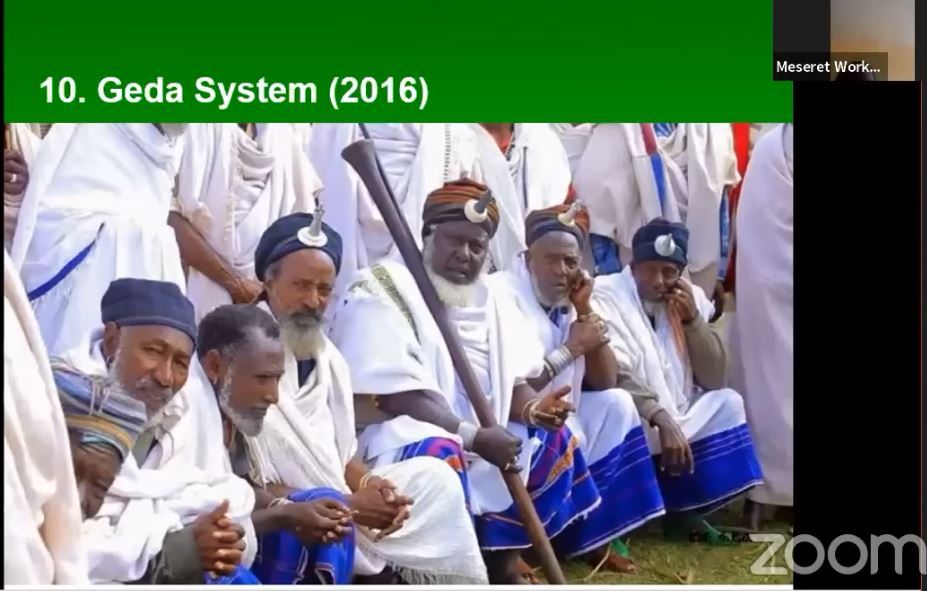
Next, Mr. Meseret explained about Geda or Gadaa in the Oromo spelling. Gadaa is an indigenous democratic system of government used by the Oromo in Ethiopia and northern Kenya. It is also practiced by the Konso and Gedeo people in southern Ethiopia. The system regulates the political, economic, social and religious activities of the community.
Under Gadaa, every eight years, the Oromo would elect by consensus nine leaders known as the Salgan ya'ii Borana (nine assemblies of Borana). A leader elected by mace stays in power for only 8 years, with elections taking place at the end of those 8 years. Whenever an Abbaa Gadaa dies while performing his function, the bokkuu (a symbol of power) is given to his wife and she guards the bokkuu and proclaims the law.
The Gada system has been inscribed by UNESCO as an Intangible Cultural Heritage since 2016. It was the brainchild of the Oromo from the Madda Walabu district in Oromia. The Oromo people regard this system as their common heritage and as a major part of their cultural identity. This is the system the Oromo people have used to democratically govern themselves for centuries.
The Oromo ruled themselves according to the Gadaa system long before the 16th century, when a three-party war began between them and the Christian kingdoms to the north and the Islamic sultanates to their east and south. As a result the Oromo absorbed Christianity and Islam. Borana and Guji groups near the Ethiopian-Kenyan border can practice Gadaa without interference. In the state of Oromia under the Ethiopian Federal system, the Gadaa system begins a renaissance across Oromia. In 2015, the Gadaa Center in Odaa Bultum was inaugurated and in 2018, the Gadaa Center in Odaa Hullee was re-established after two centuries of interruption. In 2019, Bule Hora University launched a master's program in Gadaa studies.
The above material was presented at an international webinar held by STEKOM UNIVERSITY on August 18 2022 by an academic from Debre Tabor University, Ethiopia. The academic's name is Meseret Worku who is a lecturer in the department of history and cultural heritage management. The title of the presentation delivered by Mr. Meseret was "Survey of tangible cultural of Ethiopia". The explanation starts with an introduction, then continues with an explanation of the definition of heritage, and so on.
This activity is part of the implementation of STEKOM University's commitment to increase various international activities in order to realize the vision to become an international-class university. Various international activities carried out by STEKOM University continue from year to year. There are international activities that are sustainable and there are also some international activities that are not sustainable. All types of international activities are accommodated and regulated by the International department of STEKOM University.
The characteristics of the Gadaa community are arranged in peer groups based on chronological age or genealogical generation which are called Luba. Each luba consists of all the boys in the other specified class. The entire class progresses through eleven different classes, each based on an eight year cycle, and each with its own set of rights and responsibilities. There is also Baallii which is the process of transferring power from one Gadaa party to the next.
Regarding parties, there are five Gadaa parties known as the Gadaa Oromoo shanan. These parties follow the five world views of the Oromo people. The five Gadaa parties were in order in power. A party comes to power once every forty years. Therefore, there will be no direct competition between the five Gadaa parties, but competition between individuals within one party. Gadaa's five parties have different names namely Boorana, Maccaa-Tuulama, Arsii, Gujii and Ituu-Humbannaa.
A number of scholars have studied Gadaa. Legesse has written that Gadaa is "one of the most astonishing and instructive changes in the evolution of human society". In addition to his PhD dissertation at Harvard, Legesse has published a book positioning Gadaa as an African democracy that can provide information to constitutional thinkers. The late Donald Levine said that Gadaa was "one of the most complex systems of social organization ever devised by the human imagination". For Jalata, Gadaa represents the "totality of the Oromo civilization".
Primarily, the Gadaa system is an ancient philosophy of socio-political system responsible for governing political stability, economic growth, social services, cultural commitments, ethical contracts of the religious order of the Oromo people and the practice of Gadaa Democracy which requires equal participation of both men and women. . This is debatable academically as Oromo women have no influence throughout the ages of Gadaa decisions or the clan's leadership structure, but the wives of Abbaa Gadaa appointees are treated the same as Abbaa Gadaa herself. Siinqee feminists represent women in the mace system.
Given Gadaa's symbolic significance for the Oromo, as well as its structural innovation, legal, indigenous studies, and pan-African researchers are exploring how the system might be used in the 21st century. For example, a thesis by Z. Sirna titled "Ethiopia: When the Gadaa Democracy Rules in a Federal State" explores how the system can be integrated with contemporary Ethiopian federal structures, serving as a governance mechanism for the Oromia Regional. National Country. Sirna has analyzed the Gadaa system in relation to the form of deliberative political participation used in the Western context. He concluded that the Gadaa system's 'consensus through dialogue' technique was unique but firmly rooted in Western democratic norms, and thus suitable for adoption in Ethiopia's federally structured democracy. A political party known as GSAP (Gadaa System Advancement Party) bases its ideology on Gadaa principles. A futuristic governance 2.0 project called BitGadaa draws inspiration from the principles and structure of Gadaa.
International webinar 2022 – Implementation of local culture in modern technology part 12.
International Webinar
Back to News
International Webinar
Wednesday, November 23, 2022
Priyadi, S.Kom, M.Kom
0 Views