
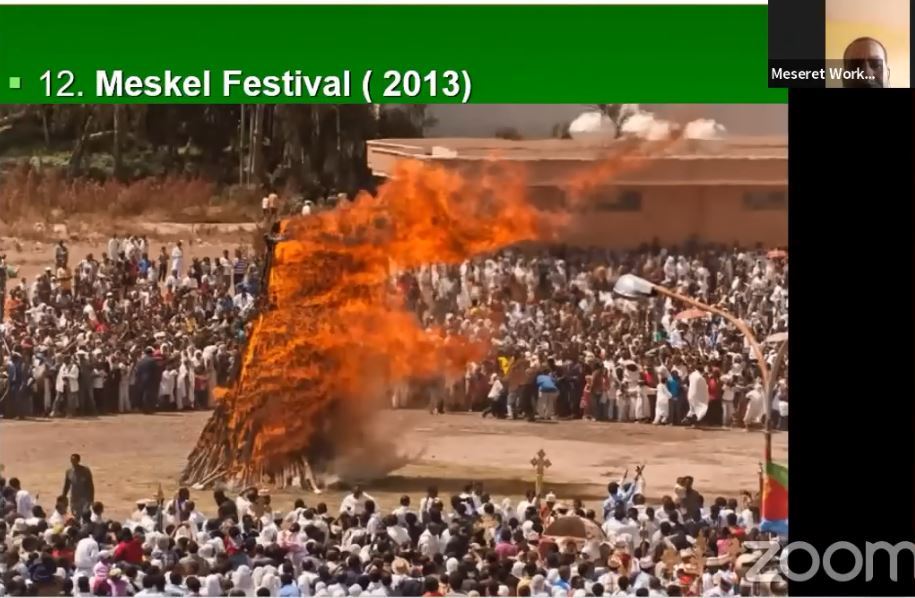
Next, Mr. Meseret explained about the tradition of the meskel
festival. Ethiopians have celebrated the annual festival of Meskel
(which means "cross" in Amharic), marking the discovery of
the "true cross" on which Jesus Christ was supposed to be
crucified. The festival is one of the major religious celebrations of
the Orthodox Church in the Horn of Africa country. The main national
feast - which falls on September 27 or 28 - is held in Meskel Square
in the capital city of Addis Abba.
The above
material was presented at an international webinar held by STEKOM
UNIVERSITAS on August 18 2022 by an academic from Debre Tabor
University, Ethiopia. The academic's name is Meseret Worku who is a
lecturer in the department of history and cultural heritage
management. The title of the presentation delivered by Mr. Meseret
was "Survey of tangible cultural of Ethiopia". The
explanation starts with a fight, then continues with an explanation
of the definition of inheritance, and so on.
This
activity is part of the implementation of STEKOM University's
commitment to increase various international activities in order to
realize the vision to become an international-class university.
Various international activities carried out by STEKOM University
continue from year to year. There are international activities that
are sustainable and there are also some international activities that
are not sustainable. All types of activities are accommodated
internationally and regulated by the International department of
STEKOM University.
Ethiopians have celebrated the
annual festival of Meskel (which means "cross" in Amharic),
marking the discovery of the "true cross" on which Jesus
Christ was supposed to be crucified. The festival is one of the major
religious celebrations of the Orthodox Church in the Horn of Africa
country. The main national feast - which falls on September 27 or 28
- is held in Meskel Square in the capital city of Addis Abba.
On
September 27, senior government officials, diplomats and Orthodox
Church leaders join in the celebration of the Damera – the lighting
of the consummation fire which signifies the speedy bringing of St.
Helena, the mother of Constantine the Great, to the place where the
cross lies. buried.
As he lit the fire of victory,
Abune Mathias, Patriarch of the Ethiopian Orthodox Church said the
Meskel (true cross) integrates people through forgiveness and love.
Many Ethiopians believe that the attainment of the summit cleanses
sins, while others think towards the immediate and the way that the
summit collapse can be used to predict the future.
Abune
Mathias condemned the Burning of the Orthodox Church in several parts
of the country and the attacks on its followers. At least 25 churches
have been burned in the past two years. While calling for peace and
unity, he lashed out at emerging divisions within the country's
Orthodox Church which refuse to link up with the recent request for a
synod by the Oromo, the country's largest ethnic group.
Takele
Umma, deputy mayor of Addis Ababa, said the government has not
abandoned the Orthodox Church and protects it as the mother of all
Ethiopians and the heritage home of the people.
An
anecdote states that in AD 326, St. Helena had started a search for
the cross, and was successful after receiving directions from a
dream. The dream led him to light a fire of excellence and follow the
stream of smoke to find where the cross was buried. Soon after, he
lit the torch to announce his success.
Orthodox
Christians in Ethiopia believe that half of the cross was given to
the Ethiopian emperor Dawit by Patriarch Alexandra as a gift to
protect members of the Coptic Church. A piece is said to be kept in
the Amba Gashen Mountains.
The festival identifies
the family and promotes reconciliation, social cohesion and peaceful
coexistence. According to reports, the feast has been celebrated in
its present form for over 600 years and in other forms since the 13th
century.
In 2013, the United Nations Educational,
Scientific and Cultural Organization inscribed the festival on the
Representative List of the Intangible Cultural Heritage of Humanity.
International webinar 2022 – Implementation of local culture in modern technology part 14.
International Webinar
Back to News
International Webinar
Sunday, November 27, 2022
Priyadi, S.Kom, M.Kom
0 Views