
At an international webinar held by STEKOM UNIVERSITY on August 18, 2022, an academic from the United States gave a presentation on "technology in gastronomic tourism". The academic's name is Elva Saldana Alvarez. Continuing the previous article, Ms. Elva then explained about the Mexican mole. Mole is a general name for several types of sauce used in Mexico. In English, the word Mole refers to a certain sauce which is actually better known as mole poblano in Spanish. Those who are familiar with Mexican cuisine will surely know the name guacamole (avocado mole).
This activity is part of the implementation of STEKOM University's commitment to increase various international activities in order to realize the vision to become an international-class university. Various international activities carried out by STEKOM University continue from year to year. There are international activities that are sustainable and there are also some international activities that are not sustainable. All types of activities are accommodated internationally and regulated by the International department of STEKOM University.
In Mexico, the term mole is used for a number of sauces, some of which are quite different from each other. The most popular types come from the Mexican states of Puebla and Oaxaca. In San Pedro Atocpan, located in the Milpa Alta federal county of Mexico, a southern suburb of Mexico City, there is the annual Mole National Fair.
Mole poblano, named after the Mexican state of Puebla, is a popular sauce in Mexican cuisine. Mole poblano is prepared with chilies, spices, unsweetened cocoa and other ingredients. There are many stories about its discovery, but none of them are official.
One of the more popular types of dish is Mole Poblano de Guajolote or Turkey with Mole. Mole is often used to prepare chicken enchilada-type dishes or cheese fillings; often spooned and poured over chicken, rice or potatoes. The recipe was created by nuns at the behest of Santa Rosa to give the impression of visiting political and church officials in Mexico in the 17th century.
Ready-to-use mole can be purchased at a store or supermarket. Ready-to-use mole is usually in the form of powder or paste with various colors, greenish black or yellow depending on the material used. In the modern era, Mole is sold in the form of cans, jars, cubes which can be dissolved in water or broth.
Mole comes from the Nahutl word mulli, which means "sauce", "mixture", "concoction", "stew". In the English accent, the form of the word molé, states that the pronunciation of the ending e is different from the word e, which has a different meaning.
Mole is one of the most representative Mexican dishes, especially for big celebrations. Ninety-nine percent of Mexicans have tried at least one type of mole. This dish enjoys its greatest popularity in central and southern Mexico, but a simpler version of Mole poblano has made its way north. However, the northern version is much more complicated and is usually used to make enchiladas.
Mole consumption is strongly associated with celebration. In Mexico, saying "go to the Mole" (ir a un Mole) means going to a wedding. Mole has a strong taste, particularly dark and is considered an acquired taste for most people. This has spawned another saying, "(estar) en su mero mole", which means something like "a cup of tea".
To promote their regional version of the sauce, a number of venues organize festivals dedicated to it. Feria Nacional del Mole (National Mole Festival) started in 1977 in San Pedro Atocpan, and is held annually in October. It starts outside the city, in the small community of Yenhuitlalpan, in May. The four restaurants there decided to take advantage of the Señor de las Misericordias (Lord of the Mercies) festival to promote their Mole. Despite their success, some people in the village dislike that they are using the religious festival for commercial purposes, so a separate Mole festival is created for the month of October. Today, 37 Mole restaurants and producers participated in the event. The most popular variety is Mole almendrado. Originally, the October version of the fair was held in the town itself, but after it became too large, it was moved to a set up fairground outside along the highway.
The city of Puebla also holds an annual Mole festival, which events are divided among the monasteries of Santa Rosa, Santa Inés and Santa Catarina. The world record for the largest Mole pot was broken at the 2005 city festival. The pot is 1.4 meters in diameter at the bottom, 1.9 meters high, and 2.5 meters in diameter at the top. Four hundred people participated in its preparation, using 800 kilos of Mole pasta, 2500 kilos of chicken, 500 kilos of tortillas and 1600 kilos of broth. The resulting food feeds 11,000 people.
The women of Santa María Magdalena in Querétaro have been known locally for their Mole for around 100 years. In 1993, they decided to hold the best Mole contest. This was the start of the Feria del Mole y Tortilla (Festival of Mole and Tortilla) which has been held every year since then. It still features Mole cooks and attracts hundreds of diners from the state. The Coatepec de Morelos community in the municipality of Zitácuaro, Michoacán, holds its annual Feria de Mole in April.
Mole has become a popular ready-to-eat product and is widely available in the United States. Several brands of Mole paste are available in the United States and can be found online. Chicago has an annual Mole festival for Mexican immigrants at the Universidad Popular community center. The event is a cooking contest, which has over 40 participants, with the winner receiving US$500.
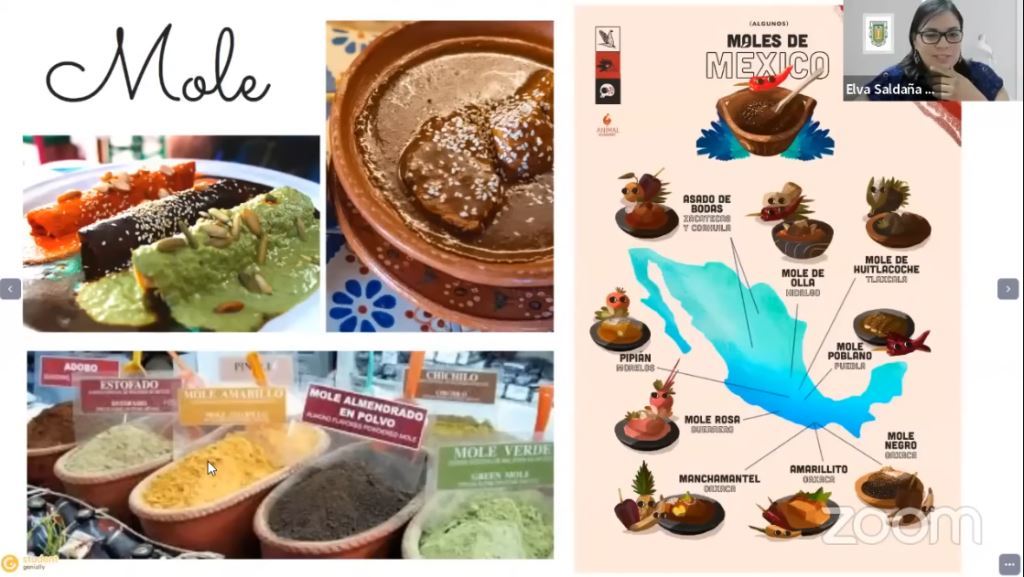
International webinar 2022 – Implementation of local culture in modern technology part 2.
International Webinar
Back to News
International Webinar
Monday, November 21, 2022
Priyadi, S.Kom, M.Kom
0 Views