
At an international webinar held by STEKOM UNIVERSITY on August 18, 2022, an academic from America gave a presentation on "technology in gastronomic tourism". The academic's name is Elva Saldana Alvarez. Continuing the previous article, Ms. Elva then explained about the virtual tour and augmented reality mexico city. Augmented reality is largely synonymous with mixed reality. There is also overlap in terminology with extended reality and computer mediated reality.
This activity is part of the implementation of STEKOM University's commitment to increase various international activities in order to realize the vision to become an international-class university. Various international activities carried out by STEKOM University continue from year to year. There are international activities that are sustainable and there are also some international activities that are not sustainable. All types of activities are accommodated internationally and regulated by the International department of STEKOM University.
Augmented reality (AR) is an interactive experience that combines the real world and computer generated content. Such content can span multiple sensory modalities, including visual, auditory, haptic, somatosensory, and olfactory. AR can be defined as a system that combines three basic features: the combination of real and virtual worlds, real-time interaction, and accurate 3D registration of virtual and real objects. Overlaid sensory information can be constructive (i.e. augment the natural environment), or deleterious (i.e. mask the natural environment). These experiences are so seamlessly intertwined with the physical world that they are perceived as immersive aspects of real environments. In this way, augmented reality changes one's perception of the real world environment, whereas virtual reality completely replaces the user's real world environment with a simulated one.
The main value of augmented reality is the way in which the components of the digital world blend into one's perception of the real world, not as a simple display of data, but through the integration of immersive sensations, which are perceived as natural parts of an environment. The earliest functional AR systems providing immersive mixed reality experiences for users were found in the early 1990s, starting with the Virtual Gear system developed at the U.S. Air Force's Armstrong Laboratory. in 1992. The first commercial augmented reality experience was introduced in the entertainment and gaming business. Furthermore, augmented reality applications have spanned commercial industries such as education, communications, medicine, and entertainment. In education, content can be accessed by scanning or viewing images with a mobile device or by using markerless AR techniques.
Augmented reality is used to enhance natural environments or situations and offer a perceptually enriched experience. With the help of advanced AR technologies (eg adding computer vision, incorporating AR cameras into smartphone applications and object recognition) information about the user's real world becomes interactive and digitally manipulated. Information about the environment and its objects is overlaid in the real world. This information can be virtual. Augmented Reality is any experience that is artificial and augments an existing or real reality, for example seeing other real or measurable information such as electromagnetic radio waves overlaid in exact alignment with where they actually are in outer space. Augmented reality also has a lot of potential in silently collecting and sharing knowledge. Augmentation techniques are usually performed in real time and in a semantic context with environmental elements. Immersive perceptual information is sometimes combined with additional information such as scores via live video feeds of sporting events. It combines the benefits of augmented reality technology and head up display (HUD) technology.
In virtual reality (VR), the user's perception of reality is completely based on virtual information. In augmented reality (AR), users are provided with additional computer-generated information in data collected from real life that enhances their perception of reality. For example, in architecture, VR can be used to create a walk-through simulation of the inside of a new building; and AR can be used to show structures and building systems that are heavily imposed on real-life views. Another example is through the use of utility applications. Some AR applications, such as Augment, allow users to embed digital objects into real environments, allowing businesses to use augmented reality devices as a way to preview their products in the real world. Similarly, it can also be used to demonstrate what a product will look like in an environment for customers, as demonstrated by companies such as Mountain Equipment Co-op or Lowe's who are using augmented reality to let customers preview what their product will look like at home. through the use of 3D models.
Augmented reality (AR) differs from virtual reality (VR) in the sense that in AR part of the surrounding environment is 'real' and simply adds a layer of virtual objects to the real environment. On the other hand, in VR the surroundings are completely virtual and computer generated. Demonstrations of how AR overlays objects onto the real world can be seen with augmented reality games. WallaMe is an augmented reality game application that allows users to hide messages in a real environment, leveraging geolocation technology to allow users to hide messages wherever they want in the world. Such apps have many uses around the world, including in activism and artistic expression.
Virtual and augmented reality tour services are available about Mexico City. Tourists travel virtually to interesting spots in Mexico. There are many interesting things in Mexico City that can be visited through this virtual visit.
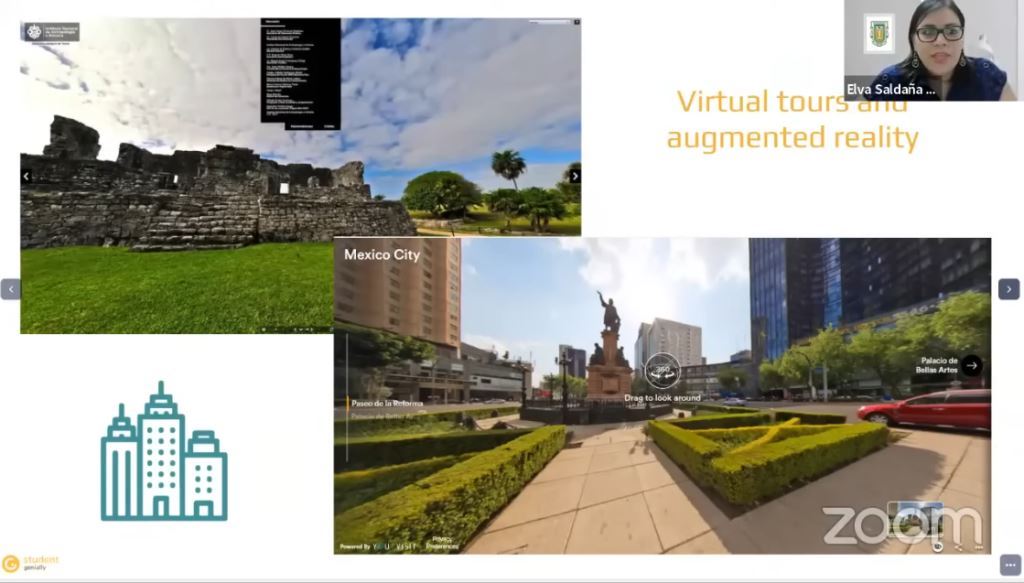
International webinar 2022 – Implementation of local culture in modern technology part 4.
International Webinar
Back to News
International Webinar
Monday, November 21, 2022
Priyadi, S.Kom, M.Kom
0 Views