
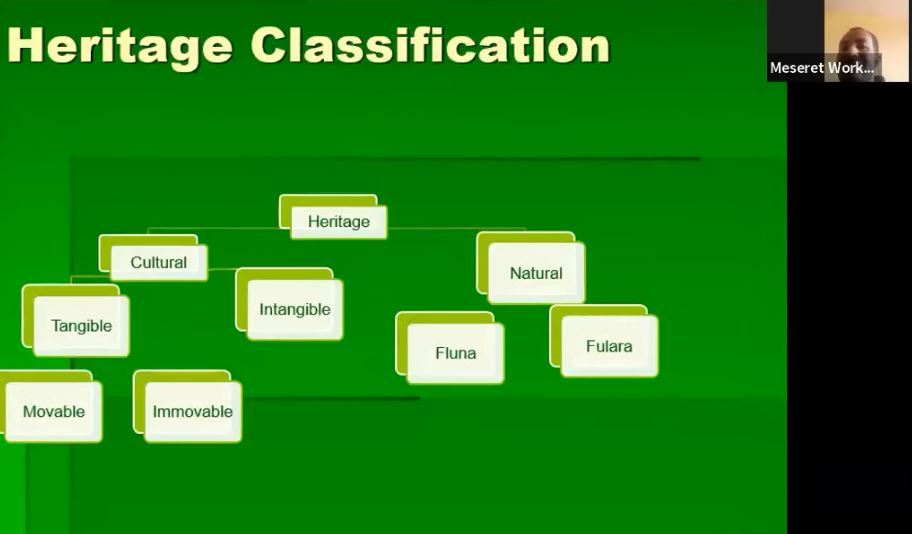
At an international webinar held by STEKOM UNIVERSITY on August 18 2022, an academic from Debre Tabor University, Ethiopia. The academic's name is Meseret Worku who is a lecturer in the department of history and cultural heritage management. The title of the presentation delivered by Mr. Meseret was "Survey of tangible cultural of Ethiopia". The explanation starts with an introduction, then continues with an explanation of the definition of heritage, and so on.
This activity is part of the implementation of STEKOM University's commitment to increase various international activities in order to realize the vision to become an international-class university. Various international activities carried out by STEKOM University continue from year to year. There are international activities that are sustainable and there are also some international activities that are not sustainable. All types of international activities are accommodated and regulated by the International department of STEKOM University.
In explaining the cultural heritage, Mr. Meseret referred to several sources. One of the sources referred to is the definition of cultural heritage from UNESCO. Heritage is the cultural heritage that we received from the past, which we live in the present and which we will pass on to future generations. With the 1972 Convention on the Protection of the World Cultural and Natural Heritage, UNESCO determined that certain places on Earth are of "outstanding universal value" and are included in the common heritage of mankind, such as the Serengeti Forest in East Africa, the Egyptian Pyramids, the Great Barrier Reef in Australia and Baroque cathedrals in Latin America.
However, cultural heritage is not limited to monuments and collections of objects. It also consists of living expressions inherited from our ancestors, such as oral traditions, performing arts, social manners, rituals, festive events, knowledge and practices related to nature and the universe, and knowledge and techniques related to traditional crafts. Despite its fragility, the intangible cultural heritage or living heritage is an important factor in maintaining cultural diversity.
For UNESCO Santiago, the notion of heritage is important for culture and the future because it represents the "cultural potential" of contemporary society, contributes to the continuous reassessment of culture and identity and is an important vehicle for the transmission of experience, skills and knowledge. between generations. Furthermore, heritage is a source of inspiration for creativity and innovation that produces contemporary and future cultural products. Cultural heritage has the potential to promote access to and enjoyment of cultural diversity. It can also enrich social capital and create a sense of individual and collective ownership, which helps maintain social and territorial cohesion. On the other hand, cultural heritage has become economically significant for the tourism sector in many countries. This also poses new challenges for its conservation.
Apart from that, in his explanation, Mr. Meseret also referred to Proclamation 209/2000 concerning the Preservation of Cultural Heritage in the country of Ethiopia. The contents are more or less like this:
WHEREAS, Cultural heritage is a trace of centuries-old ways of life, labor and creativity of peoples;
WHEREAS, Cultural Heritage is an indispensable source of information for the purposes of study and research on the origin and evolution of humans and other life forms and thus for a better understanding of nature and the environment.
THAT, Cultural Conservation makes a major and universal contribution to the development of science and to the whole of human knowledge in general.
WHEREAS, Ethiopia, a nation-state, nation-state and people with its own history and culture, through its long history has acquired many cultural heritages including those that have been registered in the World Cultural Heritage List;
WHEREAS, cultural heritage plays a major role in enabling the next generation to acquire a deep and broad awareness of their culture and history, which is an expression of their identity, so that the protection and preservation of cultural heritage has become the responsibility of every citizen. , Public,
WHEREAS, it becomes necessary to devise ways and means for the full protection and preservation of cultural heritage and to ensure that research on Cultural Conservation at all stages is carried out in a manner that is in line with national interests and the rights of the people;
International webinar 2022 – Implementation of local culture in modern technology part 5.
International Webinar
Back to News
International Webinar
Tuesday, November 22, 2022
Priyadi, S.Kom, M.Kom
0 Views