
At an international webinar held by STEKOM UNIVERSITY on August 18 2022, an academic from Debre Tabor University, Ethiopia. The academic's name is Meseret Worku who is a lecturer in the department of history and cultural heritage management. The title of the presentation delivered by Mr. Meseret was "Survey of tangible cultural of Ethiopia". The explanation starts with a fight, then continues with an explanation of the definition of inheritance, and so on.
This activity is part of the implementation of STEKOM University's commitment to increase various international activities in order to realize the vision to become an international-class university. Various international activities carried out by STEKOM University continue from year to year. There are international activities that are sustainable and there are also some international activities that are not sustainable. All types of activities are accommodated internationally and regulated by the International department of STEKOM University.
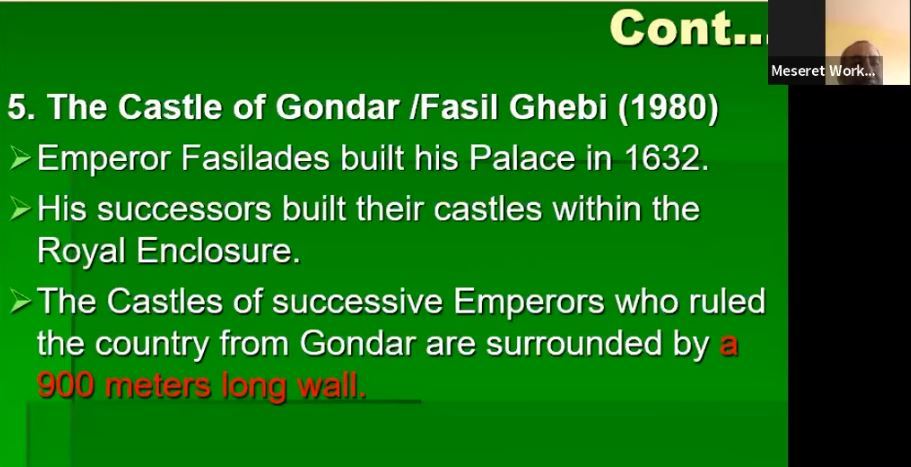
Next, Mr. Meseret explained about the cultural heritage in the Ethiopian Gondar Castle or Ghebi Fasil. Fasil Ghebbi is a fort located in Gondar, Amhara Region, Ethiopia. It was founded in the 17th century by Emperor Fasilides and was the home of the Ethiopian emperors. Its unique architecture shows diverse influences including Nubian, Indian, Arabic and Baroque characteristics. Due to its historical and architectural importance, the fort was inscribed as a UNESCO World Heritage Site in 1979. Ghebbi is the Amharic word for compound or enclosure.
The complex of buildings includes the Fasilides castle, the palace of Iyasu I, the Hall of Dawit III, the castle of Empress Mentewab, the chancellery and library of Yohannes I, the banquet hall of the emperor Bakaffa, stables, and three churches: Asasame Qeddus Mikael, Elfign Giyorgis and Gemjabet Mariyam.
Fasil Ghebbi's origins can be found in a long tradition of Ethiopian emperors traveling around their possessions, subsisting on farmers' produce and living in tents. Reflecting this connection, the precinct is often referred to as a katama ("encampment" or "fortified settlement") or makkababya, the name used for the imperial camp in the Royal Chronicle of Baeda Maryam.
Emperor Fasilides broke with the tradition of advancing through this region, and established the city of Gondar as his capital; its relative permanence makes the city of historical importance. Within the city, he ordered the construction of a magnificent building, the Fasil Jewel or Fasilides castle. The area around Fasil's Gem was bounded by a wall with many gates. Subsequent emperors built their own structures, many of which survive either wholly or partly today. Visiting Ghebbi's Fasil in the late 1950s, Thomas Pakenham observed that "dotted between the palaces are the remains of the pavilions and stalls of the imperial city". The original building was influenced by Nubian, Arab and Indian architectural designs, with the Baroque architectural style being later introduced by the Jesuit Missionaries.
Most of the buildings in Fasil Ghebbi did not survive the events of that time, but the place is still rich in buildings renovated both by Italian colonists in the late 1930s and after Ethiopia regained independence. The site was declared a World Heritage Site by UNESCO in 1979, which stated in its ruling that it faithfully represents the modern Ethiopian civilization north of Lake Tana which emerged in the early 17th century and influenced Ethiopian architecture over the years. The Ghebbi Fasil also includes the Fasilides Baths, a construction also associated with Emperor Fasilides, and the Empress Mantawab Imperial Complex in Kuskam, which is considered one of the country's most important tourist destinations.
The Ghebbi Fasil covers an area of approximately 70,000 square meters. To the south of it lies Adababay, the market of Gondar, where imperial proclamations were made, troops were presented, and criminals were executed; currently a city park.
Dawit Hall is in the northern part of the enclosure, adjacent to the Bakaffa building and the Asasame Qeddus Mikael church. Often referred to as the "House of Song", Munro-Hay notes that this may be due to misreading the Amharic zofan bet ("House of the Divan" or "House of the Throne") as the zafan bet ("House of the Song"). Munro-Hay described it as "a large one-story building with a round tower in the southeast corner", with a smaller round tower in the northeast corner and a square tower in the northwest corner "largely collapsed." The interior of the building is one long hall, to which "ordinary arched windows and doors provide light and access". As of 2002, Dawit's Hall is roofless.
The Ghebbi Fasil is surrounded by a 900 meter long curtain wall penetrated by twelve gates. These are, in counter-clockwise order: Fit Ber (also called Jan Tekle Ber) opens into Adababay; Wember Ber (Judge's Gate); Tazkaro Ber (Funeral Memorial Gate), whose bridge was destroyed by fighting during the reign of Iyasu II; Azaj Tequre Ber (Gate of Azaj Tequre), which was once connected by a bridge to the Adababay Tekle Haymanot church; Adenager Ber (Spinner's Gate), which is connected by a bridge to the Qeddus Raphael church in the weavers' section of Gondar; Qwali Ber (Gate of the Queen's Servants), next to the modern entrance to Elfin Giyorgis church in the Stables; Imbilta Ber (Gate of the Musicians); Elfign Ber (Gate of the Chamber of Secrets), which gives access to Fasil Ghebbi's private apartment; Balderas Ber (Cavalry Commander's Gate); Ras Ber (Gate of Ras), also known as Qwarenyoch Ber (Gate of the Qwara people); Ergeb Ber (Dove Gate), also known as Kechin Ashawa Ber (Gate of Gifts); Inqoye Ber (Gate of Princess Inqoye, mother of Empress Mentewab; and Gimjabet Mariyam Ber (Gate of the Treasury of Mary), which leads to the churchyard of Gimjabet Mariyam church.
International webinar 2022 – Implementation of local culture in modern technology part 8.
International Webinar
Back to News
International Webinar
Tuesday, November 22, 2022
Priyadi, S.Kom, M.Kom
0 Views