
Nanotechnology is the use of matter at the atomic, molecular and supramolecular scales for industrial purposes. The earliest and most widespread description of nanotechnology refers to the specific technological goals of precisely manipulating atoms and molecules for the manufacture of macro-scale products, also now referred to as molecular nanotechnology. A more general description of nanotechnology was later defined by the National Nanotechnology Initiative, which defines nanotechnology as the manipulation of matter with at least one dimension from 1 to 100 nanometers (nm). This definition reflects the fact that quantum mechanical effects matter at this scale of the quantum realm, so the definition shifts from a specific technological purpose to a research category that includes all types of research and technology dealing with the special properties of matter that occur. below a given size threshold. It is therefore common to see the plural forms "nanotechnology" as well as "nanoscale technology" to refer to a wide range of research and applications whose common trait is size.
Nanotechnology as defined by size is naturally broad, including fields of science as diverse as surface science, organic chemistry, molecular biology, semiconductor physics, energy storage, engineering, microfabrication, and molecular engineering. conventional to completely new approaches based on molecular self-assembly, from developing new materials with dimensions at the nanoscale to direct control of matter at the atomic scale.
Scientists are currently debating the future implications of nanotechnology. Nanotechnology may be able to create many new materials and devices with a wide variety of applications, such as in nanomedicine, nanoelectronics, energy production of biomaterials and consumer products. On the other hand, nanotechnology poses many of the same problems as new technologies, including concerns about the toxicity and environmental impact of nanomaterials, and their potential impact on the global economy, and speculation about various doomsday scenarios. This concern has led to debate among advocacy groups and governments about whether nanotechnology-specific regulations are needed.
The concepts that nanotechnology underpinned were first discussed in 1959 by the renowned physicist Richard Feynman in his lecture There's Plenty of Room at the Bottom, in which he explained the possibility of synthesis via the direct manipulation of atoms.
The term "nano-technology" was first used by Norio Taniguchi in 1974, although little is known about it. Inspired by Feynman's concepts, K. Eric Drexler used the term "nanotechnology" in his 1986 book Engines of Creation: The Coming Era of Nanotechnology, which proposed the idea of a nanoscale "assembler" that would be able to make copies of itself and other items of arbitrary complexity. arbitrary with atomic control. Also in 1986, Drexler co-founded The Foresight Institute (which he is no longer affiliated with) to help increase public awareness and understanding of the concepts and implications of nanotechnology.
The emergence of nanotechnology as a field in the 1980s occurred through the convergence of theory and general work of Drexler, who developed and popularized a conceptual framework for nanotechnology, and high-visibility experimental advances that attracted additional broad-scale attention to the prospects of atomic control. affairs. In the 1980s, two major breakthroughs sparked the growth of nanotechnology in the modern era. First, the invention of the scanning tunneling microscope in 1981 which provided unprecedented visualization of individual atoms and bonds, and was used successfully to manipulate individual atoms in 1989. Microscope developers Gerd Binnig and Heinrich Rohrer at IBM Zurich Research Laboratory received the Nobel Prize in Physics in 1986. Binnig, Quate, and Gerber also invented the analogue atomic force microscope that year.
The above material was presented by a presenter from Bangladesh in an international webinar entitled "Prospect of Nanotechnology in Food Processing and Food Packaging" which was held by STEKOM University in collaboration with the University of Bangladesh and various other parties. The name of the presenter from Bangladesh is Sharifa Sultana, PhD. The presenter's academic position is Associate Professor & Associate Head, Department of Pharmacy, FAHS at Daffodil International University, Bangladesh.
This international webinar activity is part of the implementation of STEKOM University's commitment to increase various international activities. This was done in order to realize the vision to become an international-class university. Various international activities carried out by STEKOM University continue from year to year. There are international activities that are sustainable and there are also some international activities that are not sustainable. All types of international activities are accommodated and regulated by the International department of STEKOM University.
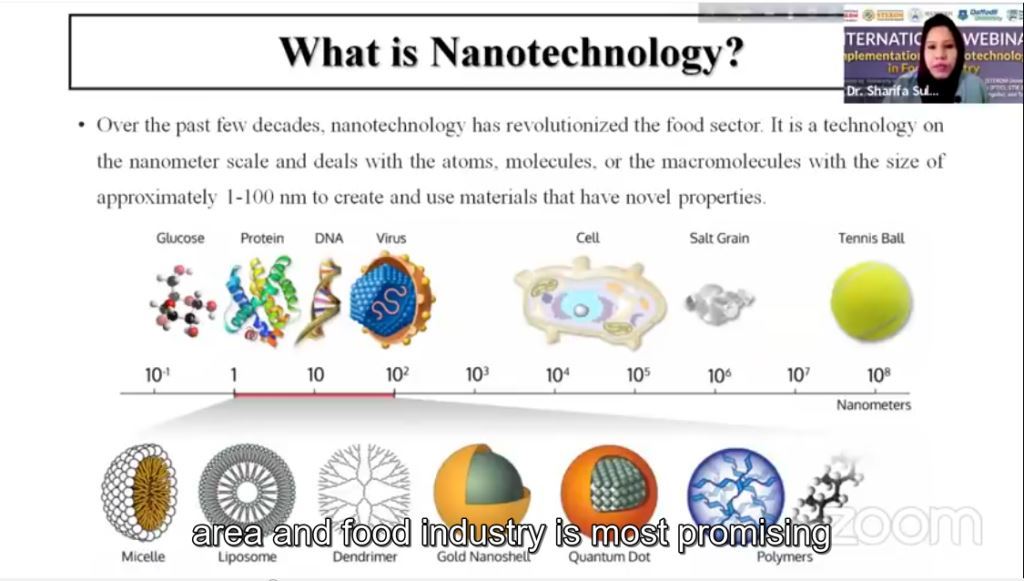
International Webinar 2022 - Implementation of Nano Technology in Food Industry - part 1
International Webinar
Back to News
International Webinar
Tuesday, January 10, 2023
Priyadi, S.Kom, M.Kom
0 Views