
A STEKOM university lecturer explains the differences between nanoscience and nanotechnology. The word Nanoscience refers to the study, manipulation and engineering of matter, particles and structures at the nanometer scale (one millionth of a millimeter, the atomic and molecular scale). Important properties of materials, such as electrical, optical, thermal and mechanical properties, are determined by the way molecules and atoms assemble at the nanoscale into larger structures. Moreover, in nanometer-sized structures these properties are often different from those at the macro scale, because quantum mechanical effects become important.
Nanotechnology is the application of nanoscience that leads to the use of new nano materials and nano-sized components in useful products. Nanotechnology will eventually give us the ability to design tailor-made materials and products with new enhanced properties, new nanoelectronic components, new types of “smart” drugs and sensors, and even interfaces between electronics and biological systems. This nascent scientific discipline lies at the interface between physics, chemistry, materials science, microelectronics, biochemistry and biotechnology. Therefore, the mastery of these disciplines requires academic and multidisciplinary scientific education.
Nanoscience and nanotechnology are at the forefront of modern research. The fast-growing economy in this field requires experts who possess extraordinary knowledge of nanoscience combined with the skills to apply this knowledge in new products. Multidisciplinary scientific education is essential to provide industry and research institutes with high-quality experts who have common backgrounds in various sub-disciplines such as electronics, physics, chemistry, materials science, biotechnology, while being experts in one particular field.
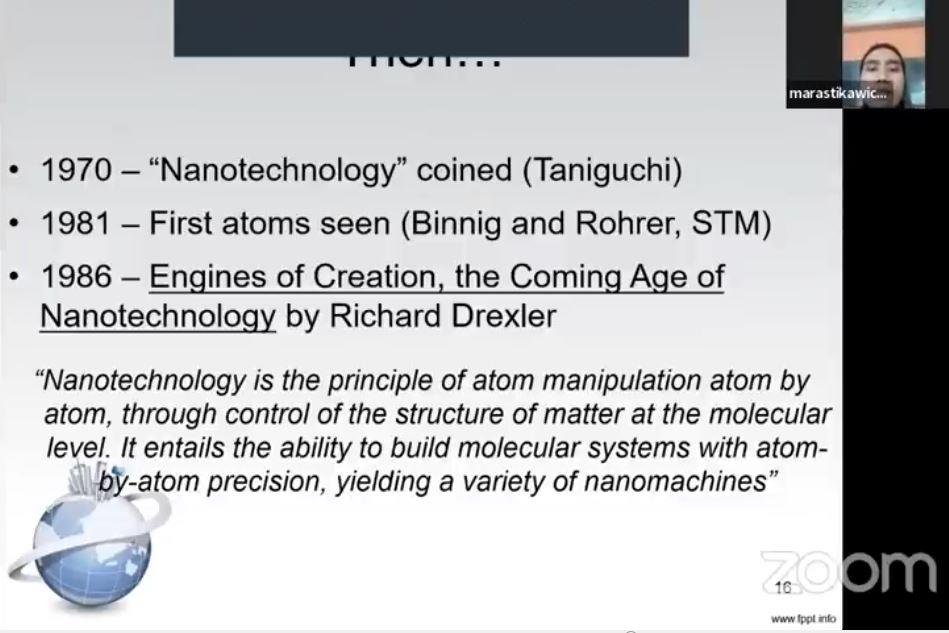
Nanoscience and nanotechnology involve the ability to see and control individual atoms and molecules. Everything on Earth is made up of atoms—the food we eat, the clothes we wear, the buildings and houses we live in, and our own bodies. But something as small as an atom is impossible to see with the naked eye. In fact, it's impossible to see with a microscope normally used in high school science classes. The microscope needed to see things at the nanoscale was invented in the early 1980s.
Once scientists had the right tools, such as the scanning tunneling microscope (STM) and the atomic force microscope (AFM), the era of nanotechnology was born. Although modern nanoscience and nanotechnology are fairly new, nanoscale materials have been used for centuries. Alternately sized gold and silver particles created color in the stained glass windows of medieval churches hundreds of years ago. The artists at that time simply did not know that the process they used to create these beautiful works of art caused changes in the composition of the materials they were working with.
Scientists and engineers are currently finding ways to intentionally fabricate materials at the nanoscale to take advantage of their enhanced properties such as higher strength, lighter weight, increased control of the light spectrum, and greater chemical reactivity than their more scaled counterparts. big.
The above material was presented by a presenter from Bangladesh in an international webinar held by STEKOM University in collaboration with the University of Bangkadesh and various other parties. The name of the presenter is Marastika Wicaksono Aji Bawono, S.Kom., M.M., M.Kom. who is a lecturer at STEKOM University, Indonesia.
This international webinar activity is part of the implementation of STEKOM University's commitment to increase various international activities. This was done in order to realize the vision to become an international-class university. Various international activities carried out by STEKOM University continue from year to year. There are international activities that are sustainable and there are also some international activities that are not sustainable. All types of international activities are accommodated and regulated by the International department of STEKOM University.
International Webinar 2022 - Implementation of Nano Technology in Food Industry - part 12
International Webinar
Back to News
International Webinar
Sunday, January 15, 2023
Priyadi, S.Kom, M.Kom
0 Views