
Food nanotechnology has penetrated many aspects of consumer products, such as food packaging. food additives and preservatives. Recognition of this new technology has advanced food processing and storage in ensuring food safety. Many conventional chemicals added as food additives or packaging materials are also found to partially exist on the nanometer scale. For example, food-grade TiO2, NP has now been found to be up to about 40% in the nanometer range
The benefits of nanotechnology for the food industry are numerous and are expected to continue to grow over time. These new, rapidly evolving technologies affect every aspect of the food system from cultivation to food production to processing, packaging, transportation, shelf life and nutrient bioavailability. The commercial application of nanomaterials will continue to impact the food industry due to their unique and novel properties. Human exposure to nanomaterials is, as a result, increasing and will continue to increase over time. Therefore, the health impact of nanomaterials in food is of concern and concern to the public. Public acceptance of food and food-related products containing nanomaterials will depend on their safety. Consequently, a uniform international regulatory framework for nanotechnology in food is required.
The National Nanotechnology Initiative in the US defines nanotechnology as the understanding and control of matter at the nanoscale where unique phenomena enable new applications. Nanomaterials are hereinafter defined as substances between 1 and 100 nm in size that exhibit physical, chemical and biological properties not found in bulk samples of the same materials. Their very small size and high surface area are associated with their greater strength, stability and chemical and biological activity. Therefore, nanotechnology enables the development of new materials with various potential applications. Nanomaterials are used in a variety of consumer, medical, commercial and industrial products. Because nanotechnology is a rapidly developing new technology, the information currently available is very limited.
What food technologists and engineers are doing to improve the safety of our food supply seems limited only by one's imagination, and nanotechnology is opening the door to entirely new product lines. Fresh fruits, vegetables, meat and poultry products are potential vehicles for the transmission of human pathogens causing foodborne disease outbreaks, which has drawn public attention to food safety. Therefore, there is a need to develop new antimicrobials to ensure food safety. Due to the antimicrobial properties of nanomaterials, nanotechnology offers great potential for new antimicrobial agents for food and food-related industries. The use of nano antimicrobial agents added directly to food or via antimicrobial packaging is an effective approach. As a result, the use of nanotechnology by the food and food-related industries is expected to increase, impacting food systems at all stages from food production to processing, packaging, transportation, storage, security, safety and quality.
The above material was presented by a presenter from Bangladesh in an international webinar entitled "Prospect of Nanotechnology in Food Processing and Food Packaging" which was held by STEKOM University in collaboration with the University of Bangladesh and various other parties. The name of the presenter from Bangladesh is Sharifa Sultana, PhD. The presenter's academic position is Associate Professor & Associate Head, Department of Pharmacy, FAHS at Daffodil International University, Bangladesh.
This international webinar activity is part of the implementation of STEKOM University's commitment to increase various international activities. This was done in order to realize the vision to become an international-class university. Various international activities carried out by STEKOM University continue from year to year. There are international activities that are sustainable and there are also some international activities that are not sustainable. All types of international activities are accommodated and regulated by the International department of STEKOM University.
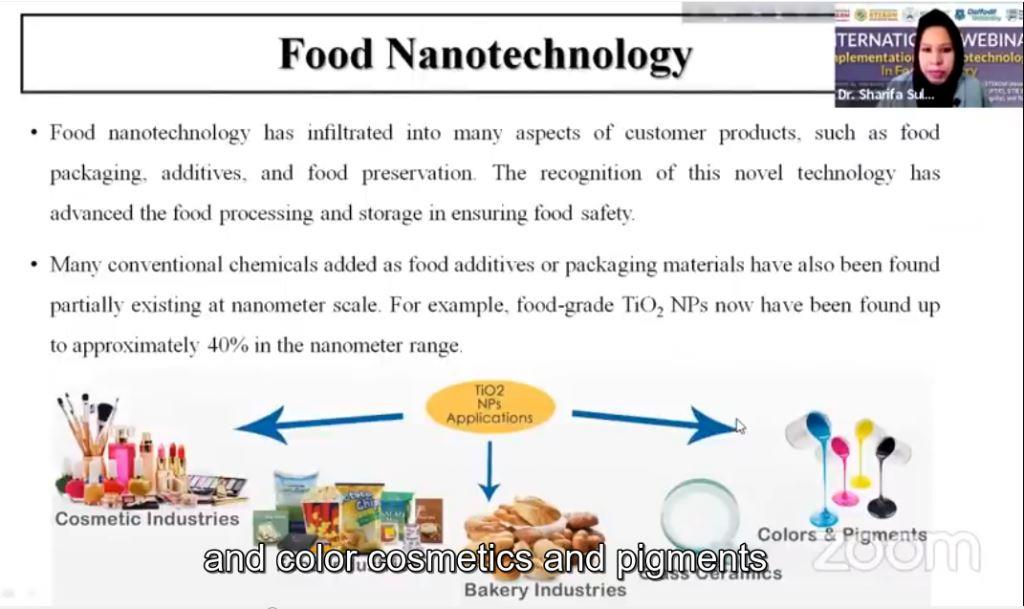
International Webinar 2022 - Implementation of Nano Technology in Food Industry - part 2
International Webinar
Back to News
International Webinar
Tuesday, January 10, 2023
Priyadi, S.Kom, M.Kom
0 Views