
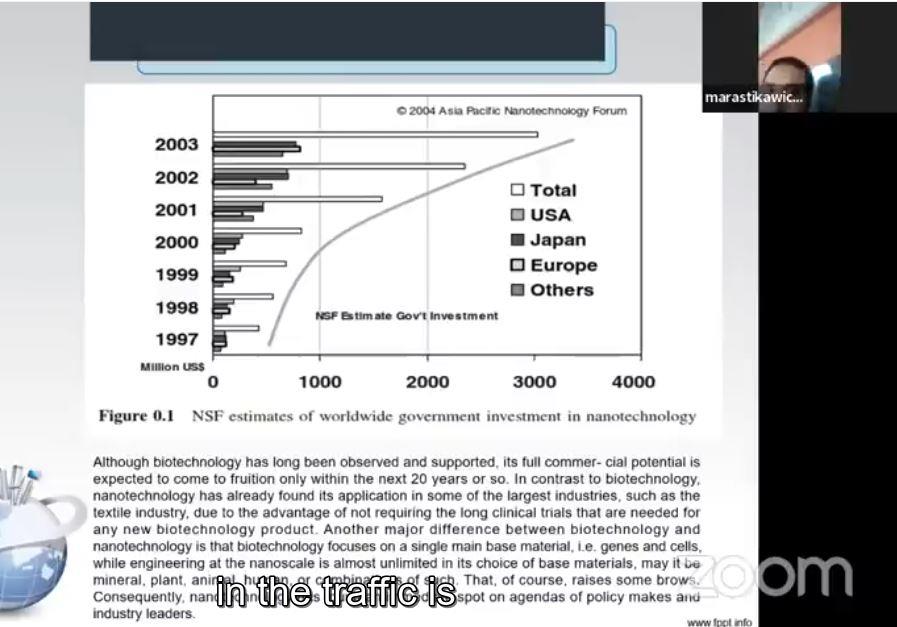
An international academic presenter from Indonesia explained about the development of nanotechnology. Nanotechnology is a rapidly growing field that touches almost all STEM (Science, Technology, Engineering and Math) areas. In a new world where technology is advancing at a far greater rate than at any other point in recorded history, nanoengineering is pushing the boundaries of conventional technological practices. This helps engineers and researchers worldwide to not only improve current product lines and technologies, but to develop entirely new functionality, which is achieved by a bottom-up construction approach.
Nanotechnology advanced rapidly after the invention of the scanning tunneling microscope (STM) in 1980 by Gerd Binnig and Heinrich Rohrer at IBM Zurich, which also earned them the Nobel prize in physics in 1986. The development of the STM was a precursor to the development of the atomic Force Microscope (AFM) which ultimately allowing scientists to view matter on an unprecedentedly small scale. We've come a long way since the 1980s and the time is right to review some of the major nanotechnology developments in the STEM field.
Reproductive medicine is looking for alternatives to help couples who want to achieve pregnancy and maintain fertility. It also aims to diagnose and treat diseases that interfere with the normal operation of the reproductive tract. ART or assisted reproductive technologies are supported by nanotechnology to achieve this feat by non-invasive detection, diagnosis, and treatment of infertility-related disorders. The development of nanobiosensors capable of identifying antigens, nucleic acids, antigens, nitrogen species, and reactive oxygen is being researched and used for higher speed and sensitivity. This nanobiosensor is part of a more complex lab-on-a-chip tool that requires minimal volumes of analyte and precursor and has the potential to replace bulky and expensive conventional detection systems. Some examples include functionalization of zinc oxide nanorods and gold nanoparticles, iron oxide nanoparticles, silica-coated gold nanoparticles with cadmium sulfide quantum dots along with anti-CA125 antibodies for the detection of ovarian cancer. A similar biosensor using gold-functionalized anti-PSA antibodies can detect PSA antigen for prostate cancer. Moreover, for in vitro ripening, the addition of antioxidants is a prerequisite but these conventional molecules may not perform their functions with high efficiency due to their inefficiency in the in-vitro environment, making the use of nanomaterials essential.
Wound healing, in general, is a natural and well-structured process. However, several factors interfere with the sequence of wound healing. Many drug delivery systems are based on nanotechnology such as the use of nanoparticles of silver, gold, copper, titanium dioxide and zinc oxide against strains of B. subtilis, E. coli and S. aureus etc. is being used commercially. Biocompatible scaffolds combined with bioactive molecules regenerate and repair damaged skin tissue. Biomaterials such as chitosan, collagen, and polylactic acid have been tested in animals showing an increase in the rate of contraction and wound epithelialization.
The above material was presented by a presenter from Bangladesh in an international webinar held by STEKOM University in collaboration with the University of Bangkadesh and various other parties. The name of the presenter is Marastika Wicaksono Aji Bawono, S.Kom., M.M., M.Kom. who is a lecturer at STEKOM University, Indonesia.
This international webinar activity is part of the implementation of STEKOM University's commitment to increase various international activities. This was done in order to realize the vision to become an international-class university. Various international activities carried out by STEKOM University continue from year to year. There are international activities that are sustainable and there are also some international activities that are not sustainable. All types of international activities are accommodated and regulated by the International department of STEKOM University.
International Webinar 2022 - Implementation of Nano Technology in Food Industry - part 5
International Webinar
Back to News
International Webinar
Wednesday, January 11, 2023
Priyadi, S.Kom, M.Kom
0 Views