
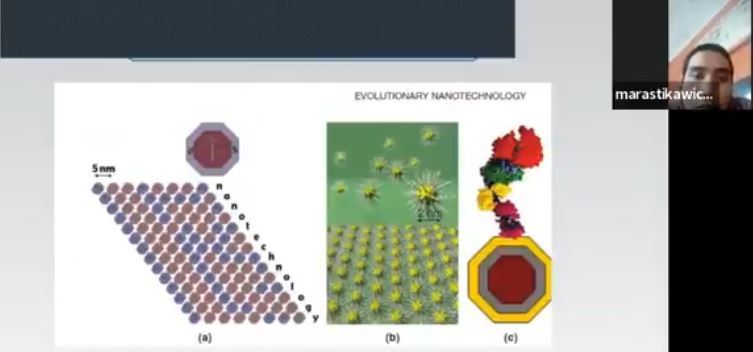
An international academic presenter from Indonesia explained the nanotechnology perspective in the context of nanoparticles. Nanoparticles (NP) due to their size have many distinct and unique original properties. The nanoscale size allows these NPs to interact at the molecular level. There are several non-invasive techniques used for molecular imaging, and there are many ways they can be used to promote better imaging quality. Multifunctional NPs are known to improve ways of monitoring and revealing molecular level events. Improving imaging through NP-based probes, such as creating high-contrast images, is the most efficient way to get better results. Therefore, greater concentration towards nanoprobe development is very important in this research scenario.
The application of NPs is considered to be very limited due to their low targeting efficiency and high level of toxicity. The unprecedented incorporation of NPs for imaging may even cause irreversible molecular and cellular damage. In the absence of an attached molecular moiety, these NPs generally exhibit a nonselective distribution throughout the body and an inability to overcome biological barriers such as the Blood Brain Barrier (BBB), and thus, fail to meet the necessary prerequisites for molecular imaging. Their surface properties must be modified for use in a variety of enhanced imaging fields and to overcome the minor drawbacks that these nanoparticles previously had.
The era of nanoprobe development paved the way for research on NP functionalization to assist various approaches to imaging techniques. Ultimately to diagnose disease and to monitor the delivery and effects of these NPs, we need efficient molecular imaging methods. Functionalized nanoprobes will serve multidimensional purposes as multiple NPs are not only able to interact at the molecular level, but also have superior optical properties that are sometimes tunable with respect to their size, as in the case of carbon nanodots. Also for the probe to be compatible with advances in imaging modality instrumentation, as in the case of hybrid imaging, functionalization is required.
Functionalization refers to surface modification of NPs, which includes conjugating onto the surface of chemicals6 or biomolecules such as folic acid, biotin molecules, oligo nucleotides, peptides, antibodies, etc., to improve properties and achieve targets with high precision. In addition, the functionalized NPs have good physical properties, anti-corrosion, anti-agglomeration and non-invasive characteristics. Intensive research has been carried out into the functioning of NPs to improve their overall efficiency and modality.
NP functionalization allows developers to embed properties of particular interest for inclusion into NPs, thereby enabling them to assist specific imaging modality approaches. This not only helps to achieve better image quality, but also increases the applicability and functionality of the imaging modality. In various studies, functionalization of NPs has also been found to be carried out with other NPs to improve their characteristics. Qu et al. working with silica NPs having high biocompatibility, coated with magnetite NPs, and further functionalized with dyes on the magnetite layer. Previously unusable silica NPs as contrast agents (CA) can be utilized as T2-weighted CAs in magnetic resonance imaging (MRI) as well as in optical imaging. This suggests that there is a dependency of the imaging technique on the functionalization approach. Reliability on images depends on the specificity of the probe to avoid false positives, and therefore, to develop highly reliable imaging techniques for diagnostic purposes, an ideal probe development strategy is required. Since it is only after diagnosis that one can take important decisions about the type of disease and intensity of treatment, proper probes with suitable surface properties are required.
The most recent research available in this area from 2012 to 2016 is reviewed. The chemistry behind this functionalization approach including noncovalent binding, covalent conjugation, surface coating etc. is discussed. An overview is given of how functionalization can enhance and assist certain imaging techniques such as confocal microscopy, fluorescence imaging, MRI, positron emission tomography (PET), and computed tomography (CT), for in vitro and in vivo studies. Functionalization allows loading NPs with multimodal characteristics, targeted functionality, and the possibility of various intraoperative procedures to be performed. Various other domains related to molecular imaging that benefit from functionalization are also discussed, such as theranostics, multimodal and hybrid imaging, intraoperative therapy and molecular targeting.
The above material was presented by a presenter from Bangladesh in an international webinar held by STEKOM University in collaboration with the University of Bangkadesh and various other parties. The name of the presenter is Marastika Wicaksono Aji Bawono, S.Kom., M.M., M.Kom. who is a lecturer at STEKOM University, Indonesia.
This international webinar activity is part of the implementation of STEKOM University's commitment to increase various international activities. This was done in order to realize the vision to become an international-class university. Various international activities carried out by STEKOM University continue from year to year. There are international activities that are sustainable and there are also some international activities that are not sustainable. All types of international activities are accommodated and regulated by the International department of STEKOM University.
International Webinar 2022 - Implementation of Nano Technology in Food Industry - part 8
International Webinar
Back to News
International Webinar
Wednesday, January 11, 2023
Priyadi, S.Kom, M.Kom
0 Views