
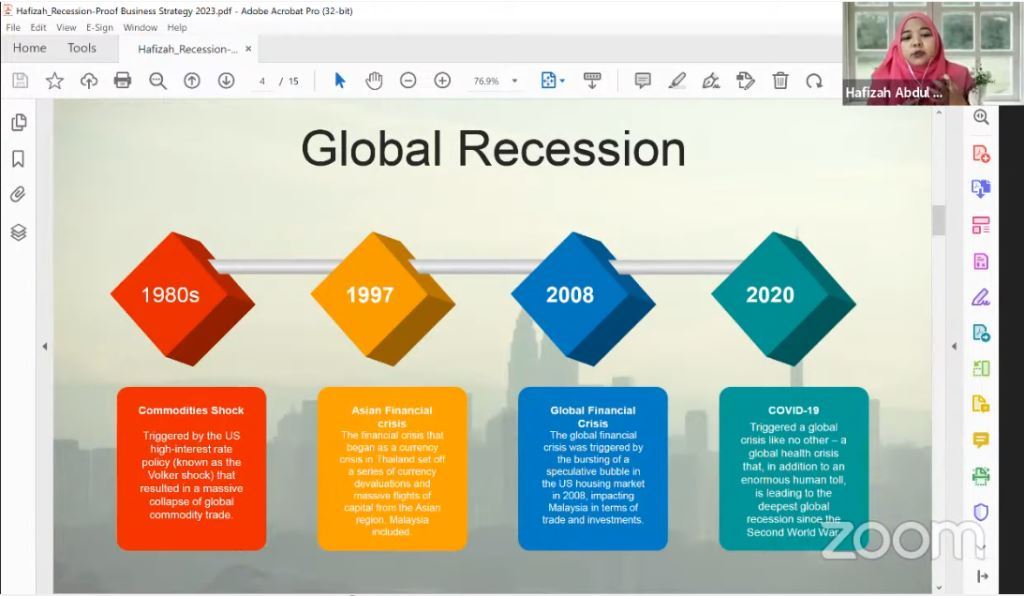
Academics from Malaysia describe the global recession in the 1980s. The recession of this period was triggered by the US high interest rate policy (known as the Volker Shock) which resulted in a massive collapse of global commodity trade. Meanwhile, other opinions say that the economic crisis that lasted from July 1981 to November 1982 was triggered by tight monetary policy in an effort to fight rising inflation.
Prior to the 2007-09 recession, the 1981-82 recession was the worst economic downturn in the United States since the Great Depression. Indeed, the unemployment rate of nearly 11 percent reached in late 1982 remains the pinnacle of the post-World War II era (Federal Reserve Bank of St. Louis). Unemployment during the 1981-82 recession was widespread, but the manufacturing, construction, and auto industries were particularly affected. Although manufacturers of goods accounted for only 30 percent of total employment at the time, they experienced 90 percent of job losses in 1982. Three-quarters of all job losses in the goods-producing sector were in manufacturing, and the housing construction industry and auto manufacturers. ended the year with 22 percent and 24 percent respectively unemployed.
The economy was already in a weak state ahead of the downturn, as the recession in 1980 had left unemployment at around 7.5 percent. The recessions of 1980 and 1981-82 were triggered by tight monetary policies in an effort to fight rising inflation. During the 1960s and 1970s, economists and policy makers believed they could lower unemployment through higher inflation, a trade-off known as the Phillips Curve. In the 1970s, the Fed pursued what economists call a "stop-go" monetary policy, which alternated between fighting high unemployment and high inflation. During the "away" period, the Fed lowers interest rates to loosen the money supply and target lower unemployment. During the "standstill" period, when inflation is rising, the Fed will raise interest rates to reduce inflationary pressures. However, the Phillips Curve exchange proved unstable in the long run, as inflation and unemployment increased together in the mid-1970s. While unemployment tended to fall slightly by the end of the decade, inflation continued to increase, reaching 11 percent in June 1979.
Paul Volcker was appointed chairman of the Fed in August 1979 largely for his anti-inflationary views. He previously served as president of the New York Fed and disapproved of Fed policies which he saw as contributing to inflation expectations. He firmly believed that rising inflation should be a top concern for the Fed: “In terms of future economic stability, [inflation] is what is likely to give us the most trouble and create the biggest recession” (FOMC Transcript 1979, 16). He also believes that the Fed faces a credibility problem when it comes to keeping inflation in check. Over the past decade, the Fed has shown that it places less emphasis on keeping inflation low, and public expectations of such continued behavior will make it even more difficult for the Fed to bring inflation down. "Failure to survive now in the fight against inflation will only make the next attempt more difficult," he said.
The above material was presented by a presenter from Malaysia in an international webinar held by STEKOM University in collaboration with Universities from Malaysia, PRC and various other parties. The title of the presentation brought by the presenter from Malaysia was "Recession-proof business strategies 2023: Malaysia's Economy Perspective." The presenter's name is Hafizah Abdul Rahim who is a senior lecturer and research fellow at the center of excellence for social innovation and sustainability, faculty of business and communication at Universiti Malaysia Perlis.
This international webinar activity is part of the implementation of STEKOM University's commitment to increase various international activities. This was done in order to realize the vision to become an international-class university. Various international activities carried out by STEKOM University continue from year to year. There are international activities that are sustainable and there are also some international activities that are not sustainable. All types of international activities are accommodated and regulated by the International department of STEKOM University.
International Webinar 2022 - Recession Proof business Strategies for 2023 – Part 1
International Webinar
Back to News
International Webinar
Monday, January 16, 2023
Priyadi, S.Kom, M.Kom
0 Views