
Malaysian academics explained that one way to withstand a recession is to secure working capital and diversify financial sources. Perhaps most important is the volume and duration of funding required. But one thing that is often overlooked: diversification.
Funding diversification is more important now than ever. In uncertain economic times, banks are increasingly frugal with overdraft facilities and more traditional forms of funding, such as term loans, are becoming more difficult to negotiate. As a result, funding must be sought from various sources.
The financial crisis of 2008 – and the stagnant conditions that followed – led high-end banks to increase barriers to entry for SMEs seeking funding. Fortunately, other sources of funding are emerging from the ashes of the crisis as financial innovation and technology offer business owners new options.
Despite this breadth of options, which now include peer-to-peer, crowdfunding, invoice financing to name a few, the majority of SMEs remain unaware of the options available to them, with business owners failing to shop around for financing. Instead, they continue to go directly to their bank to apply for an overdraft or loan, often on unattractive terms.
While the turmoil of the last decade has led to more financial choices, seeking diversity in funding is just as important in stable market conditions. The choice not to diversify is an odd one, as there have never been more options available to SMEs looking to raise funds. It seems that in stable times, complacency can set in, and many businesses rely on a limited amount of traditional forms of finance because they don't foresee situations where a lack of options could work against them.
But this is wrong. As business owners, we must always be prepared for the next downturn which, like it or not, is never far ahead. One way in which SMEs can prepare for uncertain times is by using a variety of financing options, so that when the market turns against them, and hard times come, they are fully prepared for even more difficult credit conditions.
Breaking down your business prospects into the short, medium and long term will help you figure out how best to structure your company's finances. Most importantly, diversification of types and sources of funding is very important for the sustainability of your business.
Banking financing will certainly continue to be a crucial provider of capital for the SME sector. But a wide range of options will help support your long-term prospects and reduce the wider SME sector's vulnerability to changes in credit markets.
The above material was presented by a presenter from Malaysia in an international webinar held by STEKOM University in collaboration with Universities from Malaysia, PRC and various other parties. The title of the presentation brought by the presenter from Malaysia was "Recession-proof business strategies 2023: Malaysia's Economy Perspective." The presenter's name is Hafizah Abdul Rahim who is a senior lecturer and research fellow at the center of excellence for social innovation and sustainability, faculty of business and communication at Universiti Malaysia Perlis.
This international webinar activity is part of the implementation of STEKOM University's commitment to increase various international activities. This was done in order to realize the vision to become an international-class university. Various international activities carried out by STEKOM University continue from year to year. There are international activities that are sustainable and there are also some international activities that are not sustainable. All types of international activities are accommodated and regulated by the International department of STEKOM University.
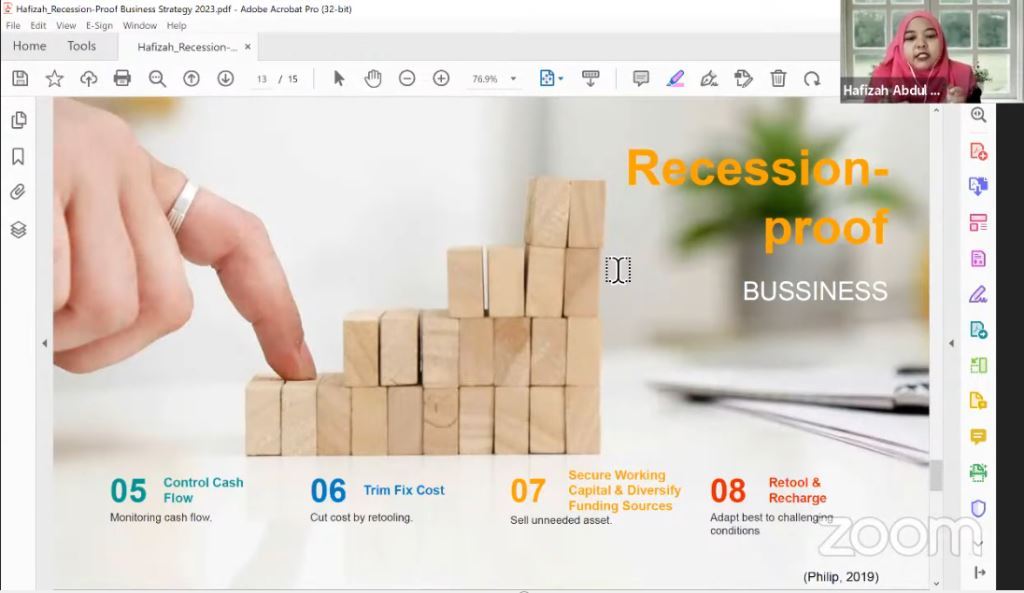
International Webinar 2022 - Recession Proof business Strategies for 2023 – Part 15
International Webinar
Back to News
International Webinar
Thursday, January 19, 2023
Priyadi, S.Kom, M.Kom
0 Views