
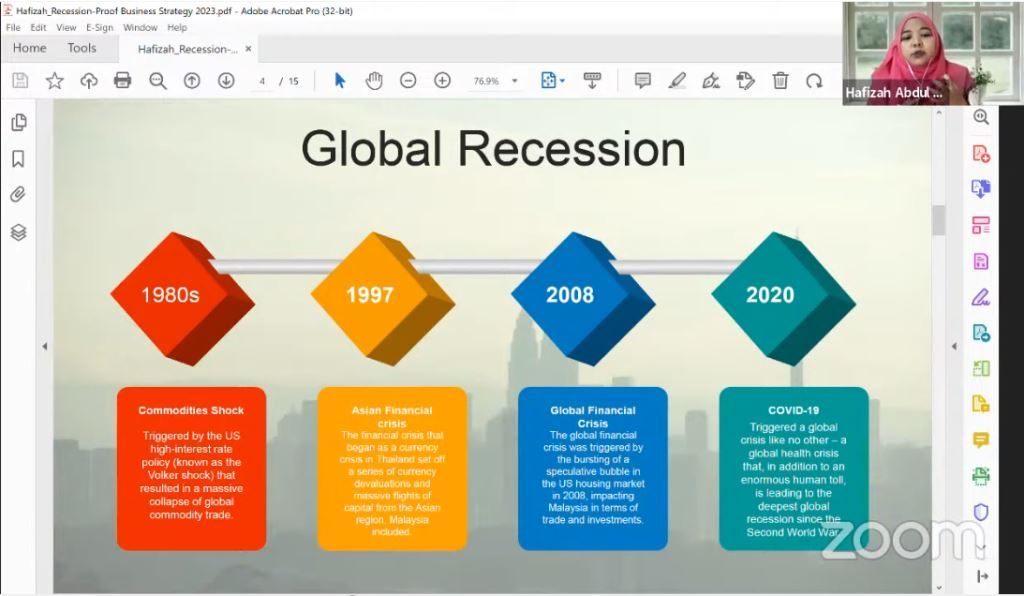
Academics from Malaysia explained about the global recession in 1997 which was centered on Asia. The Asian Financial Crisis was a financial crisis that started as a currency crisis in Thailand which sparked a series of currency devaluations and a massive scramble for capital from the Asian region, including Malaysia.
The Asian financial crisis was a period of financial crisis that gripped much of East Asia and Southeast Asia that began in July 1997 and raised fears of a world economic crisis due to financial contagion. However, the recovery in 1998–1999 was swift and fears of a crisis subsided. The crisis began in Thailand (known in Thailand as the Tom Yam Kung Crisis) on July 2, with the collapse of the Thai baht finances after the Thai government was forced to float the baht due to a lack of foreign currency to support its currency's peg to the US dollar. Capital flight immediately ensued, starting an international chain reaction. At that time, Thailand was burdened with foreign debt. As the crisis spread, much of Southeast Asia and later South Korea and Japan saw currency crashes, devaluing stock markets and other asset prices, and sharp increases in private debt.
South Korea, Indonesia and Thailand are the countries most affected by the crisis. Hong Kong, Laos, Malaysia and the Philippines have also been hurt by the slump. Brunei, mainland China, Singapore, Taiwan and Vietnam were less affected, although all saw declines in demand and confidence across the region. Japan was also affected, although not too significantly. China was minimally impacted. While the United States and Japan have been slow to respond to requests from affected countries, China enhanced its reputation in the region through its contribution of $4 billion in bailouts and its landmark decision not to devalue its own currency.
The ratio of external debt to GDP increased from 100% to 167% in the four major economies of the Association of Southeast Asian Nations (ASEAN) in 1993–96, then soared beyond 180% during the worst of the crisis. In South Korea, the ratio rose from 13% to 21% and then as high as 40%, while other northern newly industrialized countries fared much better. Only in Thailand and South Korea did the ratio of debt service to exports increase.
Although most Asian governments appear to have sound fiscal policies, the International Monetary Fund (IMF) stepped in to initiate a $40 billion program to stabilize the currencies of South Korea, Thailand, and Indonesia, economies that were hard hit by the crisis. However, efforts to stem the global economic crisis did little to stabilize the domestic situation in Indonesia. After 30 years in power, Indonesian President Suharto was forced to step down on May 21, 1998 amidst widespread rioting which was followed by sharp price hikes due to the drastic devaluation of the rupiah. The impact of the crisis lasted into 1998. By 1998, growth in the Philippines had fallen to almost zero. Only Singapore and Taiwan proved relatively well protected from the shock, but both took a serious hit in passing, the first due to their size and geographic location between Malaysia and Indonesia. But in 1999, analysts saw signs that Asian economies were recovering. After the crisis, the economy in the region worked towards financial stability and better financial supervision.
Until 1999, Asia attracted almost half of total capital inflows to developing countries. Southeast Asian economies in particular maintain high interest rates which are attractive to foreign investors seeking high returns. As a result, the region's economy received a large inflow of money and experienced a dramatic increase in asset prices. At the same time, the regional economies of Thailand, Malaysia, Indonesia, Singapore and South Korea experienced high growth rates, of 8–12% of GDP, in the late 1980s and early 1990s. This achievement is widely recognized by financial institutions including the IMF and World Bank, and is known as part of the "Asian economic miracle".
The above material was presented by a presenter from Malaysia in an international webinar held by STEKOM University in collaboration with Universities from Malaysia, PRC and various other parties. The title of the presentation brought by the presenter from Malaysia was "Recession-proof business strategies 2023: Malaysia's Economy Perspective." The presenter's name is Hafizah Abdul Rahim who is a senior lecturer and research fellow at the center of excellence for social innovation and sustainability, faculty of business and communication at Universiti Malaysia Perlis.
This international webinar activity is part of the implementation of STEKOM University's commitment to increase various international activities. This was done in order to realize the vision to become an international-class university. Various international activities carried out by STEKOM University continue from year to year. There are international activities that are sustainable and there are also some international activities that are not sustainable. All types of international activities are accommodated and regulated by the International department of STEKOM University.
International Webinar 2022 - Recession Proof business Strategies for 2023 – Part 2
International Webinar
Back to News
International Webinar
Monday, January 16, 2023
Priyadi, S.Kom, M.Kom
0 Views