
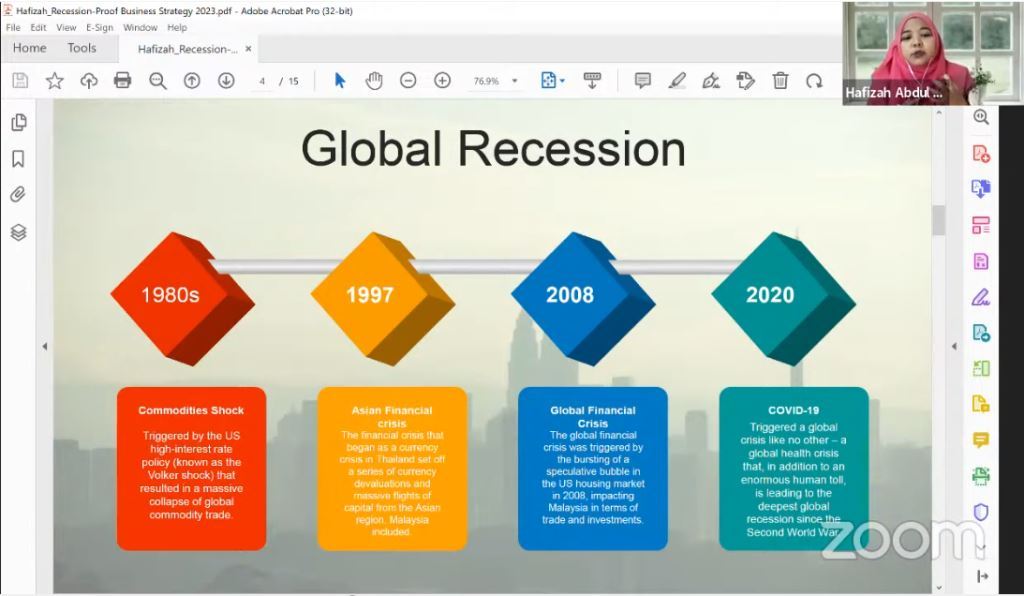
Academics from Malaysia explained about the global recession in 2008 related to Malaysia. The 2008 global financial crisis was a global financial crisis that was triggered by the burst of the speculative bubble in the US housing market in 2008, which impacted the country of Malaysia in terms of trade and investment.
The 2008/09 global financial crisis that started in the US was caused by excessive lending by banks, especially housing loans. Banks repackage this debt and sell it to investors. When the property bubble burst, it threw borrowers into default and set off a domino effect that paralyzed the US banking system, eventually pushing some into liquidation. Then this incident spread to other countries, including Malaysia.
For Malaysia, the country is affected in terms of financial and trade channels. Malaysia, a trade-reliant nation, has been particularly hard hit in terms of trade and investment. Exports fell 45% to RM38 billion in January 2009 from RM64 billion in July 2008. Like other Asian countries, Malaysia has experienced capital flight. Portfolio investment experienced large outflows and the stock market, which has high foreign participation, took a hit due to foreign investor repatriation of funds. The economy plunged into recession, contracting 1.7% in 2009.
The Malaysian government subsequently launched two fiscal stimulus programs of RM67 billion, approximately 10% of GDP in 2008 and 2009. The first stimulus (RM7 billion) was intended for projects with a high multiplier impact on the economy. They also took steps to support personal consumption such as reducing the Employee Deposit Fund contribution rate to 8% from 11%.
The second stimulus package in 2009 is seen as the largest in history at a massive RM60 billion, consisting of a combination of fiscal injections, government guarantees on bonds and private loans, investment in equity shares for projects with high multiplier effect, private finance initiatives and tax incentives. Meanwhile, Bank Negara Malaysia cut interest rates three times, for a total of 150 basis points, and the overnight policy rate fell to 2%.
In the record of Malaysia's economic history, this country since independence experienced three periods of major economic shocks, namely in 1985/86, 1997/1998, and 2008/2009. It should be noted that the causes of each crisis were very different in nature, considering that the country was at the stage of developments over the last four decades.
The above material was presented by a presenter from Malaysia in an international webinar held by STEKOM University in collaboration with Universities from Malaysia, PRC and various other parties. The title of the presentation brought by the presenter from Malaysia was "Recession-proof business strategies 2023: Malaysia's Economy Perspective." The presenter's name is Hafizah Abdul Rahim who is a senior lecturer and research fellow at the center of excellence for social innovation and sustainability, faculty of business and communication at Universiti Malaysia Perlis.
This international webinar activity is part of the implementation of STEKOM University's commitment to increase various international activities. This was done in order to realize the vision to become an international-class university. Various international activities carried out by STEKOM University continue from year to year. There are international activities that are sustainable and there are also some international activities that are not sustainable. All types of international activities are accommodated and regulated by the International department of STEKOM University.
International Webinar 2022 - Recession Proof business Strategies for 2023 – Part 3
International Webinar
Back to News
International Webinar
Monday, January 16, 2023
Priyadi, S.Kom, M.Kom
0 Views