
Academics from Malaysia explained about the global recession in 2020, the main cause of which was COVID-19. The 2020 global financial crisis was triggered by COVID-19, a global health crisis which, in addition to claiming many human casualties, caused the deepest global recession since the second world war. The coronavirus (Covid-19) pandemic that has spread across the world has devastated the global economy. In the first quarter of 2020 alone, the economies of many G20 countries experienced contractions.
The impact of the Covid-19 pandemic, which has now infected more than 3 million people in various parts of the world, is truly devastating. The economic crisis that emerged was different from previous crises. If the two previous crises (dot com bubble & 2008 global financial crisis) were purely due to phenomena in the financial sector, this crisis was actually triggered by phenomena in the field that spread everywhere.
The Covid-19 pandemic attacks the production factor of the economy itself, namely humans. People infected with the corona virus will experience respiratory system disorders with symptoms such as coughing, shortness of breath, chest pain to pneumonia. This virus is spreading very fast. Many countries choose the lockdown option to suppress the spread of the virus.
But the lockdown option comes at a cost. With the existence of lockdowns in various parts of the world, especially in G20 member countries such as the US, Italy, Spain, France, China, and Singapore, economic activity has also been hampered.
Under lockdown conditions, people are prohibited from leaving the house and carrying out their usual activities, many factories and offices are closed or operating but not at full capacity. As a result, production decreases, supply chains become disrupted and demand weakens. This phenomenon is the biggest threat to the economy which the International Monetary Fund (IMF) later referred to as The Great Lockdown in its report.
The consequences of the lockdown on the economy were clear when many G20 countries began releasing their sacred figures (economic growth) for the first quarter of 2020. For information, the economic output of the G20 countries accounts for more than 80% of global Gross Domestic Product (GDP), so seeing the contraction that has occurred in many G20 countries can give an illustration that the global economy is indeed gloomy.
In the first quarter of 2020, the US economy contracted by 4.8% (annualized). This is the deepest contraction since 2008 and the first contraction since 2014. The unemployment rate in the US has also jumped sharply. Since March 21, 30.3 million people have filed unemployment claims in the US. Likewise for Europe, referring to Trading Economics data, the eurozone economy contracted by 3.3% year on year (yoy) in the first quarter of 2020. Countries that have contracted Covid-19 and implemented massive lockdowns in Europe such as Spain, Italy and France must feel their economies have fallen significantly.
China as the second largest economy in the world reported that its economy contracted by 6.8% (yoy) in 1Q20. This is the first contraction since the release of data in 1992 and can be an illustration of how scary the impact of Covid-19 is on the economy considering that China was the first country to be infected with an outbreak.
Unlike most other countries that have implemented lockdowns, South Korea is the only country with a different 'style' of handling Covid-19. Instead of slowing down the wheels of the economy, South Korea preferred to carry out mass Covid-19 tests when the number of cases jumped significantly at the end of last February.
With this strategy, South Korea succeeded in reducing the number of Covid-19 cases in the country to around 10 thousand. However, South Korea cannot avoid the economic impact caused by the outbreak of the Covid-19 outbreak. In the first quarter of this year, South Korea's GDP only grew 1.3% (yoy).
The above material was presented by a presenter from Malaysia in an international webinar held by STEKOM University in collaboration with Universities from Malaysia, PRC and various other parties. The title of the presentation brought by the presenter from Malaysia was "Recession-proof business strategies 2023: Malaysia's Economy Perspective." The presenter's name is Hafizah Abdul Rahim who is a senior lecturer and research fellow at the center of excellence for social innovation and sustainability, faculty of business and communication at Universiti Malaysia Perlis.
This international webinar activity is part of the implementation of STEKOM University's commitment to increase various international activities. This was done in order to realize the vision to become an international-class university. Various international activities carried out by STEKOM University continue from year to year. There are international activities that are sustainable and there are also some international activities that are not sustainable. All types of international activities are accommodated and regulated by the International department of STEKOM University.
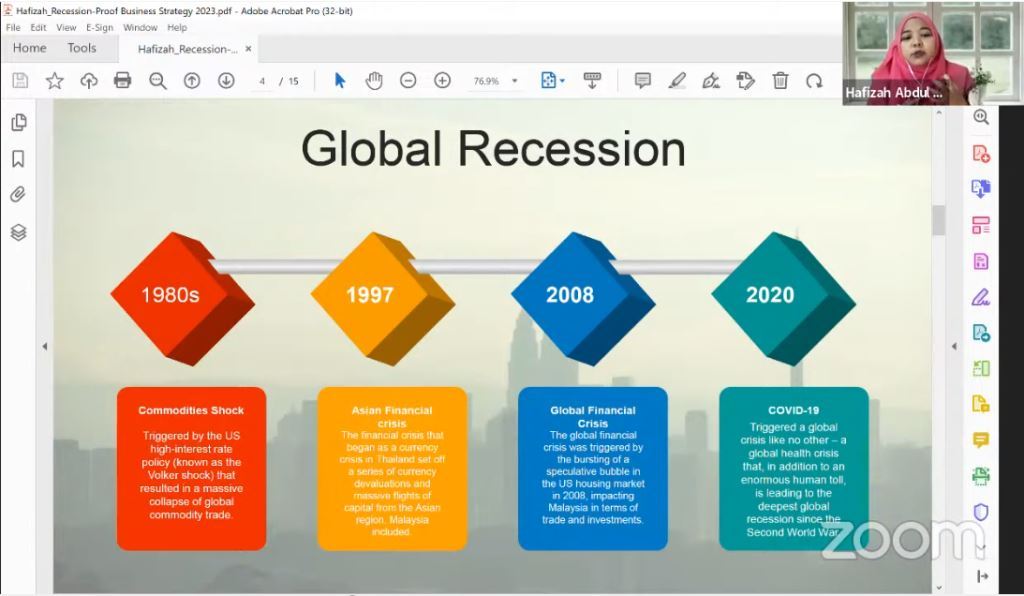
International Webinar 2022 - Recession Proof business Strategies for 2023 – Part 4
International Webinar
Back to News
International Webinar
Monday, January 16, 2023
Priyadi, S.Kom, M.Kom
0 Views