
The value chain is the series of sequential steps that go into the creation of a finished product, from initial design to its arrival at the customer's doorstep. Identify the chain of every step in the process where value is added, including the procurement, manufacture and marketing stages of its production.
The company performs value chain analysis with complex evaluation procedures involved in every step of its business. The purpose of value chain analysis is to increase production efficiency so that companies can provide maximum value at minimum cost.
The STEKOM University international webinar presenter who delivered the material was Veleriia lymar from Ukraine. He is a Doctor in economics. The functional position of the scholar is Associate professor. At his campus, Mr. Veleriia plays the role of Acting. head of the department of international relations and foreign policy. The campus where he is domiciled is 'Vasyl' Stus Donetsk National University, Ukraine.
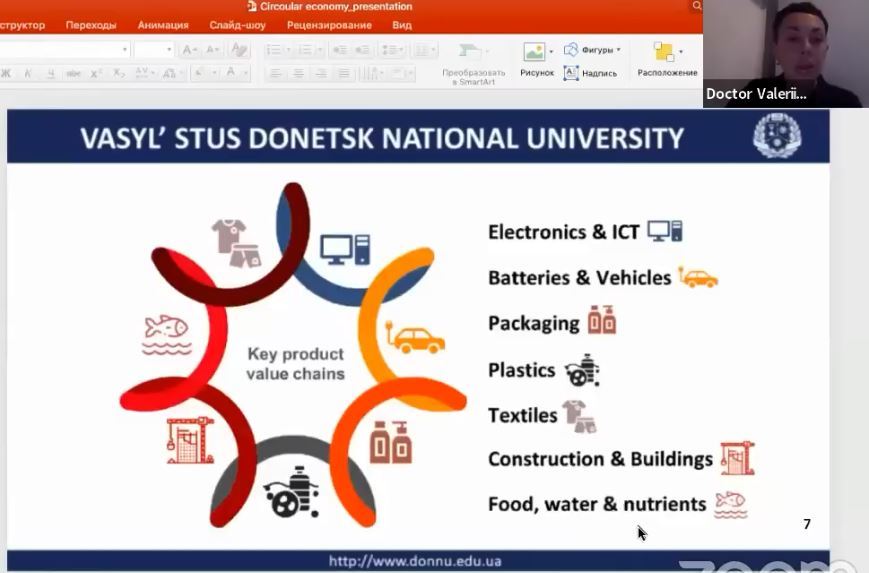
The title of the presentation delivered by Mr. Veleriia was "Analyzing a New Circular Economy Action Plan". At the beginning of his presentation, Mr. Veleriia explained about the new circular economy action plan developed by the European Commission. The European Commission adopted a new circular economy action plan (CEAP) in March 2020 Europe. It is one of the key building blocks of the Green Deal, Europe's new agenda for sustainable growth. The EU's transition to a circular economy will reduce pressure on natural resources and will create sustainable growth and jobs. It is also a prerequisite for achieving the EU's 2050 climate neutrality target and for halting biodiversity loss.
The webinar activity is part of the implementation of STEKOM University's commitment to increase various international activities in order to realize the vision to become an international-class university. Various international activities carried out by STEKOM University continue from year to year. There are international activities that are sustainable and there are also some international activities that are not sustainable. All types of activities are accommodated internationally and regulated by the International department of STEKOM University.
Due to increasing competition for unbeatable prices, excellent products and customer loyalty, companies must constantly assess the value they create to maintain their competitive advantage. The value chain can help a company to differentiate its inefficient business areas, then implement a strategy that will optimize its procedures for maximum efficiency and profitability.
Apart from ensuring that production mechanisms are smooth and efficient, it is important for businesses to have customers confident and secure enough to remain loyal. Value chain analysis can also help in this regard.
Michael E. Porter, from Harvard Business School, introduced the value chain concept in his book, Competitive Advantage: Creating and Sustaining Superior Performance. He wrote: "Competitive advantage cannot be understood by looking at a company as a whole. It derives from the many separate activities a company performs in designing, producing, marketing, delivering, and supporting its product."
In his concept of the value chain, Porter divides business activities into two categories, "primary" and "support", of which we provide examples of activities below. The specific activities in each category will vary by industry.
The main activities consist of five components, and all are important to add value and create competitive advantage:
- Logistics covers various functions such as receiving, storing and managing inventory.
- Operations include procedures for converting raw materials into finished products.
- Outgoing logistics includes activities to distribute the final product to consumers.
- Marketing and sales include strategies to increase visibility and target the right customers—such as advertising, and pricing.
- Services include programs to maintain products and enhance consumer experiences—such as customer service, maintenance, repairs, refunds and exchanges.
International Webinar 2022 - The advantages of green engineering part 3
International Webinar
Back to News
International Webinar
Tuesday, November 29, 2022
Priyadi, S.Kom, M.Kom
0 Views