
Another important area of green engineering is the improvement of industrial emission filters. There are many types of air pollution, but by far the most dangerous type is particulate matter. Particulate matter, or PM, is thought to be responsible for millions of cases of respiratory illness and millions of deaths worldwide each year. It is made of tiny particles, which are capable of damaging human lung cells.
The World Health Organization says that particulate matter is the biggest threat to people's health in countries with poor air quality. For this reason, it is important that industrial air filters are used to protect people from exposure to particulate matter. Why are particles so dangerous to human health? What can be done to reduce the overall level of particulate matter in the air?
Particulate matter does not refer to a single air pollutant, but rather refers to small particles of air pollution that are harmful in general. PM can have a wide variety of sources and compositions because of this. Possible sources of particles can include natural and man-made sources.
Natural sources of particles are things like volcanoes and forest fires. Sources of particulate matter associated with humans include the burning of fossil fuels, the intrusion of dirt and dust on construction sites, the burning of biofuels such as wood for cooking or heating, and the intrusion of road dust by vehicular traffic.
Chemical particle arrays often include pollutants defined by the EPA as air pollutant criteria. Air pollutant criteria include particulates (PM), sulfur dioxide, nitrogen oxides, and volatile organic compounds. Particulate matter is a general term that can refer to almost any type of solid down to 0.1 micron in size, which is minuscule. To better understand particulate matter, 1 micron is 1/100 of the diameter of a human hair, invisible to the human eye.
Sulfur dioxide is a colorless gas that contributes to acid rain. The main source of sulfur dioxide in the atmosphere is the burning of fossil fuels by industrial facilities and power plants. Other sources of sulfur dioxide include ignition and car exhaust or other forms of transportation. Burning fossil fuels.
Nitrous oxide is a colorless, odorless gas that causes fog and inflames the lining of the lungs. Nitrogen oxide is released primarily by trucks, cars, off-road equipment and power plants. Volatile organic compounds are compounds that can interact with sunlight and heat in the atmosphere to produce ozone. Although ozone is beneficial in the upper atmosphere, it is a toxic air pollutant at ground level.
Exposure to particulate matter irritates the lungs, causing an increased susceptibility to infection. Exposure to PM pollution can cause a number of different health problems, including stroke, heart attack, chronic obstructive pulmonary disorder, asthma, and even premature death in those with pre-existing cardiovascular or respiratory disease. Industrial air filtration units help protect people's lungs and prevent them from getting these diseases.
The IEA (International Energy Agency) estimates that every year around the world around 6.5 million people die from air pollution. Most of these deaths are directly caused by particles. PM pollution is very dangerous because it is so small. It's small enough that it can get into people's lungs and bloodstream, damaging the cells inside.
Particulate matter retreats into three different categories, PM1, PM2.5 and PM10. These particles are smaller than 1 micrometer each, smaller than 2.5 micrometers, and smaller than 10 micrometers each. The smaller the air pollution particles, the more dangerous they are. PM1 is the most dangerous form of air pollution to human health because it is very small and is home to 99 percent of all airborne particles.
The STEKOM University international webinar presenter who delivered the material was Kefale Kebie Bishaw who has an M.Sc academic degree in Structural Engineering. He is also a lecturer and researcher at Debre Tabor University which is located in the city of Debre Tabor, Country of Ethiopia. STEKOM University has collaborated with the University several times. This time the international activity being held was an international webinar entitled "Advantage of Green Engineering".
The title of the presentation delivered by Mr. Kefale was "Advantage of Green Engineering / Technology". At the beginning of his presentation, Mr. Kefale explained the outline of his presentation. The outline presented by Mr. Kefale included the following points:
- What is Green Engineering?
- Green Engineering Category,
- Green Engineering Driving Factors,
- Benefits and Some Limitations,
- Conclusions and recommendations.
The webinar activity is part of the implementation of STEKOM University's commitment to increase various international activities in order to realize the vision to become an international-class university. Various international activities carried out by STEKOM University continue from year to year. There are international activities that are sustainable and there are also some international activities that are not sustainable. All types of international activities are accommodated and regulated by the International department of STEKOM University.
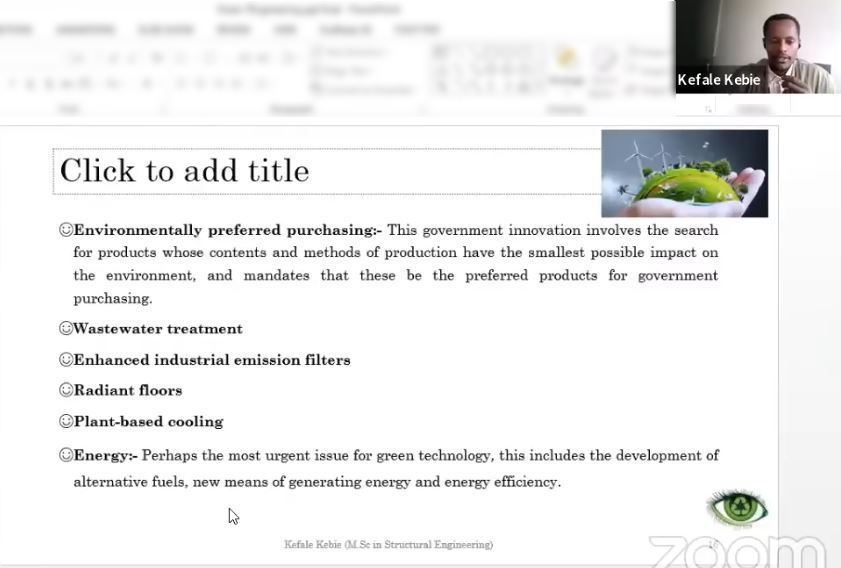
International Webinar 2022 - The excellence of green engineering part 15
International Webinar
Back to News
International Webinar
Monday, December 5, 2022
Priyadi, S.Kom, M.Kom
0 Views