
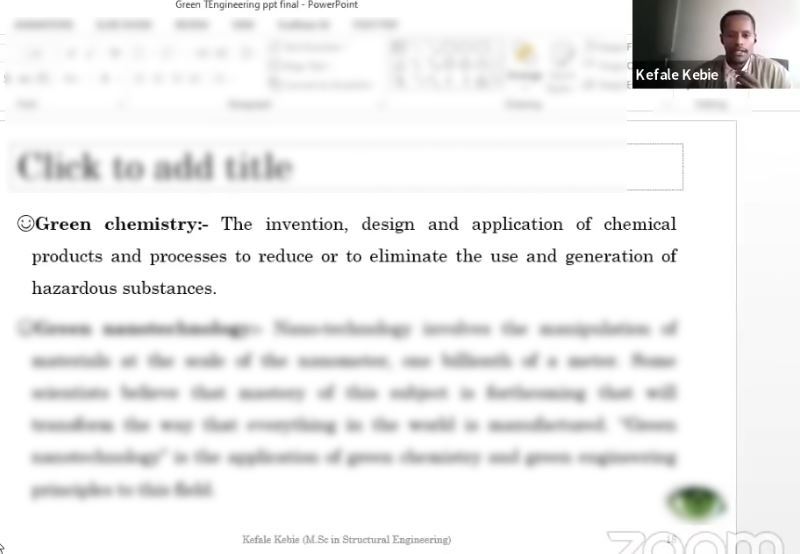
Another green engineered subject that is no less important than any other is green chemicals. Green chemical engineering includes the invention, design and application of chemical products and processes to reduce or eliminate the use and generation of hazardous substances. Green chemistry, also called sustainable chemistry, is a branch of chemistry that teaches the design of chemical products and processes to reduce or eliminate the use and generation of hazardous compounds. In 1990 the Pollution Prevention Act 1990 was passed in the United States. The law aims to help prevent environmental pollution problems due to hazardous compounds or chemicals.
The idea of green chemistry was originally developed as a response to the Pollution Prevention Act of 1990, which stated that United States national policy should limit or reduce pollution by using better process designs (including production changes in product costs, manufacturing processes, use of raw materials). ). , and recycling). The United States Environmental Agency (EPA), which is known as a regulatory body for human health and the environment, moved away from a command and control policy and implemented the idea of Green Chemistry. In 1991, the EPA launched a research grant program that encourages the redesign of existing chemical products and processes to reduce adverse impacts on human health and the environment. The EPA then collaborated with the US National Science Foundation (NSF) to fund basic research on green chemistry in the early 1990s.
The introduction of the annual President Green Chemistry Challenge Award in 1996 attracted the attention of academia and the green chemical industry. These program and technology awards are now a cornerstone of the green chemistry education curriculum.
The mid to late 1990s saw an increasing number of international green chemistry meetings being held, such as the Gordon Research Conference on Green Chemistry, and green chemistry networks that have developed in the United States, United Kingdom, Spain, and Italy.
In 1998, Paul Anastas together with John C. Warner developed principles that serve as guidelines in green chemistry practice.[5] The twelve principles discuss various ways to reduce the impact of chemical production on the environment and human health, and also indicate research priorities in the development of green chemical technologies.
The twelve principles of green chemistry developed by Paul Anastas and John Warner, namely:
- Prevention : It is better to prevent the production of waste, rather than treat and clean up waste.
- Atomic economy : Through a new synthetic method designed to maximize the incorporation of all materials used in the process into the final product, resulting in less waste being generated.
- Harmless chemical synthesis : Synthetic methods should avoid using or producing substances which are toxic to humans and the environment.
- Designing safer chemicals : The resulting chemical product must be designed to achieve the desired function while minimizing its toxicity.
- Safer solvents and auxiliaries: As much as possible avoid or minimize the use of adjuvants (such as solvents, separators, and the like), and use safer solvents or auxiliaries that are not harmful to the environment when they must be used.
- Design for energy efficiency: The energy requirements of chemical processes to minimize their environmental and economic impact. If possible use synthetic methods carried out at ambient temperature and pressure.
- Use of renewable raw materials : Raw materials or raw materials used must be renewable (if technically and economically possible).
- Reducing derivatives: Reducing unnecessary derivatives (use of blocking groups, protection, temporary modification of physical or chemical processes) or avoided whenever possible, as these steps require additional reagents and can generate waste,
- Catalysis: The use of catalytic reagents (as selective as possible) is preferable to stoichiometric reagents.
- Design for degradation : The chemical products produced must be designed in such a way that at the end of their function, they can decompose into degradation products that are harmless and do not last long in the environment.
- Real-time analysis for pollution prevention : Development of the necessary analytical methodologies to enable real-time analysis for pollution prevention, monitoring and control in processes prior to the formation of hazardous substances.
- Use of Inherently Safer chemicals for accident prevention : Use of substances in chemical processes whenever possible using chemicals that have a low potential for accidents, including explosions, fires, and the like.
The STEKOM University international webinar presenter who delivered the material was Kefale Kebie Bishaw who has an M.Sc academic degree in Structural Engineering. He is also a lecturer and researcher at Debre Tabor University which is located in the city of Debre Tabor, Country of Ethiopia. STEKOM University has collaborated with the University several times. This time the international activity being held was an international webinar entitled "Advantage of Green Engineering".
The title of the presentation delivered by Mr. Kefale was "Advantage of Green Engineering / Technology". At the beginning of his presentation, Mr. Kefale explained the outline of his presentation. The outline presented by Mr. Kefale included the following points:
- What is Green Engineering?
- Green Engineering Category,
- Green Engineering Driving Factors,
- Benefits and Some Limitations,
- Conclusions and recommendations.
The webinar activity is part of the implementation of STEKOM University's commitment to increase various international activities in order to realize the vision to become an international-class university. Various international activities carried out by STEKOM University continue from year to year. There are international activities that are sustainable and there are also some international activities that are not sustainable. All types of international activities are accommodated and regulated by the International department of STEKOM University.
International Webinar 2022 - The excellence of green engineering part 18
International Webinar
Back to News
International Webinar
Tuesday, December 6, 2022
Priyadi, S.Kom, M.Kom
0 Views