
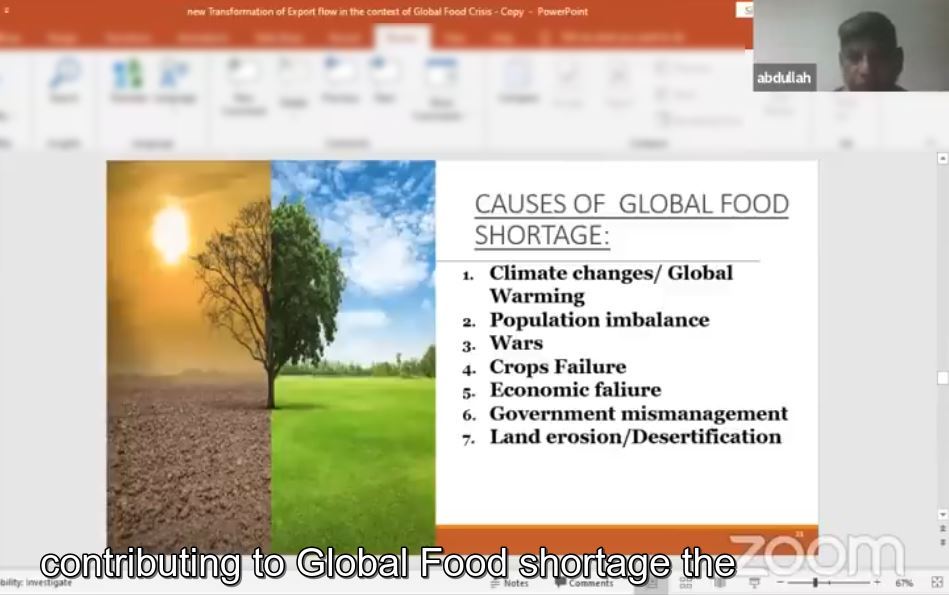
The war will affect the global food shortage. Russia and Ukraine have been known as one of the world's agricultural product suppliers with a total production of 29% wheat, 19% corn and 78% sunflower oil of global demand. Data from the World Resources Institute states that since the Russian aggression, world wheat and corn prices have risen by 41% and 28%. Researchers from the Center for Indonesian Policy Studies (CIPS) said that Russia is the world's main exporter of oil, natural gas and mineral goods. Due to its large production of natural gas and potash, Russia is also a large producer of fertilizers. The existence of a war between the two countries is of course a global problem because of their role as one of the suppliers of agricultural products to the world's needs.
Directly, this war hampered the trade process between the two countries. In addition to the declining production, the blockade on Ukrainian ports has also been one of the causes of delays in the export-import process from this country. The blockage of port access occurred in areas off the southern coast of Ukraine, including the main port of Odesa on the Black Sea. It is known that so far Ukraine has been shipping its agricultural products by land with trains and by sea with cargo ships. As a result of this aggression, Ukraine's distribution channels were cut off.
The war between Russia and Ukraine from the start was allegedly going to have an impact on the world food crisis. Currently, the impact of the Russian invasion on Ukraine can be seen from the number of people in the world who are experiencing famine. In 2022, it is known that there has been an increase in the number of people around the world who are experiencing food vulnerability. In the 2022 SOFI (The State of Food Security and Nutrition in The World) report, five agencies under the United Nations estimate that the number of hungry people in the world will reach 828 million people in 2021. This number has increased from the previous number of 782 million people in 2020. When compared to the pre-pandemic period, this hunger number has increased to 150 million people. In addition to the pandemic, other aggravating factors are climate change and La Nina storms, climate patterns that change ocean conditions and meteorology.
The link between the Ukrainian and Russian wars to the instability of the food supply is indeed a real thing. The raging war and difficulties in exporting agricultural products, especially wheat and cereals, have triggered a number of restrictions on the export of agricultural products in other countries, such as India, which had imposed restrictions on the export of wheat and sugar. The limited supply of food ingredients causes world food prices to soar. Rising prices for food and related commodities, disrupted global security conditions, eventually led to quite high inflation. This certainly makes the number of people vulnerable to access to food will also increase.
Moreover, with the various wars that took place in various other parts of the world. Like several wars that took place in the Middle East, Southeast Asia, and maybe other less exposed places. In conditions of war, of course, their agricultural production and food ingredients will certainly be greatly disrupted. Therefore, parties who have the mandate and authority over the interests of the community at large, really need to take strategic and serious actions to deal with the issue of food shortages.
The presenter who delivered the material was Abdullah Athar, Senior Lerturer College of Management Science from Pakistan. This material was presented at an international webinar organized by the University of Science & Computer Technology (STEKOM University) in collaboration with the Karachi Institute of Economics & Technology (Pakistan), Universiti Malaysia Perlis (Malaysia), STIE STEKOM, Association of Industrial and Vocational Communities (PERKIVI), Indonesian Smart Teacherpreneur Association (PTIC) and TopLoker.com. The webinar will be held on December 8, 2022 online using zoom media. All scheduled international presenters managed to attend and fill in the material properly.
The webinar activity is part of the implementation of STEKOM University's commitment to increase various international activities in order to realize the vision to become an international-class university. Various international activities carried out by STEKOM University continue from year to year. There are international activities that are sustainable and there are also some international activities that are not sustainable. All types of international activities are accommodated and regulated by the International department of STEKOM University.
International Webinar 2022 - Transformation of Export Flows in the Context of Global Food Crisis - Part 15
International Webinar
Back to News
International Webinar
Tuesday, December 20, 2022
Priyadi, S.Kom, M.Kom
0 Views