
The year 2022 saw a rapid increase in food prices and shortages in food supply around the world. The worsening crisis in various parts of the world is due to the worsening geopolitical and economic crises. The crisis follows the food security and economic crisis during the COVID-19 pandemic.
Following Russia's 2022 invasion of Ukraine, the Food and Agriculture Organization, as well as other food commodity market watchers, warned about falling food supplies and rising prices. Much of the concern is related to supply shortages of key commodity crops, such as wheat, maize and oilseeds, which could lead to higher prices. The invasion also caused fuel and associated fertilizer prices to rise, causing further food shortages and rising prices.
Even before the invasion, food prices were at record highs. As of February 2022, year-over-year food prices are up 20%, according to the Food and Agriculture Organization. The war further increased prices year over year by another 40% in March. The compounding issues, including the Russian invasion of Ukraine, as well as climate-related crop failures, are expected to reverse the global trend of reducing hunger and malnutrition.
Some areas, such as East Africa and Madagascar, are already experiencing drought and famine due to failed agricultural systems and climate change, and rising prices are expected to make matters worse. Even countries in the Global North that normally have a secure food supply, such as the UK and the US, are starting to feel the direct impact of cost inflation due to food insecurity. Some analysts described the price increase as the worst since the 2007-2008 world food price crisis. Although early international responses to the food crisis indicated that some suppliers or crops could reduce global shortages and price increases (eg the proposed entry of grain from India), as of June 2022 there were no effective international efforts to reduce prices.
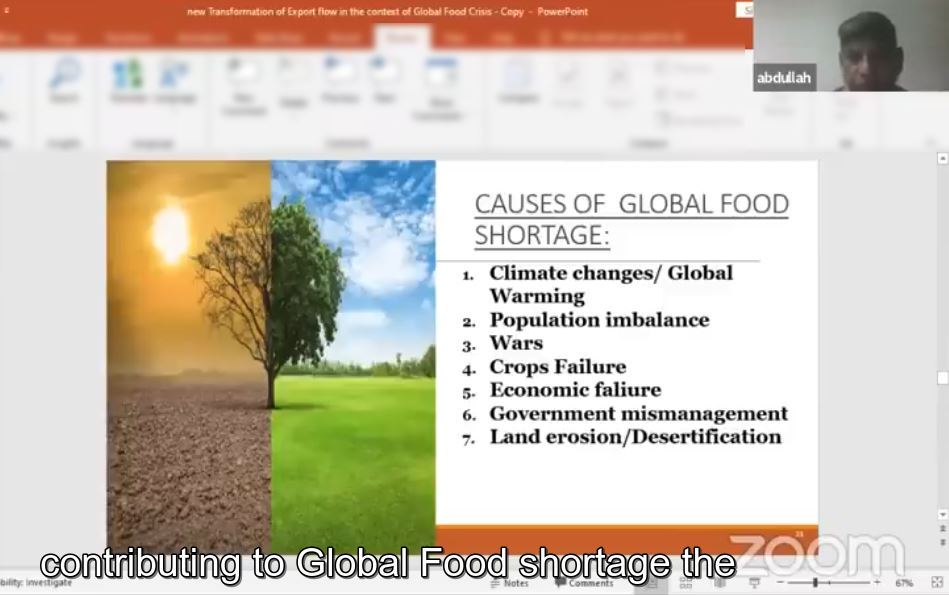
Conditions of global food shortages can also be driven by mismanagement of government and soil erosion or land conversion. Government management mistakes will have an impact on the ability of farmers to produce food ingredients because the carrying capacity or facilities for farmers will not be optimal. Likewise, land erosion and land conversion will also reduce the ability of farmers to produce food. The reason is because the land they can use will erode to become narrower than before.
The presenter who delivered the material was Abdullah Athar, Senior Lerturer College of Management Science from Pakistan. This material was presented at an international webinar organized by the University of Science & Computer Technology (STEKOM University) in collaboration with the Karachi Institute of Economics & Technology (Pakistan), Universiti Malaysia Perlis (Malaysia), STIE STEKOM, Association of Industrial and Vocational Communities (PERKIVI), Indonesian Smart Teacherpreneur Association (PTIC) and TopLoker.com. The webinar will be held on December 8, 2022 online using zoom media. All scheduled international presenters managed to attend and fill in the material well.
The webinar activity is part of the implementation of STEKOM University's commitment to increase various international activities in order to realize the vision to become an international-class university. Various international activities carried out by STEKOM University continue from year to year. There are international activities that are sustainable and there are also some international activities that are not sustainable. All types of international activities are accommodated and regulated by the International department of STEKOM University.
International Webinar 2022 - Transformation of Export Flows in the Context of Global Food Crisis - Part 16
International Webinar
Back to News
International Webinar
Tuesday, December 20, 2022
Priyadi, S.Kom, M.Kom
0 Views