
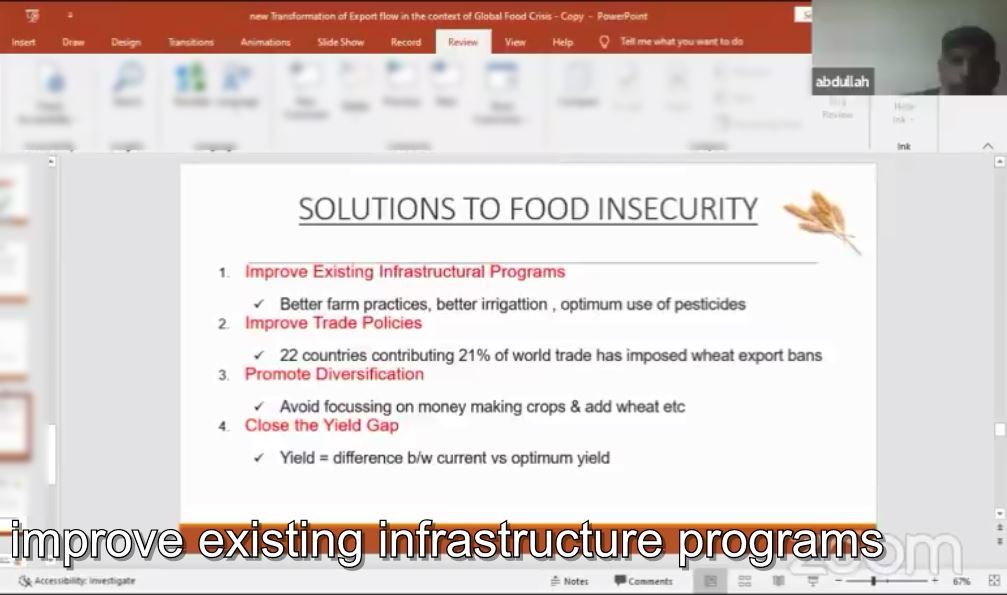
Improvements in trade policies can be a solution to food insecurity, according to academics from Pakistan. Moving food from areas of surplus to areas of deficit and transmitting price signals to farmers is perhaps its most obvious role from a market perspective. But governments can do more, not only to alleviate the most immediate crises, but also in the long term, by implementing sound trade policy measures that contribute to stronger and more sustainable food security.
Food security is one of the global challenges discussed at the recently concluded 12th World Trade Organization Ministerial Conference. Results? Declaration on trade and food security and decision to exclude food purchased by the United Nations World Food Program from export restrictions. In the food security declaration, the ministers sent a clear message that they would work together to overcome the food crisis and underlined the important role trade plays in its solution. They also highlight important principles for sustainable trade: keeping trade open, carefully implementing export restrictions, sharing information on policies affecting trade, and working together to increase productivity in food production.
However, further action is needed. Tighter discipline for trade that distorts support for agriculture creates fairer trading systems and better incentives for food production in many developing countries. The discussions at the WTO are important and will continue but also without a deadline. In general, trade policies that can be taken by the government to anticipate food vulnerabilities are as follows:
- Use trade policies to reduce the cost of new technologies: The key issues for long-term global security are productivity growth and more sustainable farming practices. Trade policies, for example, can be used to lower the cost of new technologies, digital devices, and renewable energy technologies by reducing import duties and other trade barriers on equipment and inputs used in the agricultural sector. This could be a theme for discussion in the Trade and Environmental Sustainability Structured Discussions which currently involve more than 70 WTO members.
- Prevent export restrictions: Export restrictions distort trade, create incentives for corruption and limit the supply of scarce resources. Despite pledging to circumvent export restrictions in response to high food prices, more than 20 countries currently use them. To prevent export restrictions, policy makers must provide evidence-based facts about their impact in the countries that use them. While most people accept that export restrictions are detrimental to global food security, the argument that speaks to the self-interest of countries that impose them is less well known.
- More attention to the impact of sustainable development on developing countries: An important dimension of food security is having enough money to buy food. Trade has a role to play as it can contribute to employment, increase household income and women's economic empowerment. From a food security perspective, it is important for developed countries to consider the impact of exports from developing countries when drafting new regulations affecting market access. This is a clear sustainability issue that deserves more attention, for example within the EU.
The end of the food crisis may not be in sight, but there are actions that can be taken to reduce its global impact. Trade policy is one of the keys to strengthening food security.
The presenter who delivered the material was Abdullah Athar, Senior Lerturer College of Management Science from Pakistan. This material was presented at an international webinar organized by the University of Science & Computer Technology (STEKOM University) in collaboration with the Karachi Institute of Economics & Technology (Pakistan), Universiti Malaysia Perlis (Malaysia), STIE STEKOM, Association of Industrial and Vocational Communities (PERKIVI), Indonesian Smart Teacherpreneur Association (PTIC) and TopLoker.com. The webinar will be held on December 8, 2022 online using zoom media. All scheduled international presenters managed to attend and fill in the material well.
The webinar activity is part of the implementation of STEKOM University's commitment to increase various international activities in order to realize the vision to become an international-class university. Various international activities carried out by STEKOM University continue from year to year. There are international activities that are sustainable and there are also some international activities that are not sustainable. All types of international activities are accommodated and regulated by the International department of STEKOM University.
International Webinar 2022 - Transformation of Export Flows in the Context of Global Food Crisis - Part 18
International Webinar
Back to News
International Webinar
Wednesday, December 21, 2022
Priyadi, S.Kom, M.Kom
0 Views