
Mr Adi from STEKOM University explains that the current food crisis is largely caused by a combination of four factors:
- Conflict is still the biggest driver of food crises, with 60 percent of the world's hungry living in areas ravaged by war and violence.
- Climate change destroys life, crops and livelihoods.
- The economic consequences of the COVID-19 pandemic
Here are some examples of how climate is contributing to food crises:
- Average temperatures are increasing faster in Africa than in the rest of the world.
- Precipitation increases in Africa by 30% in wet areas and decreases by 20% in dry areas.
- 95% of African farmers rely on rainfall and do not have irrigation systems.
- Lack of rain and extreme heat kill livestock and damage crops but so does too much rain.
- Pakistan was hit by disastrous monsoon floods in late August, affecting 33 million people.
- South Sudan faces fourth year of flooding in a row.
- Nigeria in 2021 experienced a delay in rainfall, which reduced its crop yields by more than 65%. When the rains did come, the resulting floods washed away what was left.
- In Latin America, above average rainfall expected in parts of Guatemala and Honduras increases the likelihood of flooding in low-lying areas this year
Climate change will increasingly challenge resource-intensive conventional farming systems. Good agricultural practices, based on soil and water management and pest control, combined with increased access to markets, can lead to significant increases in agricultural productivity, adaptation to climate change, and increased resilience to supply shocks, whether due to climate change or limited resources .
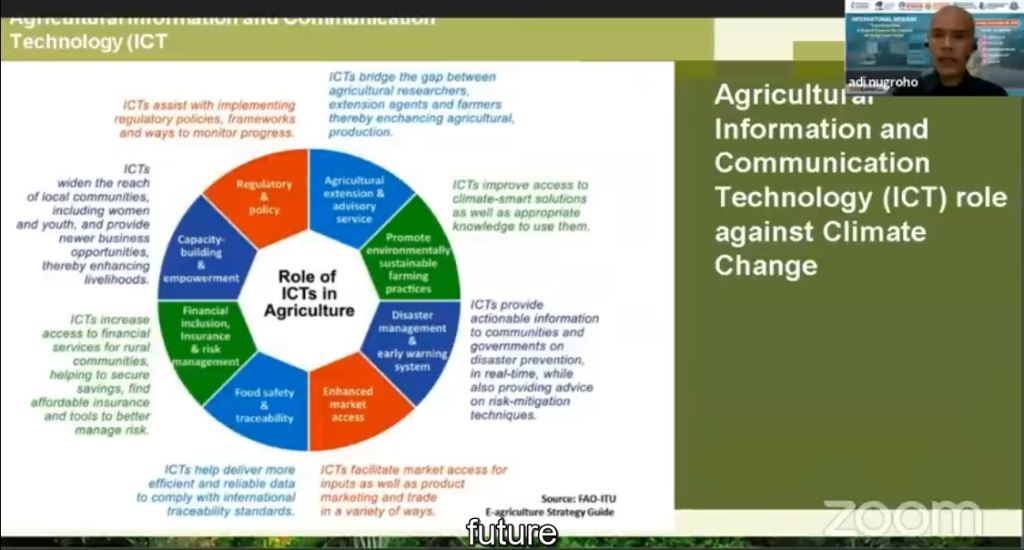
Currently, ICT applications related to agriculture and its adaptation to climate change are found at both the macro and micro levels. These range from large-scale projects such as satellite weather monitoring and large-scale sensor networks, to projects that raise awareness of vulnerable communities and individuals to help them identify and manage their own adaptation needs.
There are many potential applications of ICT in agriculture. ICTs help implement regulatory policies, frameworks and ways to monitor progress. ICT bridges the gap between agricultural researchers, extension workers and farmers thereby increasing agricultural production. ICT increases access to climate smart solutions as well as the right knowledge to use them. ICTs provide actionable information to communities and governments on disaster prevention, in real-time, as well as provide advice on risk mitigation techniques. ICTs facilitate market access for inputs as well as the marketing and trade of products in a number of ways. ICTs help provide more efficient and reliable data to comply with international traceability standards. ICT improves access to financial services for rural communities, helps secure savings, find affordable insurance, and tools to better manage risk. ICT extends the reach of local communities, including women and youth, and provides new business opportunities, thereby improving livelihoods.
The presenter who delivered the material was Mr. Adi Nugroho who is a graphic design lecturer at STEKOM University, Indonesia. The title of the presentation presented by Mr. Adi was "Digital Imaging Role in Information Technology Against Food Crysis". This material was presented at an international webinar organized by the University of Science & Computer Technology (STEKOM University) in collaboration with the Karachi Institute of Economics & Technology (Pakistan), Universiti Malaysia Perlis (Malaysia), STIE STEKOM, Association of Industrial and Vocational Communities (PERKIVI), Indonesian Smart Teacherpreneur Association (PTIC) and TopLoker.com. The webinar will be held on December 8, 2022 online using zoom media. All scheduled international presenters managed to attend and fill in the material properly.
The webinar activity is part of the implementation of STEKOM University's commitment to increase various international activities in order to realize the vision to become an international-class university. Various international activities carried out by STEKOM University continue from year to year. There are international activities that are sustainable and there are also some international activities that are not sustainable. All types of international activities are accommodated and regulated by the International department of STEKOM University.
International Webinar 2022 - Transformation of Export Flows in the Context of Global Food Crisis - Part 21
International Webinar
Back to News
International Webinar
Sunday, January 1, 2023
Priyadi, S.Kom, M.Kom
0 Views