
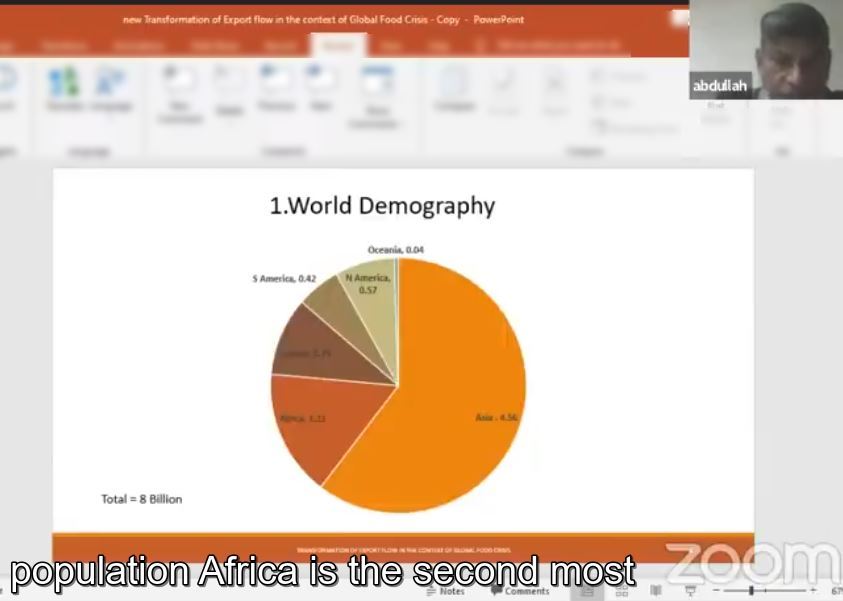
Earth has a human population of over 8 billion, with an overall population density of 50 people per square km (130 per square mile), excluding Antarctica. Nearly 60% of the world's population lives in Asia, with nearly 2.8 billion in China and India combined. The percentage share of India, China, and the rest of South Asia's world population has remained at about the same level for the last few thousand years of recorded history. The world literacy rate has increased dramatically in the last 40 years, from 66.7% in 1979 to 86.3% today. The lower literacy rate is largely due to poverty. Lower literacy rates are mostly found in South Asia and Sub-Saharan Africa. The world's largest ethnic group is the Han Chinese, with Mandarin being the most widely spoken language in the world in terms of native speakers.
The world population is predominantly urban and peri-urban, and there has been significant migration towards cities and urban centres. The urban population jumped from 29% in 1950 to 55.3% in 2018. Interpolation of the United Nations prediction that the world will be 51.3 percent urban by 2010, Ron Wimberley, Libby Morris and Gregory Fulkerson estimate May 23, 2007 it will be the first time that the urban population has outnumbered the rural population in history. China and India are the most populous countries, as birth rates have consistently declined in rich countries and have remained high in poor countries to date. Tokyo is the largest urban agglomeration in the world.
In 2021, the global total fertility rate is expected to be 2.32 children per woman, which is slightly below the global average for the surrogate fertility rate of around 2.33 (as of 2003), meaning the world population is declining. However, world population growth is unequally distributed, with total fertility rates ranging from one of the lowest in the world, 0.83 in Singapore, to the highest, 6.49 in Niger. The United Nations predicts an annual population increase of 1.14% for 2000. The current world population growth is around 1.09%. People under the age of 15 make up over a quarter of the world's population (25.18%), and people aged 65 and over make up nearly ten percent (9.69%) by 2021.
The world population more than tripled during the 20th century from about 1.65 billion in 1900 to 5.97 billion in 1999. This reached 2 billion in 1927, 3 billion in 1960, 4 billion in in 1974, and 5 billion in 1987. The world's overall population is approximately 8 billion as of November 2022. Currently, population growth is fastest among low-income and less developed countries. The United Nations projects a world population of 9.15 billion in 2050, an increase of 32.7% from 6.89 billion in 2010.
The fact that there are so many inhabitants of the earth and their distribution, logically also shows how great the people's need for food is. Especially in developing countries where the density is quite high, they will need more food than areas that have a smaller population.
The presenter who delivered the material was Abdullah Athar, Senior Lerturer College of Management Science from Pakistan. This material was presented at an international webinar organized by the University of Science & Computer Technology (STEKOM University) in collaboration with the Karachi Institute of Economics & Technology (Pakistan), Universiti Malaysia Perlis (Malaysia), STIE STEKOM, Association of Industrial and Vocational Communities (PERKIVI), Indonesian Smart Teacherpreneur Association (PTIC) and TopLoker.com. The webinar will be held on December 8, 2022 online using zoom media. All scheduled international presenters managed to attend and fill in the material well.
The webinar activity is part of the implementation of STEKOM University's commitment to increase various international activities in order to realize the vision to become an international-class university. Various international activities carried out by STEKOM University continue from year to year. There are international activities that are sustainable and there are also some international activities that are not sustainable. All types of international activities are accommodated and regulated by the International department of STEKOM University.
International Webinar 2022 - Transformation of Export Flows in the Context of Global Food Crisis - Part 5
International Webinar
Back to News
International Webinar
Sunday, December 18, 2022
Priyadi, S.Kom, M.Kom
0 Views