
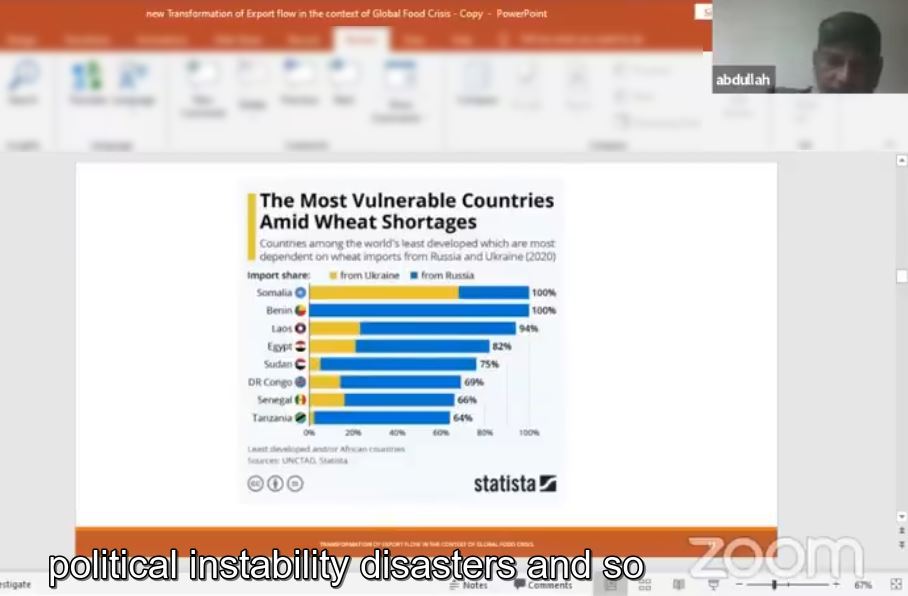
The war in Ukraine jeopardized vital grain supplies in many of the world's less developed countries. Among them, countries in Africa and the Middle East in particular rely heavily on wheat imports from Russia and Ukraine. According to the UN Comtrade database, Benin and Somalia source all their grain from Ukraine and/or Russia. Egypt's dependency stands at 82 percent, according to data.
While crop failures are expected in Ukraine in 2022, Russia has imposed a ban on exports of products such as wheat until the end of June 2022, leading observers are predicting shortages and rising prices among their trading partners and on world markets. Egypt and Somalia are among the countries where wheat is traditionally used in some of the most common staple foods. Food shortages have loomed large over the last nation due to the resurgence of conflict and drought, causing international organizations to warn of the risk of severe famine even before the invasion.
Ukraine and Russia are also among the world's top exporters of other important food staples. About two-thirds of global exports of essential sunflower products such as oil and feed come from Ukraine and Russia.
Unfortunately, there could be more damage to global food supplies to come later this year and throughout 2023. Logistical problems this year have resulted in an 18 million to 22 million metric ton reduction in grain exported from Ukraine and Russia per year. Prolonged conflict undermines farmers' ability to prepare land, plant seeds, and protect and fertilize crops, which is likely to result in even lower crop volumes the following season. Part of this deficit could be recovered depending on the success of the Black Sea export agreement, logistical improvements and other interventions. However, factors including the impact of drought across the world's food storages—a trend that is expected to worsen over time—confound that forecast.
Despite a good harvest this summer and fall, Russia's yields may be lower in the coming season due to global trade restrictions. Hybrid seeds, crop protection products, and, to a lesser extent, machinery and software may be subject to import bans, especially those affecting wheat production.
Fertilizer scarcity and higher fertilizer prices are also expected to reduce crop yields in countries heavily dependent on fertilizer imports, such as Brazil. This is likely to further reduce the volume of grain on world markets.
What other exporting countries do can either add more grain to the global supply or reduce it further. On the one hand, continued or even further trade restrictions could exacerbate global scarcity, while high harvests and dwindling reserves could lessen the impact. Climatic events can also affect the delicate balance. It is not known which scenario will win.
The presenter who delivered the material was Abdullah Athar, Senior Lerturer College of Management Science from Pakistan. This material was presented at an international webinar organized by the University of Science & Computer Technology (STEKOM University) in collaboration with the Karachi Institute of Economics & Technology (Pakistan), Universiti Malaysia Perlis (Malaysia), STIE STEKOM, Association of Industrial and Vocational Communities (PERKIVI), Indonesian Smart Teacherpreneur Association (PTIC) and TopLoker.com. The webinar will be held on December 8, 2022 online using zoom media. All scheduled international presenters managed to attend and fill in the material well.
The webinar activity is part of the implementation of STEKOM University's commitment to increase various international activities in order to realize the vision to become an international-class university. Various international activities carried out by STEKOM University continue from year to year. There are international activities that are sustainable and there are also some international activities that are not sustainable. All types of international activities are accommodated and regulated by the International department of STEKOM University.
International Webinar 2022 - Transformation of Export Flows in the Context of Global Food Crisis - Part 9
International Webinar
Back to News
International Webinar
Monday, December 19, 2022
Priyadi, S.Kom, M.Kom
0 Views