
Design thinking refers to the set of cognitive, strategic, and practical procedures used by designers in the design process, and to the body of knowledge that has developed about how people reason when involved with design problems. Design thinking is also linked to recipes for product and service innovation in business and social contexts.
Design thinking has a history spanning from the 1950s and 60s, with roots in the study of design cognition and design methods. It has also been referred to as "designed ways of knowing, thinking and acting" and as "designed thinking". Many key concepts and aspects of design thinking have been identified through studies, across different design domains, of design cognition and design activity in both laboratory and natural contexts.
The term design thinking has been used to refer to a specific cognitive style (think like a designer), general design theory (ways of understanding how designers work), and a set of pedagogical resources (through which organizations or inexperienced designers can learn to approach complex problems with designed way). The different uses have created some confusion in the usage of the terms.
In the 2000s and 2010s, there was significant growth in interest in applying design thinking across a wide range of diverse applications—for example as a catalyst to gain a competitive advantage in business or to enhance education, but doubts around design thinking as a panacea for innovation have expressed by several critics.
Historically, designers tended to be involved only in the latter part of the new product development process, focusing their attention on product aesthetics and functionality. Many businesses and other organizations are now recognizing the usefulness of design embedded as a productive asset across organizational policies and practices, and design thinking has been used to help many types of business and social organizations become more constructive and innovative. Designers bring their methods to business either by taking part in the early stages of the product and service development process or by training others to use design methods and building innovative thinking skills in organizations.
The iterative, non-linear, process of design thinking includes activities such as context analysis, user testing, problem finding and framing, idea and solution generation, creative thinking, sketches and drawings, prototyping, and evaluation.
Core features of design thinking include the ability to:
- solve obscure or 'evil' problems
- adopt a solution-focused strategy
- use abductive and productive reasoning
- employ non-verbal, graphic/spatial modeling media, eg, sketching and prototyping.
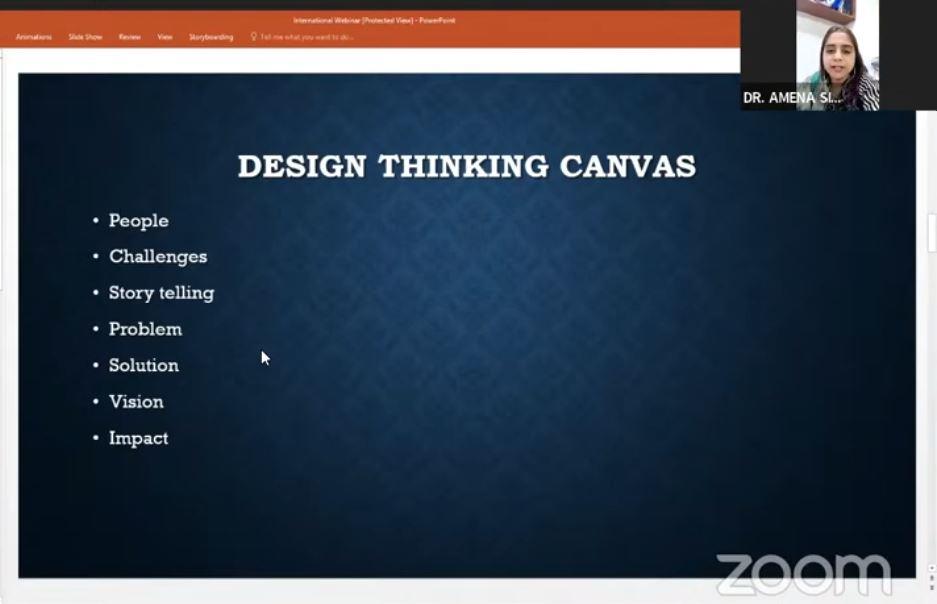
The material above was presented by a presenter from Pakistan in an international webinar held by STEKOM University in collaboration with Universities from Pakistan, Malaysia, and various other parties. The name of the presenter is Dr. Amena Sibghatullah who is an assistant professor and head of marketing college of management science, KIET University, Pakistan.
This international webinar activity is part of the implementation of STEKOM University's commitment to increase various international activities. This was done in order to realize the vision to become an international-class university. Various international activities carried out by STEKOM University continue from year to year. There are international activities that are sustainable and there are also some international activities that are not sustainable. All types of international activities are accommodated and regulated by the International department of STEKOM University.
International Webinar 2023 - The Role of Digital Based Innovative to Improve Competitiveness – Part 14
International Webinar
Back to News
International Webinar
Wednesday, February 8, 2023
Priyadi, S.Kom, M.Kom
0 Views