
The Internet of Things (IoT) is seeing the proliferation of intelligent networked devices, capable of generating large amounts of data on aspects of our personal and professional lives. However, it is not these smart devices that add value, but rather the potential to capture, interpret, analyze and act on the information they compose.
Business Intelligence (BI) technologies enable companies – and individuals – to share insights that are captured and transmitted between objects with Internet connectivity. This valuable insight can then be leveraged to bring better services to the market and improve their business performance and efficiency.
According to a recent Gartner report, 20.8 billion connected 'things' will be in use by 2020. Therefore, the opportunity for companies to effectively mine these new data sources, to uncover new insights, is a potential source of competitive advantage and Huge new income. river. Reporting and analytics will be critical for businesses looking to derive value from IoT. So, here are some of the benefits that companies, both large and small, can expect:
1. Increased customer satisfaction
BI, together with IoT, empowers businesses to explore and mine consumer-generated data to better understand and anticipate customer needs. Armed with accurate data on individual customer preferences, businesses can offer highly customized marketing and promote products that suit individual tastes and lifestyles thereby enhancing customer experience and loyalty.
Transport for London is reportedly evaluating how IoT data can help improve commuter travel. By monitoring passenger behavior, TfL aims to be able to react to passenger needs, for example by letting people know where traffic jams are, optimizing traffic lights and ensuring boarding at subway stations more efficiently.
2. More efficient business operations
The scope for improving business operations, through a detailed analysis of the operations, is limitless and extends to various sectors. Manufacturers can use IoT to optimize production and supply chains – leveraging connected devices in the production process and the supply chain itself – to monitor efficiency. Likewise, farmers can use connected sensors to monitor crops and livestock to increase operational efficiency.
For example, a group of wine producers in Germany are currently testing IoT technology to optimize the management of their wine production and improve the quality of their products. IoT sensors, installed throughout the vineyard, measure and record air and soil humidity as well as temperature and solar intensity. Through analysis of data collected on vineyard conditions, winemakers are empowered with information that enables them to decide when is the best time to fertilize and water the vines in order to obtain the highest quality grapes.
3. Greater profitability
The sheer volume of information generated through smart, connected devices – both in terms of new and rapidly expanding data types and sources – means that organizations have an opportunity to use BI to become more profitable. Data-driven insights can be used to improve existing products and services.
For example, insurance companies can analyze data from IoT solutions to provide more accurate and personalized quotes and improve marketing through user demographic information and retail shopping habits.
BI also enables stakeholders to turn data-driven insights into a commodity in itself. This insight, which comes from the various connected smart devices that make up the IoT phenomenon, can then become an entire business itself, with third parties able to sell that information to consumers and enterprises.
Businesses can, of course, sell those insights to individuals directly (in addition to using that information to improve products and services), and individuals can resell usage data related to their personal devices to businesses (often in exchange for various incentives and rewards).
4. Expect new trends
BI represents the opportunity to find patterns, predict trends, and forecast with more confidence than ever before. BI provides access to these patterns across the organization, meaning that relevant users and departments are kept up to date with new trends.
Likewise, by monitoring the flow of data from sensors connected across complex machines or systems – such as escalators or airport hardware – it is possible to identify when a component may fail, allowing businesses to move into a position of preventive maintenance.
IoT promises to revolutionize the workplace and consumer lifestyles, providing stakeholders with information that enables organizations to run more efficiently and for businesses to offer products and services tailored to the individual needs of their customers. However, any business looking to benefit from this fast-evolving technology will need solid analytical tools capable of turning multiple data sources into valuable insights that will increase their bottom line.
The above material was presented by a presenter from Malaysia in an international webinar held by STEKOM University in collaboration with Universities from Pakistan, Malaysia, and various other parties. The name of the presenter is Dr. Farahida Mohd who is an assistant professor at a University in Malaysia.
This international webinar activity is part of the implementation of STEKOM University's commitment to increase various international activities. This was done in order to realize the vision to become an international-class university. Various international activities carried out by STEKOM University continue from year to year. There are international activities that are sustainable and there are also some international activities that are not sustainable. All types of international activities are accommodated and regulated by the International department of STEKOM University.
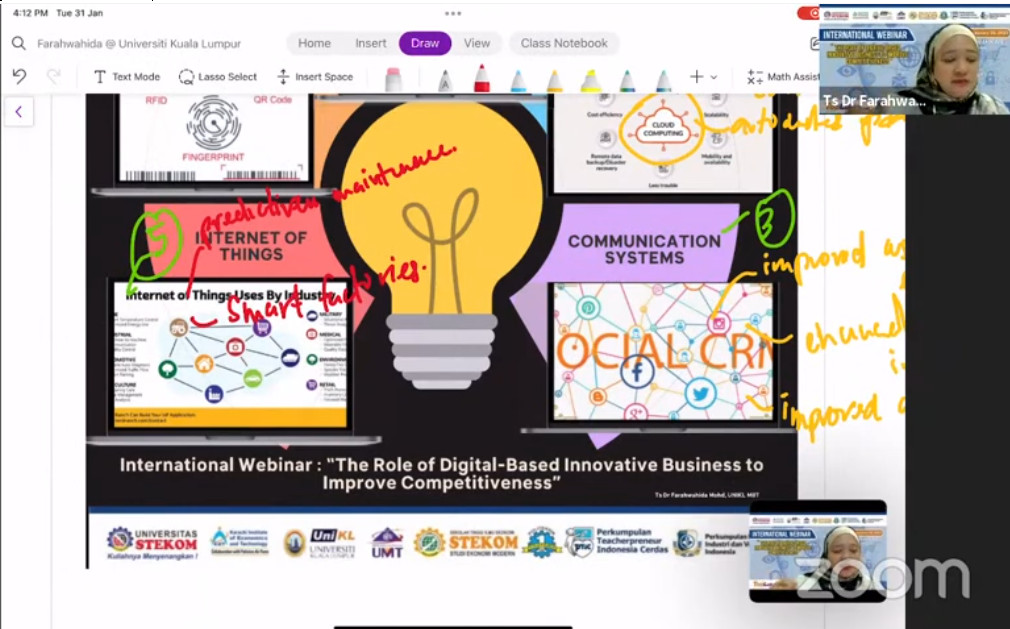
International Webinar 2023 - The Role of Digital Based Innovative to Improve Competitiveness – Part 25
International Webinar
Back to News
International Webinar
Thursday, February 16, 2023
Priyadi, S.Kom, M.Kom
0 Views